
• KZT/USD = 0.00219
  • TJS/USD = 0.10850
  • UZS/USD = 0.00008
  • TMT/USD = 0.29850
  • KZT/USD = 0.00219
  • TJS/USD = 0.10850
  • UZS/USD = 0.00008
  • TMT/USD = 0.29850
  • KZT/USD = 0.00219
  • TJS/USD = 0.10850
  • UZS/USD = 0.00008
  • TMT/USD = 0.29850
  • KZT/USD = 0.00219
  • TJS/USD = 0.10850
  • UZS/USD = 0.00008
  • TMT/USD = 0.29850
  • KZT/USD = 0.00219
  • TJS/USD = 0.10850
  • UZS/USD = 0.00008
  • TMT/USD = 0.29850
  • KZT/USD = 0.00219
  • TJS/USD = 0.10850
  • UZS/USD = 0.00008
  • TMT/USD = 0.29850
  • KZT/USD = 0.00219
  • TJS/USD = 0.10850
  • UZS/USD = 0.00008
  • TMT/USD = 0.29850
  • KZT/USD = 0.00219
  • TJS/USD = 0.10850
  • UZS/USD = 0.00008
  • TMT/USD = 0.29850
28 October 2026

Viewing results 1 - 6 of 4

Kazakhstan Proposes a Preventive Diplomacy Mechanism for CICA

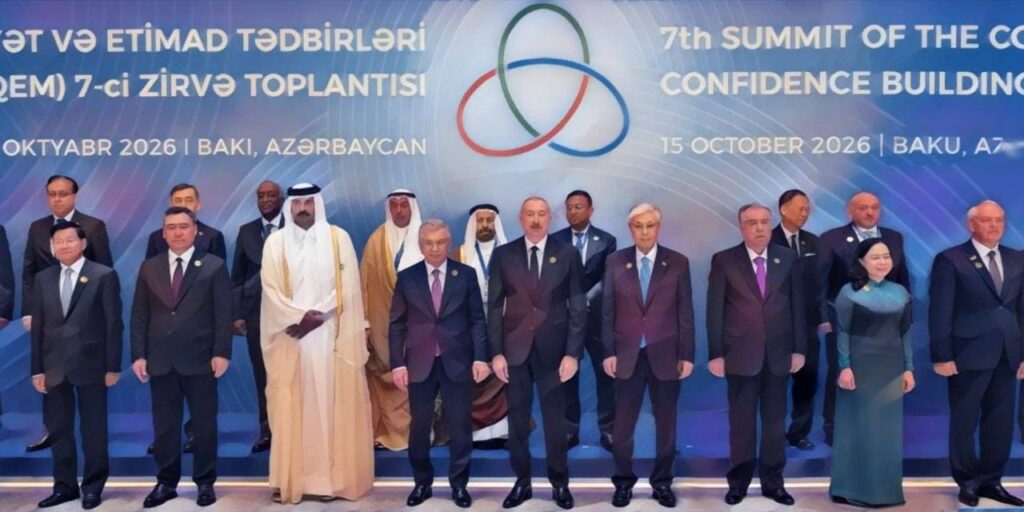
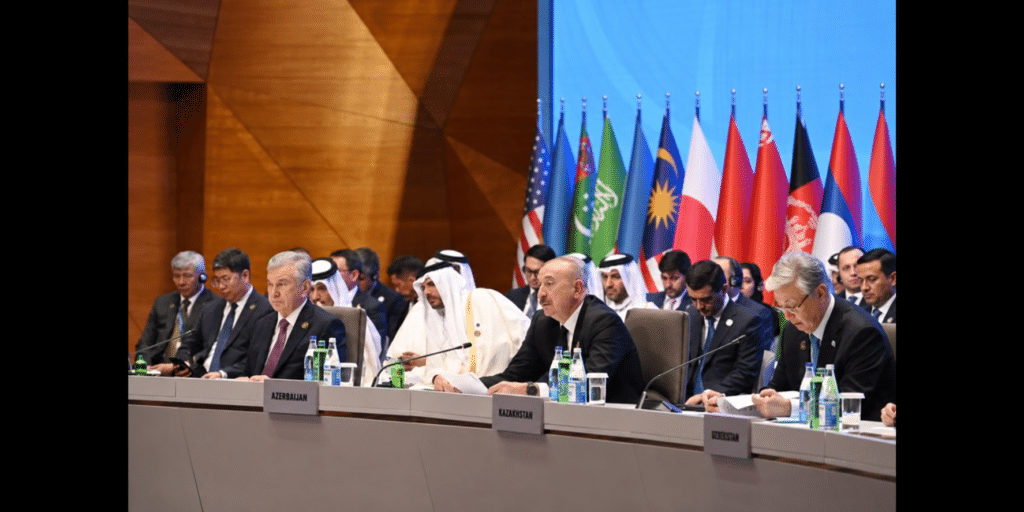
Kazakhstan’s proposal to establish a preventive diplomacy mechanism presents the Asian forum with a specific task: determining who, with whose consent, and through what procedures can help reduce tensions before they escalate into open conflict. On October 15, 2026, at the seventh summit of the Conference on Interaction and Confidence Building Measures in Asia (CICA) in Baku, Kazakhstan’s President Kassym-Jomart Tokayev proposed launching a preventive diplomacy mechanism. The initiative came amid efforts to transform CICA into a full-fledged international organization and make its activities more practical. However, the proposed mechanism’s process for requesting assistance, powers, funding, and operating procedures were not detailed in the summit announcement. For Central Asia, crisis prevention has direct practical significance. Disagreements over water use, transit restrictions, or disruptions to cross-border infrastructure can affect several countries simultaneously. Even a technical problem can take on a political dimension if the parties lack agreed-upon information and have no way to discuss the situation quickly. Preventive diplomacy is useful at a stage when there is still room for agreement, but routine working contacts are no longer sufficient. CICA already has a foundation for such work. Its activities are based on sovereign equality, noninterference, and consensus-based decision-making. The Catalogue of Confidence Building Measures covers military-political, economic, environmental, and human issues, as well as new challenges and threats. Its agenda includes transport corridors, energy security, and cooperation in the digital sphere. Discussions on crisis prevention can therefore be linked to existing areas of cooperation. As Aigerim Bakhtiyarova, deputy director of the Institute of Applied Research and Analytics at the Academy of Public Administration under the President of the Republic of Kazakhstan, noted in comments to The Times of Central Asia, differences in the foreign policy doctrines and geopolitical positions of CICA member states do not diminish their shared interest in regional security. “Today, strategic predictability has become a very rare but very important condition for multilateral partnership, essential for peace, stability, and development,” the expert said. In her assessment, even countries engaged in open rivalry have an interest in maintaining channels of communication that can prevent conflicts from spreading and limit the associated economic and humanitarian costs. However, a shared interest in preventing conflicts does not necessarily mean that states are prepared to grant additional powers to a multilateral mechanism. The principle of consensus creates conditions for trust while also setting limits on the future mechanism. When members’ interests diverge, agreeing on a collective position may take longer than the pace of a developing crisis allows. Therefore, in developing the initiative, it is important to determine which actions require a separate decision by all member states and which can be carried out under a previously agreed mandate, at the request and with the consent of the parties directly concerned. The following are possible approaches to implementing the proposal, rather than announced components of the mechanism. One realistic option could be a system of national contact points authorized to receive requests for urgent consultations. Their task would be to quickly connect the...
CICA’s Next Chapter in Asian Cooperation

At the October 15 summit of the Conference on Interaction and Confidence Building Measures in Asia (CICA) in Baku, Kazakhstan proposed a mechanism for preventive diplomacy to address disputes before they escalate. President Kassym-Jomart Tokayev said the mechanism would give each member state a role in decision-making and help translate political commitments into coordinated action. If adopted, the proposal could increase Astana’s influence among Asia’s larger powers by making its founding initiative more enduring. Influence Through an Asian Agenda Kazakhstan already coordinates CICA’s military-political dimension, working with Türkiye on military exchanges, training-center visits, and seminars that include mediation. Kazakhstan could draw on these exchanges when seeking members’ agreement on a mandate for preventive diplomacy. They provide experience of organizing cooperation in a politically sensitive field, although a standing role in addressing emerging disputes would require a separate political agreement defining what members authorize the mechanism to do. The Think Tank Forum offers another example of Kazakhstan’s influence over CICA’s institutional development. China initiated the Forum in 2014; its transformation into a permanent CICA advisory body followed in October 2021, when member states acted on Tokayev’s initiative. Azerbaijan hosted the first meeting outside China in September 2025, at which the handover to the Indian Council of World Affairs was announced; the latter now chairs the Forum for 2026–2027. Kazakhstan thus helped turn a Chinese initiative into a permanent CICA advisory body that Azerbaijani and Indian institutions subsequently helped sustain. China also contributes funding and seconded personnel to the Secretariat; Kazakhstan can build influence by securing agreement on standing arrangements through which other members pursue their priorities. At the Baku summit, Tokayev also proposed establishing a CICA Water Partnership to promote joint research, technology exchange, and water-saving measures. He suggested that Central Asian countries and Azerbaijan could jointly advance a proposal for an International Water Organization under the United Nations. These proposals could give Kazakhstan a role in shaping cooperation on water security within CICA and, through a joint regional initiative, at the UN. Kazakhstan's Foundational Role in CICA's Development Kazakhstan conceived CICA in 1992 and has led its institutional development, including the effort to transform it into a full-fledged international organization. The initiative has a constituency extending well beyond Central Asia. Fifteen states adopted CICA’s first founding declaration in 1999. With Laos’s accession at Baku, CICA now has 29 members, ranging from China, India, Pakistan, and Russia to Iran, Israel, and South Korea. The 2022 Astana summit launched CICA’s transformation into a full-fledged international organization. The Road Map endorsed by member states in 2023 specified reforms through which to pursue that transformation. The reforms cover the Charter, implementation of confidence-building measures, procedural rules, and the Secretariat’s organization. These changes affect CICA’s capacity to carry agreements forward between high-level meetings. Within CICA, the consensus rule makes collective agreement a condition both of institutional change and of policy coordination. Kazakhstan thus has an interest in the procedures through which future cooperation will be organized. Cambodia’s pre-summit ratification of the convention on the Secretariat’s...

Kazakhstan Proposes Asian Transport Strategy at Baku Summit

Kazakhstan has proposed a common transport strategy for Asia at a summit in Baku, where Central Asian leaders called for closer economic and technological cooperation. The leaders of Kazakhstan, Kyrgyzstan, and Uzbekistan presented their initiatives on October 15 at the seventh summit of the Conference on Interaction and Confidence Building Measures in Asia (CICA). The proposals came amid negotiations to transform the forum into a full-fledged international organization. CICA has particular historical significance for Kazakhstan. The idea of establishing the forum was first proposed in 1992 by Nursultan Nazarbayev, then the country’s president, at the United Nations General Assembly. President Kassym-Jomart Tokayev called for the development of a CICA Transport Connectivity Strategy. It would examine the potential of China’s Belt and Road Initiative, the International North–South Transport Corridor, the Trans-Caspian International Transport Route, also known as the Middle Corridor, and the Trump Route for International Peace and Prosperity, a planned transport link through Armenia. The Middle Corridor connects China and Central Asia with European markets through the Caspian Sea, Azerbaijan, Georgia, and Turkey. The North–South Corridor focuses on freight transportation between Russia, the Caspian region, Iran, and India. For Central Asian countries, developing several routes simultaneously means having more export options and reducing dependence on individual transit routes. Tokayev also linked the prospects for improved transport connectivity to better relations between Azerbaijan and Armenia. Opening transport links in the South Caucasus could expand shipping options between Asia and Europe, although the specific arrangements for operating new routes have yet to be agreed upon. Another proposal from Kazakhstan is a CICA Water Partnership for joint research, technology exchange, and water conservation. Tokayev also raised the issue of protecting the Caspian Sea. For Central Asia, water management is closely linked to growing demand from agriculture and the energy sector, as well as the effects of climate change. Kyrgyz President Sadyr Japarov focused on investment and industrial cooperation. He called on CICA member states to pursue more joint projects, invited investment in the Tamchy Special Financial Investment Territory, and proposed developing cross-border digital infrastructure. The country is building the China–Kyrgyzstan–Uzbekistan railway to expand its transit connections. Uzbek President Shavkat Mirziyoyev presented proposals on the responsible use of artificial intelligence (AI), confidence-building, and climate cooperation. He proposed establishing a CICA expert platform to develop common recommendations and coordinate practical measures on AI. Tashkent is pursuing digitalization domestically and is interested in international standards and technological partnerships. The summit adopted the Baku Declaration and admitted Laos as CICA’s 29th member. The transport proposals came a week after regional leaders agreed to prioritize East–West and North–South transport routes at an October 8 meeting in Avaza, Turkmenistan.

CICA Headquarters Officially Inaugurated in Astana

Kazakhstan marked a milestone in its diplomatic history with the official opening of the headquarters of the Conference on Interaction and Confidence-Building Measures in Asia (CICA) in Astana. President Kassym-Jomart Tokayev presided over the ceremony, calling it a moment of “symbolic and strategic importance.” CICA, a multilateral forum aimed at enhancing peace, security, and cooperation across Asia, was founded on October 5, 1992, at the initiative of Kazakhstan’s first President, Nursultan Nazarbayev. He proposed the creation of a pan-Asian platform during the 47th session of the UN General Assembly. Today, CICA comprises 28 member states, with 10 additional countries and five international organizations, including the United Nations, holding observer status. Its executive body, the CICA Secretariat, is now permanently based in Kazakhstan’s capital. Speaking at the June 2025 inauguration, President Tokayev highlighted the organization’s enduring relevance amid rising global tensions. “More than three decades ago, Kazakhstan initiated the creation of the CICA, an initiative that received broad international support as a timely step towards strengthening regional stability and security,” he said. “Today, when geopolitical tensions are intensifying, the principles of trust, mutual understanding, and dialogue are becoming particularly relevant. The CICA, covering almost 90% of Asia's territory and representing more than half of the world's population, plays an important role in shaping the new architecture of international relations.” Tokayev emphasized the need for a renewed commitment to multilateralism and the rules-based international order. “Force is increasingly replacing legal principles. In these circumstances, it is particularly important that all states unconditionally adhere to international law and the UN Charter, without resorting to selective interpretation,” he stated. He also reaffirmed Kazakhstan’s domestic reform agenda and its vision for regional integration. “We are actively modernizing our transport and logistics infrastructure, railways, highways, and seaports, in cooperation with international partners. This is critically important both for domestic growth and for ensuring the sustainability of regional supply chains,” he noted. Digital transformation was another focal point of Tokayev’s address. “We are striving to build a digital state in which AI will be a driver of innovation, growth, and digital sovereignty. Kazakhstan is forming a sustainable, environmentally responsible economy integrated into global value chains,” he said. The broader geopolitical climate, including ongoing instability in the Middle East, has further highlighted the need for cooperative mechanisms like CICA. As The Times of Central Asia previously reported, the escalating conflict between Iran and Israel, both CICA members, risks disrupting vital trade and transport routes in Central Asia’s southern corridor. The opening of CICA’s headquarters thus reinforces Kazakhstan’s longstanding ambition to serve as a platform for dialogue and diplomacy in an increasingly polarized world.
