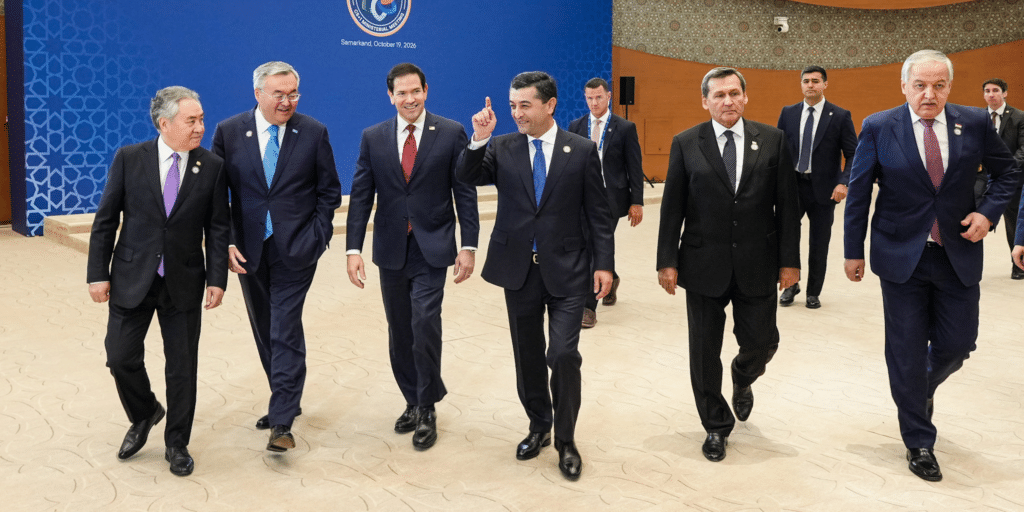
Kazakhstan’s proposal to establish a preventive diplomacy mechanism presents the Asian forum with a specific task: determining who, with whose consent, and through what procedures can help reduce tensions before they escalate into open conflict.
On October 15, 2026, at the seventh summit of the Conference on Interaction and Confidence Building Measures in Asia (CICA) in Baku, Kazakhstan’s President Kassym-Jomart Tokayev proposed launching a preventive diplomacy mechanism. The initiative came amid efforts to transform CICA into a full-fledged international organization and make its activities more practical. However, the proposed mechanism’s process for requesting assistance, powers, funding, and operating procedures were not detailed in the summit announcement.
For Central Asia, crisis prevention has direct practical significance. Disagreements over water use, transit restrictions, or disruptions to cross-border infrastructure can affect several countries simultaneously. Even a technical problem can take on a political dimension if the parties lack agreed-upon information and have no way to discuss the situation quickly. Preventive diplomacy is useful at a stage when there is still room for agreement, but routine working contacts are no longer sufficient.
CICA already has a foundation for such work. Its activities are based on sovereign equality, noninterference, and consensus-based decision-making. The Catalogue of Confidence Building Measures covers military-political, economic, environmental, and human issues, as well as new challenges and threats. Its agenda includes transport corridors, energy security, and cooperation in the digital sphere. Discussions on crisis prevention can therefore be linked to existing areas of cooperation.
As Aigerim Bakhtiyarova, deputy director of the Institute of Applied Research and Analytics at the Academy of Public Administration under the President of the Republic of Kazakhstan, noted in comments to The Times of Central Asia, differences in the foreign policy doctrines and geopolitical positions of CICA member states do not diminish their shared interest in regional security.
“Today, strategic predictability has become a very rare but very important condition for multilateral partnership, essential for peace, stability, and development,” the expert said. In her assessment, even countries engaged in open rivalry have an interest in maintaining channels of communication that can prevent conflicts from spreading and limit the associated economic and humanitarian costs.
However, a shared interest in preventing conflicts does not necessarily mean that states are prepared to grant additional powers to a multilateral mechanism. The principle of consensus creates conditions for trust while also setting limits on the future mechanism. When members’ interests diverge, agreeing on a collective position may take longer than the pace of a developing crisis allows. Therefore, in developing the initiative, it is important to determine which actions require a separate decision by all member states and which can be carried out under a previously agreed mandate, at the request and with the consent of the parties directly concerned.
The following are possible approaches to implementing the proposal, rather than announced components of the mechanism.
One realistic option could be a system of national contact points authorized to receive requests for urgent consultations. Their task would be to quickly connect the relevant government agencies, clarify the nature of the disagreement, and determine whether the parties are willing to hold discussions with CICA’s assistance. This would require confidentiality rules, response deadlines, and a clear division of responsibilities between the Secretariat and member states.
A second element could be joint fact-finding. For example, when movement through a border crossing is suddenly restricted, a neighboring country may perceive the restriction as political pressure, while the actual cause may be a technical malfunction or temporary security requirements. Coordinated consultations between transport and border authorities could help establish the cause, expected duration of the restriction, and possible temporary solutions. CICA’s role in such a case would be to facilitate contact at the parties’ request. The decision itself would remain with the competent authorities.
A similar procedure could be applied to water issues. During periods of low water availability, discrepancies in forecasts and water withdrawal data can complicate negotiations. With the parties’ agreement, technical discussions involving hydrologists and representatives of relevant agencies could be organized to clarify the underlying data before disagreements are raised to the political level. Such consultations should be based on existing agreements and take into account the powers of basin management and interstate bodies.
At the Baku summit, Kazakhstan also proposed establishing a CICA Water Partnership and developing a transport connectivity strategy. These initiatives can be considered complementary, since the resilience of transport routes and the shared use of water resources require regular information exchange and coordinated action.
Aigerim Bakhtiyarova points out that soft power tools could become an important resource for conflict prevention, although their significance is often viewed primarily in terms of cultural interaction. In her opinion, Asian traditions of diplomacy and political thought allow the prevention of disputes before they develop into open confrontation to be regarded as one of the principles of ensuring security. From this perspective, CICA provides opportunities to develop a common agenda and align the interests of member states.
The expert identifies three particularly relevant areas of cooperation: water resources, transport connectivity, and artificial intelligence. She believes preventive diplomacy mechanisms should be developed where these areas intersect, while taking into account differences in countries’ levels of development and capabilities.
The digital sphere deserves particular attention. The development of artificial intelligence and the expansion of digital infrastructure create new opportunities for cooperation, but they also increase the importance of information security, transparency in technological decisions, and trust between states. At the summit, Tokayev also proposed adding artificial intelligence as a sixth dimension alongside CICA’s five existing dimensions of cooperation.
In this context, Bakhtiyarova sees potential in information exchange, joint events, and consultations on artificial intelligence and digitalization. However, she believes that differences in access to information and levels of professional training could become obstacles. Practical cooperation could therefore begin with agreeing on channels for reporting digital incidents, sharing experience, and developing relevant expertise while complying with national legislation and information security requirements.
Initial preventive diplomacy projects should therefore focus on a limited range of tasks where the parties have a shared interest in achieving practical results: restoring communication between government agencies, coordinating notifications, verifying information, or maintaining working contacts during periods of strained relations. Attempting to address the most acute military-political conflicts from the outset would require a level of trust and authority that cannot be assumed to exist in advance.
Expert support also deserves particular attention. CICA already has a Think Tank Forum, which received permanent platform status in 2021. This could provide a basis for discussing the preparation of scenario assessments and confidential expert consultations on specific risks. It would be important, however, to distinguish independent analysis from the organization’s official position. Expert materials should help participants verify assumptions, assess the consequences of decisions, and identify acceptable courses of action.
For Central Asia, cooperation with the United Nations is also a fundamental consideration. The United Nations Regional Centre for Preventive Diplomacy for Central Asia (UNRCCA) has operated in Ashgabat since 2007 and was established at the initiative of the region’s five countries. Its mandate already provides for support in conflict prevention, monitoring of regional threats, and cooperation with international organizations. The Centre’s accumulated experience in consultations, early warning, and engagement with regional governments could be useful in developing procedures for CICA’s new mechanism. CICA’s broader membership, in turn, offers opportunities to involve countries beyond Central Asia in preventive consultations when necessary.
For Central Asian countries, the practical value of CICA’s preventive diplomacy mechanism will depend largely on its ability to facilitate timely dialogue and coordinated action when cross-border risks arise. A first step could be to develop clear consultation procedures and test them through voluntary pilot projects.