• KZT/USD = 0.00213
  • TJS/USD = 0.10830
  • UZS/USD = 0.00008
  • TMT/USD = 0.29850
  • KZT/USD = 0.00213
  • TJS/USD = 0.10830
  • UZS/USD = 0.00008
  • TMT/USD = 0.29850
  • KZT/USD = 0.00213
  • TJS/USD = 0.10830
  • UZS/USD = 0.00008
  • TMT/USD = 0.29850
  • KZT/USD = 0.00213
  • TJS/USD = 0.10830
  • UZS/USD = 0.00008
  • TMT/USD = 0.29850
  • KZT/USD = 0.00213
  • TJS/USD = 0.10830
  • UZS/USD = 0.00008
  • TMT/USD = 0.29850
  • KZT/USD = 0.00213
  • TJS/USD = 0.10830
  • UZS/USD = 0.00008
  • TMT/USD = 0.29850
  • KZT/USD = 0.00213
  • TJS/USD = 0.10830
  • UZS/USD = 0.00008
  • TMT/USD = 0.29850
  • KZT/USD = 0.00213
  • TJS/USD = 0.10830
  • UZS/USD = 0.00008
  • TMT/USD = 0.29850
06 August 2026

Viewing results 1 - 6 of 9

Medical Staff in Turkmenistan Resign En Masse Over Extortion to Avoid Picking Cotton

Hospitals and clinics in the Turkmen city of Turkmenabat are facing a growing staffing crisis as doctors and nurses resign en masse in protest over extortionate cash demands, particularly those tied to the annual cotton harvest. Efforts by local authorities to ease the burden have so far proven ineffective. According to sources cited by Chronicles of Turkmenistan, three family nurses recently resigned from Turkmenabat City Clinic No. 2, leaving just 11 nursing staff at the facility. Their responsibilities have since been redistributed among remaining colleagues, nearly doubling individual workloads, while salaries have only risen by 30%. The added pressure has led many remaining staff to consider resigning as well. Similar developments are unfolding at other clinics across the city. One doctor and two nurses have left Polyclinic No. 5, while multiple specialists have exited Polyclinics No. 3 and No. 4. The primary cause, according to local healthcare workers, is systematic extortion, most notably mandatory contributions for cotton harvesting. In September, Turkmenistan’s Ministry of Health reportedly issued a directive requiring medical personnel to participate in the cotton campaign. Employees in the Lebap region were assigned daily quotas to pick 45 kilograms of cotton. At both the new multidisciplinary hospital and the infectious diseases hospital in Turkmenabat, medical staff have been dispatched to the fields immediately after completing night shifts. Those unwilling or unable to comply must pay for a substitute picker, at a rate of 50 manats (approximately $14.30) per day. In practice, the burden of physical labor during this period often falls on staff nearing retirement age. One doctor at the infectious diseases hospital revealed that up to two-thirds of some employees’ monthly salaries are spent hiring replacement pickers during the cotton season. “Not everyone can work in the fields after a full shift, but everyone is expected to pay. That’s why many simply quit,” he said. In an attempt to stem the exodus, clinic administrators reduced the daily contribution for hiring workers from 50 to 30 manats (around $8.50) in mid-October. However, sources told Chronicles of Turkmenistan that the adjustment has done little to stop the resignations. Chief physicians have been trying to rehire former employees and bring retirees back into service, but interest remains low. As workloads increase and staff numbers dwindle, the quality of medical care continues to deteriorate.
Uzbekistan Rejects UN Allegations in Gulnara Karimova Case

The government of Uzbekistan has formally rejected allegations by the United Nations Human Rights Council’s Working Group on Arbitrary Detention concerning the case of Gulnara Karimova, the eldest daughter of the country’s late president, Islam Karimov. The UN body had earlier declared that Karimova’s 2014 detention was arbitrary and lacked a legal basis. In a response published by Uzbekistan’s National Center for Human Rights, the government asserted that all criminal proceedings against Karimova were conducted in full compliance with national legislation and international obligations, including the International Covenant on Civil and Political Rights. “The government is concerned that the Working Group formed its opinion based on one-sided and subjective information provided by the source, while Uzbekistan’s official response was not taken into account due to procedural deadlines,” the statement read. “This approach undermines the principles of impartiality that UN bodies must observe.” Legal Process and Rights of the Defendant According to the statement, Karimova had access to legal counsel throughout the legal process. She retained the right to choose or be appointed a lawyer, to review case materials, to appeal court decisions, and to consult privately with her legal representative. The government rejected claims that she had been subjected to extended house arrest without due process or that she faced a so-called “kitchen trial.” Officials maintained that all procedures and hearings were held lawfully. “At present, she has the right to appeal court decisions as provided by law,” the statement noted. Authorities also dismissed any suggestion that the prosecution was politically motivated. “All actions by law enforcement and judicial authorities were based solely on legal and factual grounds confirming the defendant’s guilt, and were unrelated to her economic activities, political status, or views,” the statement read. Karimova was convicted of tax evasion, money laundering, illegal appropriation of state property, fraud, and other serious crimes. According to the government, these actions resulted in significant financial losses to the state. Officials stated that all verdicts were supported by evidence and issued by competent courts. International Cooperation and Asset Repatriation The statement also drew attention to the 2022 agreement between Uzbekistan and Switzerland to establish the Vision 2030 Fund, financed by assets previously associated with Karimova. The fund supports Uzbekistan’s national reform agenda and the UN Sustainable Development Goals and is administered through the UN Multi-Partner Trust Fund. In closing, the government reaffirmed its commitment to international human rights obligations and expressed its willingness to maintain constructive dialogue with UN mechanisms. “The government reserves the right to defend its reputation in international institutions and to convey reliable information to all interested parties,” the statement concluded.

Kyrgyz Authorities Step Up Pressure on Kloop: Searches, Arrests, and International Outcry

In late May, Kyrgyz security forces conducted coordinated raids on the homes of eight current and former employees of the independent media outlet Kloop. Operatives from the State Committee for National Security (GKNB) simultaneously entered apartments in Bishkek and Osh. Video journalist Alexander Alexandrov and former cameraman Joomart Duulatov were detained and remain in custody on charges of “public calls for mass unrest” under Article 278 of the Criminal Code. The other six individuals were released after hours of interrogation but were compelled to sign non-disclosure agreements. According to Kloop’s editorial staff, five minutes before the raids began, the outlet received an anonymous email with the subject line: “You have crossed the line.” The incident drew swift condemnation from human rights groups. The Committee to Protect Journalists (CPJ) demanded an immediate end to what it described as persecution, while other international organizations called for the charges to be dropped. From Student Project to Investigative Powerhouse Founded in 2007 by journalists Bektur Iskender and Rinat Tukhvatushin, Kloop began as a training platform for aspiring reporters. The outlet gained prominence during its around-the-clock reporting on the 2010 uprising. It later evolved into a leading investigative publication, exposing high-profile cases such as the 2017 “Samaragate” voter data scandal and the 2019 financial network linked to customs official Raiymbek Matraimov. Despite legal threats, including lawsuits from the Matraimov family that were later withdrawn, Kloop’s reporting bolstered its credibility and amplified its visibility, making it increasingly unwelcome in official circles. Escalating Crackdown Tensions escalated in August 2023 when the Bishkek Prosecutor’s Office filed a lawsuit to dissolve the Kloop Media Foundation, accusing it of “negative coverage of government activities.” The Oktyabrsky District Court approved the request in February 2024, and the Supreme Court upheld the decision that July in a closed session. The ruling remained classified for a month. The Ministry of Culture subsequently ordered Kloop’s website to be blocked within Kyrgyzstan, despite assurances that the foundation’s removal from the official register would not impede freedom of expression. In response, the editorial team relocated servers abroad and registered a new legal entity. Nevertheless, the authorities resumed the pressure in January 2024 with searches targeting other independent outlets, including Temirov Live and 24.kg. By May, the security forces were back at Kloop. The investigation now alleges that Kloop continued to operate illegally post-liquidation, publishing materials purportedly aimed at “inciting public discontent.” This echoes the case against Temirov Live, where several journalists were imprisoned, including director Makhabat Tazhibek Kyzy, who is serving a six-year sentence. Human rights advocates argue the charges are part of a broader strategy to criminalize dissent. International Reactions The arrests have provoked international condemnation. Amnesty International, Human Rights Watch, Civil Rights Defenders, and Reporters Without Borders were among more than a dozen NGOs that issued a joint statement decrying a “new wave of repression” threatening the future of independent journalism in Kyrgyzstan. The statement urged the immediate release of detained journalists and called on international partners, particularly the European Union, to adopt a...

Kazakh Activists Slam PACE Member’s Allegations

Kazakh civil activists have strongly criticized a written declaration signed by 20 of the 306 members of the Parliamentary Assembly of the Council of Europe (PACE), labeling it a “defamatory document.” Their response, representing various non-governmental organizations and public associations across Kazakhstan, accuses PACE signatories of bias, double standards, and a lack of objectivity in its assessment of human rights and democratic practices in the country. The contentious declaration, published on the PACE website on February 5, 2025, alleges that Kazakhstan has imprisoned eight political dissidents and is repressing another five individuals living abroad. However, Kazakh civil society representatives argue that these claims are misleading and politically motivated. A key point of contention is the alleged connection between the individuals named in the declaration and Mukhtar Ablyazov, a notorious figure accused of embezzling $8-10 billion during his tenure as chairman of BTA Bank. Ablyazov has been the subject of multiple legal judgments in the UK and US, with liabilities exceeding $5 billion, including two jury trial verdicts in the Southern District of New York in 2022 and 2024 with regard to the laundering of the stolen funds. The activists assert that the individuals referenced in the PACE declaration are not political prisoners but rather individuals convicted of ordinary criminal offenses. In their February 24 response, the Kazakh civil society representatives expressed concern over what they perceive as an attempt by certain PACE members to “militarize” Europe’s democratic agenda against Kazakhstan. “We are deeply concerned about how individual PACE representatives are attempting to ‘militarize’ Europe’s democratic agenda in relation to Kazakhstan,” the statement reads. “We have every reason to believe that the authority of PACE is being actively used by criminal elements to advance their interests - among whom we include Mukhtar Ablyazov and his supporters.” While the PACE declaration called for an investigation into Kazakhstan, the civil activists countered by urging European law enforcement agencies to investigate potential abuses of office by PACE representatives. They accused PACE of turning a blind eye to systemic corruption, such as the “Qatargate” scandal, and questioned whether connections between those implicated in “Qatargate” and individuals shaping PACE’s stance on Kazakhstan are fueling a biased agenda. [caption id="attachment_29119" align="aligncenter" width="683"] According to its website, the National Endowment for Prosperity is an "organization dedicated to the protection of human rights, strengthening democracy and developing civil society, implementing a wide range of projects and initiatives in these areas."[/caption] The rebuttal, titled “Response of representatives of civil society of Kazakhstan to the declaration of the Parliamentary Assembly of the Council of Europe,” was signed by 20 prominent figures from Kazakh civil society. These include Marlen Imangaliyev from the "Veterans of military operations who took part in the settlement of the interethnic conflict in Nagorno-Karabakh in the Caucasus region" public association; Usen Suleimen and Marat Sarsembayev from the “National Endowment for Prosperity”; Salamat Kabidayev from the "Eurasian Peace and Accord" institution; and Dauyl Togzhan from the "Alash Ulandary" public foundation. The response underscores the activists’ belief that the actions...

Deported Tajik Opposition Activist Ikromov Sentenced to 23 Years in Prison

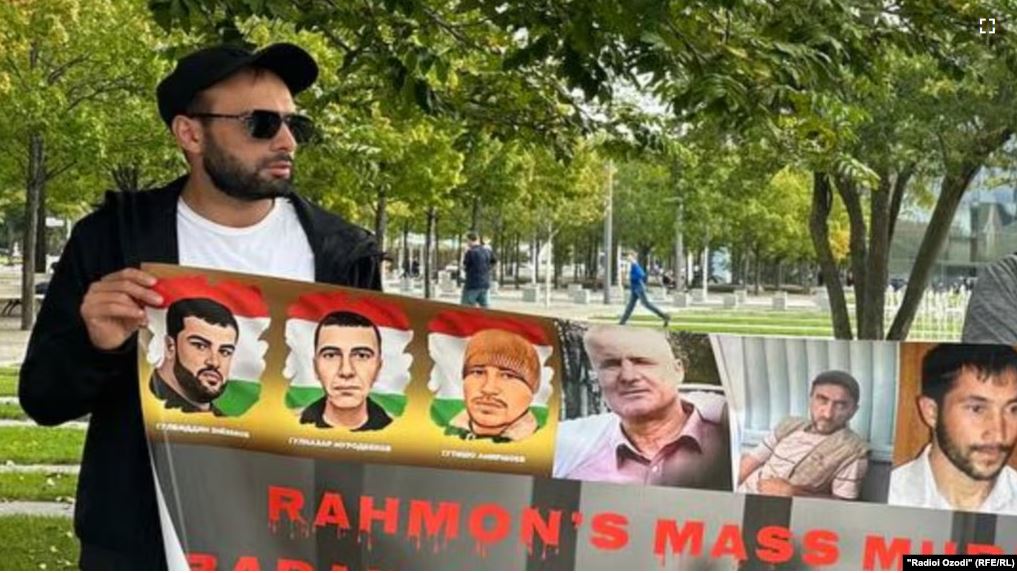
Tajik opposition activist Farrukh Ikromov, who had sought asylum in Europe, was deported from Poland to Tajikistan in April and subsequently sentenced to 23 years in prison in Dushanbe. Opposition sources have now informed Radio Ozodi of Ikromov's sentencing, though the Tajik authorities have not issued any official statement on the matter. According to Abdusattor Boboev, head of the Polish-based Citizens' Committee for the Rescue of Political Prisoners in Tajikistan, Ikromov was transferred from a Dushanbe pre-trial detention center to prison in October. Another activist, Saidiskhok Boboev, corroborated this information, stating that a recently released prisoner saw Ikromov and confirmed his 23-year sentence. Ikromov’s relatives, who reside abroad, lack detailed information about his sentencing. A close family member explained that they receive occasional updates about his status through a relative in Tajikistan. Ikromov’s deportation followed the denial of his asylum request in Poland. After this initial denial, He sought protection in Germany, but he was returned to Poland, where he was placed in a migrant detention center before being deported to Tajikistan. According to Abdusattor Boboev, shortly before his deportation, he reported being unexpectedly photographed, after which all contact with him ceased. Ikromov also participated in protests against Tajik President Emomali Rahmon's visit to Germany in September 2023. Opposition activists had expressed concern that if deported to Tajikistan, Ikromov would face mistreatment and a lengthy prison term. In recent years, several EU countries, including Germany, have complied with Tajikistan’s requests to extradite political activists, many of whom have subsequently received lengthy prison sentences. International human rights organizations have sharply criticized these actions. The Times of Central Asia previously reported on another Tajik activist, Dilmurod Ergashev, whose deportation from Germany was ordered by the Kleve administrative court on October 28, shortly after he was detained. The court ruled that Ergashev should be deported despite his pending application for political asylum before another court. Prior to his anticipated deportation, Ergashev attempted suicide. Ergashev, a member of the opposition Group of 24, has opposed the regime of Rahmon and joined the Reform and Development of Tajikistan movement in 2024. He has resided in Germany for 13 years.

Tajik Activist Ergashev Tried to Commit Suicide Before Deportation from Germany, Reports Associate

Tajik opposition activist Dilmurod Ergashev has attempted suicide before his expected deportation from Germany to Tajikistan. The Insider reports this quoting Ergashev's associate, Sharofiddin Gadoev. According to Gadoev, Ergashev was found in his deportation prison cell with wounds on his stomach, body, and arms, as well as slashed veins. He was taken to a hospital, where he received stitches. “Ergashev realizes that returning to Tajikistan would mean imminent reprisals and repression from Emomali Rahmon's regime. He would rather die than fall into the hands of a regime known for its cruelty to political opponents,” Gadoev said. Gadoev's Reform and Development of Tajikistan movement appealed to the international community and human rights organizations to intervene to prevent Ergashev's deportation. “We demand that the German authorities reconsider their decision and grant Dilmurod Ergashev the protection he deserves as a political refugee. The activist's fate should not be held hostage to bureaucratic decisions. This is a critical moment when the international community must demonstrate unity and determination in defending the rights of those fighting for freedom and justice in their countries,” the statement said. The Times of Central Asia wrote earlier that the deportation order was issued by the Kleve administrative court on October 28, shortly after the activist was detained. The court ordered Ergashev to be deported by November 7, despite his application for political asylum, which is still pending in another court. Ergashev actively opposes the regime of Tajik President Emomali Rahmon and is a member of the opposition Group of 24. He joined the Reform and Development of Tajikistan movement in 2024 and has lived in Germany for 13 years.