
• KZT/USD = 0.00221
  • TJS/USD = 0.10830
  • UZS/USD = 0.00008
  • TMT/USD = 0.29760
  • KZT/USD = 0.00221
  • TJS/USD = 0.10830
  • UZS/USD = 0.00008
  • TMT/USD = 0.29760
  • KZT/USD = 0.00221
  • TJS/USD = 0.10830
  • UZS/USD = 0.00008
  • TMT/USD = 0.29760
  • KZT/USD = 0.00221
  • TJS/USD = 0.10830
  • UZS/USD = 0.00008
  • TMT/USD = 0.29760
  • KZT/USD = 0.00221
  • TJS/USD = 0.10830
  • UZS/USD = 0.00008
  • TMT/USD = 0.29760
  • KZT/USD = 0.00221
  • TJS/USD = 0.10830
  • UZS/USD = 0.00008
  • TMT/USD = 0.29760
  • KZT/USD = 0.00221
  • TJS/USD = 0.10830
  • UZS/USD = 0.00008
  • TMT/USD = 0.29760
  • KZT/USD = 0.00221
  • TJS/USD = 0.10830
  • UZS/USD = 0.00008
  • TMT/USD = 0.29760
18 October 2026

Viewing results 1 - 6 of 21

Central Asia’s Rail Corridors: U.S. and Chinese Partnerships in Perspective

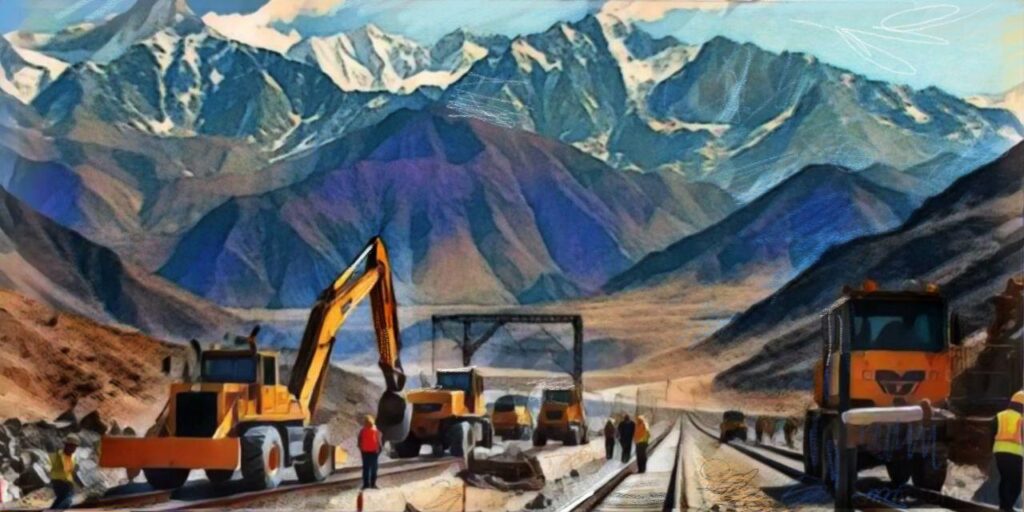
Kazakhstan’s railways are modernizing with a U.S. supplier, while Kyrgyzstan and Uzbekistan are advancing a new trans‑mountain link with China. On September 22, 2025, Wabtec and KTZ announced a multi‑year locomotive and services package worth about $4.2 billion, described by the company as its “largest” agreement. In parallel, China, Kyrgyzstan, and Uzbekistan formalized a joint company to build the long-planned CKU railway, with China holding a 51% stake. Central Asia’s rail networks are thus being reshaped by two major partnerships - one with the United States and one with China. Rather than a zero-sum rivalry, these projects show how regional governments are pursuing different infrastructure strategies to expand connectivity. Kazakhstan and Wabtec: Modernizing an Existing Network In September 2025, Kazakhstan’s railway operator KTZ signed a $4.2 billion agreement with U.S.-based Wabtec for 300 Evolution Series ES44ACi locomotives. The diesel-electric engines are tailored for Kazakhstan’s 1,520 mm gauge network and harsh climate, replacing aging Soviet-era stock. Wabtec finalized full ownership of the Astana locomotive plant in late 2023; production and services for 1,520-mm stock are now fully under Wabtec’s Kazakhstan subsidiary. Local manufacturing and long-term service contracts are expected to expand domestic engineering capacity. The locomotives’ digital diagnostic systems should improve fuel efficiency and maintenance intervals. According to the official Wabtec press release, the agreement “strengthens KTZ’s role as a critical and reliable hub for the Middle Corridor,” while KTZ CEO Talgat Aldybergenov said it “confirms our commitment to advanced technologies in the transport sector”. Rail accounts for about 64% of Kazakhstan’s freight turnover (2024), so locomotive performance directly affects Middle Corridor throughput. Financing details have not been disclosed, but the purchase appears to be domestically funded through KTZ and state support. For Astana, the order fits its multi-vector foreign-policy approach: Kazakhstan continues its partnerships with France’s Alstom, China’s CRRC, and Russia, maintaining balance across suppliers. While the locomotives are diesel, Kazakhstan is also electrifying key lines with European partners. Diesels provide an immediate boost without new catenary investment, and Wabtec claims lower emissions than previous models. Over time, expanded electrification could complement this upgrade. Overall, the Wabtec partnership represents incremental modernization. This is an interoperability-based approach that strengthens existing routes rather than building new corridors from scratch. [caption id="attachment_37655" align="aligncenter" width="950"] Image: trains.com - One of Kazakhstan’s modern Evolution Series diesel locomotives (model TE33A) produced through a partnership with U.S. firm Wabtec. Kazakhstan’s railways carry about 64% of the country’s freight, making such upgrades crucial for trade connectivity.[/caption] The China–Kyrgyzstan–Uzbekistan (CKU) Railway: Building a New Corridor After nearly three decades of discussion, China, Kyrgyzstan, and Uzbekistan launched construction of the CKU railway in late 2024. The 523 km line will run from Kashgar (Xinjiang) through the Kyrgyz mountain ranges to Andijan, Uzbekistan. It will provide a second direct China–Central Asia connection, bypassing reliance on Kazakhstan’s network. The CKU is designed with dual gauges: standard (1,435 mm) in China and broad (1,520 mm) in Kyrgyzstan and Uzbekistan, with a dry-port transshipment hub in Makmal, Kyrgyzstan. This compromise allows integration with existing Central...

Opinion: Bridging Histories, Building Futures – Central Asia, Pakistan, and the Dream of a Railway

On 5 September 2025, the Times of Central Asia published an article titled “Trans-Afghan Railway: Can Uzbekistan Build a Railway Through Afghanistan to Reach the Sea?” Reading it stirred something deep within me. The piece was not just about steel tracks or trade corridors - it was about dreams, history, and the future of a region I have long been passionate about: Central Asia. I am not a political analyst; I am an engineer by training and a student of history by passion. Having worked in Afghanistan and witnessed the landscape of its geography and politics up close, I feel a personal connection to the idea of connectivity between Pakistan and Central Asia by rail. This is not just a policy debate for me - it is a lifelong vision tied to my family history, my professional journey, and my fascination with the region’s rich past. When the Soviet Union withdrew its last troops from Afghanistan on 15 February 1989, ending its long and bloody war, the region entered a new and uncertain chapter. That very moment coincided with the beginning of my own career. Just two months earlier, I had started my first job as a Junior Engineer. For me, the Soviet withdrawal was not only a historical milestone; it was also a symbolic reminder of how deeply Afghanistan and its neighbors were tied to global currents of power, conflict, and change. Standing at the threshold of my professional life, I wondered how this region - so often defined by wars - might instead be remembered for bridges, trade, and railways. My fascination with Central Asia is also deeply personal. From my mother’s side, my family traces its lineage back to Bukhara. This explains why many families in Pakistan carry the name Bukhari, as their ancestors once migrated southward from that historic Central Asian city. History was not abstract for me - it lived in the stories of my elders and in the books I devoured as a student. In my school years, I read the Baburnama twice. These memoirs of Zahīr ud-Dīn Muhammad Bābur, the founder of the Mughal Empire, fascinated me. Born in Andijan in the Ferghana Valley (modern-day Uzbekistan), Babur’s life was a reminder of how Central Asia and South Asia have always been linked - through migration, culture, politics, and ambition. In 1992, I made my first trip to Tashkent. The journey was more than a visit; it was a pilgrimage to the heart of a region I had admired from afar. That first encounter left an indelible mark on me, and more than three decades later, my passion for Central Asia remains unending. Long before modern projects and international agreements, history itself carved the routes of connectivity. The Khyber Pass, lying between present-day Pakistan and Afghanistan, has for centuries served as a gateway between Central and South Asia. Caravans laden with silk, spices, and stories once passed through its rugged cliffs. Empires - from the Mughals to the British - understood its importance. And...

Opinion: A Railway to the Future – Uzbekistan’s Bold Path to Connectivity and Carbon Cuts

I still remember the thrill of boarding the sleek high-speed train from Tashkent to Bukhara. What could have been an ordinary journey turned into something unforgettable - the kind of experience that stays alive in the memory long after the trip ends. The speed, the comfort, and above all, the hospitality of Uzbekistan Railways revealed more than just modern engineering; it was a glimpse into the vision of a country determined to connect its people and its future to the wider world. The resonance of this project is deep. The Silk Road was once the artery of global exchange, moving not just goods but ideas, cultures, and entire civilizations between East and West. From Xi’an to Samarkand, Bukhara, and Tashkent, caravans carried silk, porcelain, and paper eastward, while wool, stones, fruits, and glassware travelled west. The CKU Railway is not simply another infrastructure project; it is the revival of this legacy, adapted for the 21st century. By shortening transport routes by nearly 900 kilometers and halving transit times, it promises to transform Uzbekistan’s geographic disadvantage into a strategic strength. For a landlocked country, this is more than steel on tracks - it is a lifeline to global markets. That is where railways carry an underappreciated advantage. Beyond the economics, rail is also a climate solution. The International Energy Agency (IEA) has found that rail freight is three to four times more energy-efficient than trucks. Trains use 65–80% less fuel per kilogram of cargo. The European Environment Agency calculates that a ton of freight moved by train emits 14–20 grams of CO₂ per kilometer, while the same tonnage on trucks produces 60–120 grams. That is a four- to fivefold difference. If the 20th century belonged to highways, the 21st must belong to railways. To grasp what this means for Central Asia, consider the region’s emissions profile. According to the EDGAR 2023 dataset, annual greenhouse gas emissions (excluding LULUCF, 2022) stand at roughly 320 MtCO₂e for Kazakhstan, 214 MtCO₂e for Uzbekistan, 99 MtCO₂e for Turkmenistan, 22 MtCO₂e for Kyrgyzstan, and 21 MtCO₂e for Tajikistan. Transport is responsible for around a tenth of that, and road freight dominates. The opportunity for reductions through a modal shift is therefore enormous. Take Uzbekistan as a case in point. The country moves about 90 billion ton-km of freight annually, within a regional total of some 350 billion. At present, 70% of this moves by road and 30% by rail. Imagine that by 2035, half of current road freight shifts to electrified rail - around 32 billion ton-km. On trucks, that freight would generate 2.9 MtCO₂e per year. On electrified trains, it would produce only 0.54 MtCO₂e. The savings: 2.4 MtCO₂e annually, or more than 1% of Uzbekistan’s entire national emissions. For a single infrastructure project, that is an extraordinary return in climate terms. The regional potential is just as striking. If similar shifts occurred across Central Asia, annual savings would reach 7–9 MtCO₂e by 2035 - the equivalent of removing two million cars from the road....
