

• KZT/USD = 0.00213
  • TJS/USD = 0.10800
  • UZS/USD = 0.00008
  • TMT/USD = 0.29850
  • KZT/USD = 0.00213
  • TJS/USD = 0.10800
  • UZS/USD = 0.00008
  • TMT/USD = 0.29850
  • KZT/USD = 0.00213
  • TJS/USD = 0.10800
  • UZS/USD = 0.00008
  • TMT/USD = 0.29850
  • KZT/USD = 0.00213
  • TJS/USD = 0.10800
  • UZS/USD = 0.00008
  • TMT/USD = 0.29850
  • KZT/USD = 0.00213
  • TJS/USD = 0.10800
  • UZS/USD = 0.00008
  • TMT/USD = 0.29850
  • KZT/USD = 0.00213
  • TJS/USD = 0.10800
  • UZS/USD = 0.00008
  • TMT/USD = 0.29850
  • KZT/USD = 0.00213
  • TJS/USD = 0.10800
  • UZS/USD = 0.00008
  • TMT/USD = 0.29850
  • KZT/USD = 0.00213
  • TJS/USD = 0.10800
  • UZS/USD = 0.00008
  • TMT/USD = 0.29850

Viewing results 1 - 6 of 2

Nearly 160,000 Citizens of Tajikistan Listed in Russia’s Controlled Persons Register

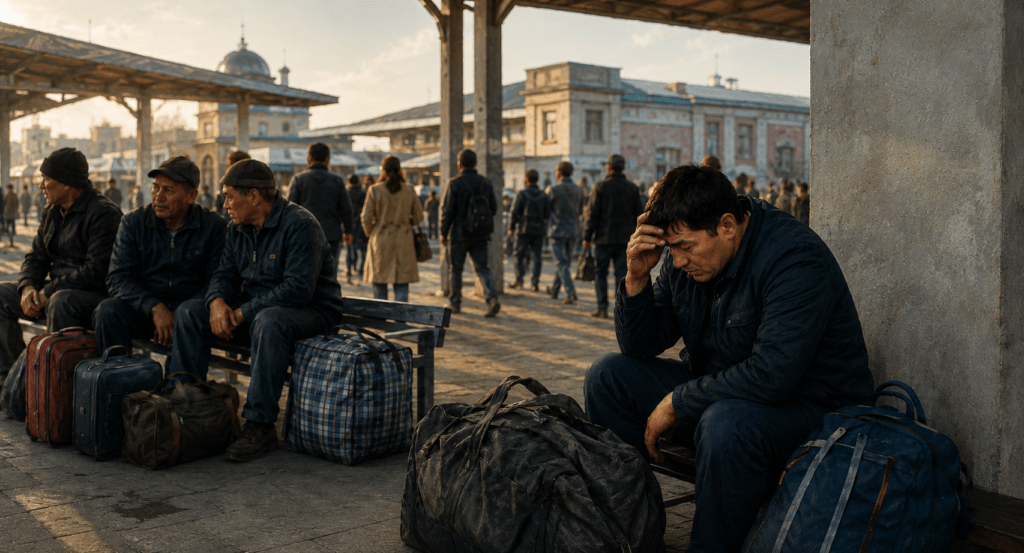
Nearly 160,000 citizens of Tajikistan, including about 25,000 minors, have been listed in Russia’s register of controlled persons, a senior official from Tajikistan’s migration service said. The figure reflects the impact of tighter Russian migration rules on one of Central Asia’s largest sources of migrant labor. Sharif Norzoda, Tajikistan’s deputy minister of labor, migration, and employment, said around 160,000 citizens of Tajikistan are currently listed in the register, with children included because they accompanied family members who had moved to Russia. The register, maintained by Russia’s Interior Ministry, is updated every four hours and contains information on foreign nationals who no longer have legal grounds to remain in the country. Individuals included in the database are required to regularize their legal status in Russia. Norzoda said more than 15,000 citizens of Tajikistan had sought assistance from the country’s migration service during the reporting period. The ministry also said 3,953 Tajik citizens facing temporary bans on entering Russia were advised against unnecessary travel after consulting migration authorities, helping them avoid being turned back at the border. According to the ministry, more than 10,700 labor migrants who returned from Russia have already found employment in Tajikistan. Russia introduced the register of controlled persons on February 5, 2025, to tighten migration enforcement. The database is accessible through the Russian Interior Ministry’s website and the government’s online services portal. It is intended to monitor foreign citizens whose legal right to stay in Russia has expired. The tighter migration regime has prompted Tajikistan to diversify destinations for its migrant workers. As previously reported by The Times of Central Asia, the government has expanded labor migration initiatives beyond Russia, seeking new employment opportunities in Europe and East Asia.

Opinion: Russia’s Migration Crackdown Tests Central Asia’s Labor Alternatives

Russia is no longer the unquestioned labor destination it once was for Central Asian workers. That shift is real, but it is easy to overstate. The Times of Central Asia recently reported that labor migration from the region is becoming more diverse. Workers are looking not only to Russia, but also to South Korea, the Gulf states, the United Kingdom, Poland, Belarus, and other destinations. The old Russia-centered model is weakening, even if it has not collapsed. The question is scale. It now intersects with two other filters: legal status and banking access. Alternative labor markets can absorb some Central Asian workers, but they cannot yet replace the Russian labor outlet. Russia did not function as an ordinary destination. For years, it acted as the region's largest external labor valve: geographically close, linguistically familiar, legally accessible for some, and large enough to absorb millions of workers across construction, services, logistics, agriculture, and municipal labor. South Korea, the UK, Poland, and the Gulf can offer higher wages and more formal recruitment channels. They can also reduce overdependence on Moscow. But they are more selective, more bureaucratic, and much smaller in immediate absorption capacity. That leaves a more important question: can new destinations expand fast enough to offset a narrowing Russian market? For now, the answer is probably no. Diversification Is Real, but Not Replacement The difference between diversification and replacement is crucial. A worker from Kyrgyzstan leaving for seasonal work in the UK, or a worker from Uzbekistan entering an organized recruitment program in South Korea, represents a genuine shift. These routes can be safer, better paid, and less exposed to the social hostility now facing many Central Asian migrants in Russia. But they cannot absorb workers on the same scale. Russia's labor market absorbed Central Asian workers in very large numbers because it had a combination few other destinations can match: proximity, low entry costs, dense migrant networks, Russian-language familiarity, and long-standing informal labor channels. Even as those channels become more restrictive, they remain embedded in household economies across the region. This is why diversification should be read as a partial adaptation, not a full exit. For governments in Tashkent, Bishkek, and Dushanbe, the search for new labor markets is necessary. It reduces exposure to Russian policy shocks. It gives workers more choices. It also helps governments negotiate better legal recruitment schemes. Yet the structural problem remains. If Russia closes the door faster than alternatives can open, pressure does not disappear. It returns home through unemployment, lower remittances, and frustrated expectations. The EAEU Line Russia's migration crackdown does not affect Central Asia evenly. The most important dividing line is not geography. It is legal status. Kyrgyzstan and Kazakhstan are members of the Eurasian Economic Union (EAEU), which allows the free movement of labor among member states. In practical terms, citizens of Kyrgyzstan and Kazakhstan have a different legal status in Russia than citizens of Uzbekistan and Tajikistan. They do not face the same work-permit and labor-patent system. That does not...