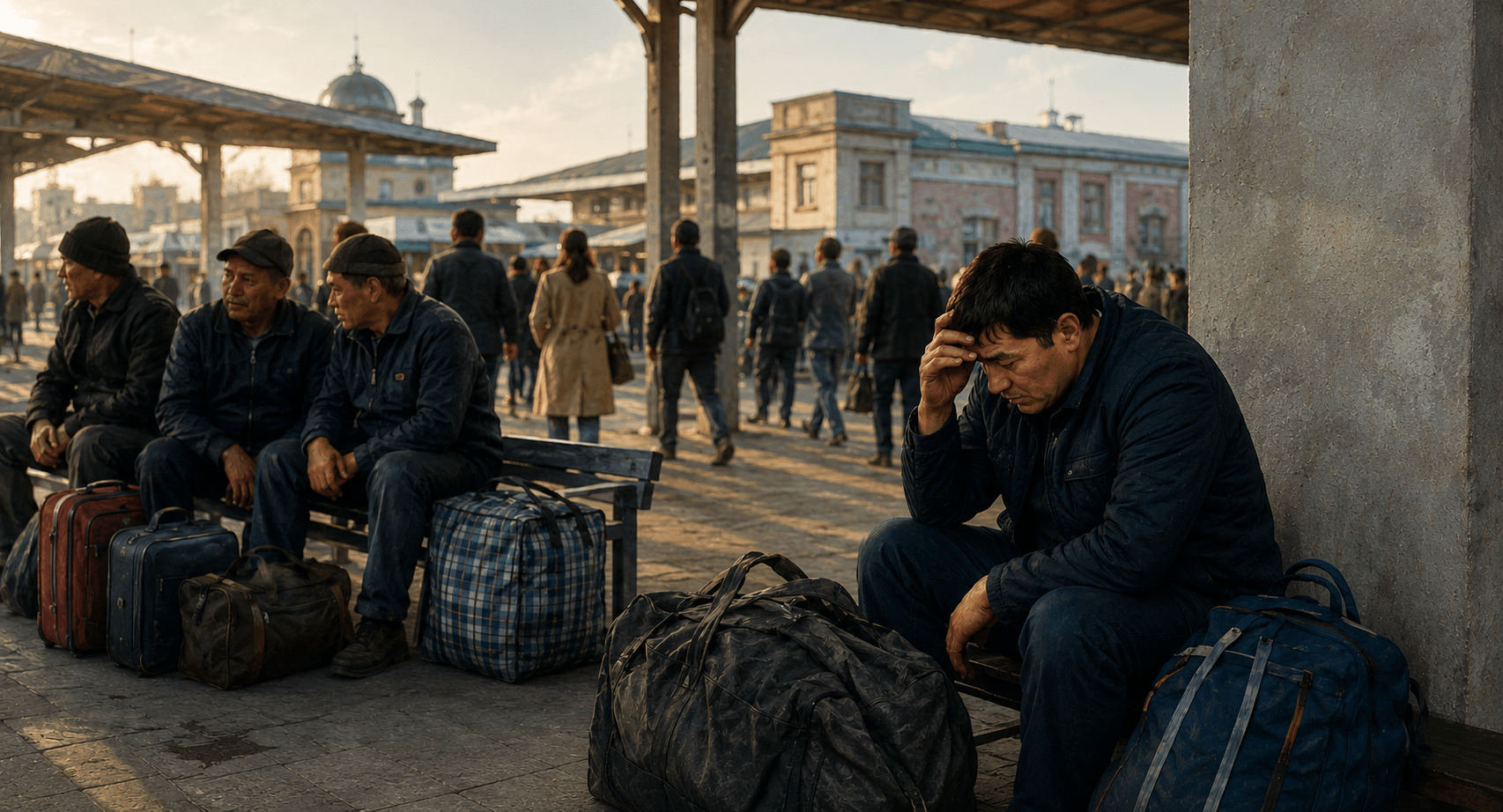
Russia is no longer the unquestioned labor destination it once was for Central Asian workers. That shift is real, but it is easy to overstate.
The Times of Central Asia recently reported that labor migration from the region is becoming more diverse. Workers are looking not only to Russia, but also to South Korea, the Gulf states, the United Kingdom, Poland, Belarus, and other destinations. The old Russia-centered model is weakening, even if it has not collapsed.
The question is scale. It now intersects with two other filters: legal status and banking access.
Alternative labor markets can absorb some Central Asian workers, but they cannot yet replace the Russian labor outlet. Russia did not function as an ordinary destination. For years, it acted as the region’s largest external labor valve: geographically close, linguistically familiar, legally accessible for some, and large enough to absorb millions of workers across construction, services, logistics, agriculture, and municipal labor.
South Korea, the UK, Poland, and the Gulf can offer higher wages and more formal recruitment channels. They can also reduce overdependence on Moscow. But they are more selective, more bureaucratic, and much smaller in immediate absorption capacity.
That leaves a more important question: can new destinations expand fast enough to offset a narrowing Russian market?
For now, the answer is probably no.
Diversification Is Real, but Not Replacement
The difference between diversification and replacement is crucial.
A worker from Kyrgyzstan leaving for seasonal work in the UK, or a worker from Uzbekistan entering an organized recruitment program in South Korea, represents a genuine shift. These routes can be safer, better paid, and less exposed to the social hostility now facing many Central Asian migrants in Russia. But they cannot absorb workers on the same scale.
Russia’s labor market absorbed Central Asian workers in very large numbers because it had a combination few other destinations can match: proximity, low entry costs, dense migrant networks, Russian-language familiarity, and long-standing informal labor channels. Even as those channels become more restrictive, they remain embedded in household economies across the region.
This is why diversification should be read as a partial adaptation, not a full exit.
For governments in Tashkent, Bishkek, and Dushanbe, the search for new labor markets is necessary. It reduces exposure to Russian policy shocks. It gives workers more choices. It also helps governments negotiate better legal recruitment schemes.
Yet the structural problem remains. If Russia closes the door faster than alternatives can open, pressure does not disappear. It returns home through unemployment, lower remittances, and frustrated expectations.
The EAEU Line
Russia’s migration crackdown does not affect Central Asia evenly.
The most important dividing line is not geography. It is legal status.
Kyrgyzstan and Kazakhstan are members of the Eurasian Economic Union (EAEU), which allows the free movement of labor among member states. In practical terms, citizens of Kyrgyzstan and Kazakhstan have a different legal status in Russia than citizens of Uzbekistan and Tajikistan. They do not face the same work-permit and labor-patent system.
That does not make migrants from Kyrgyzstan immune. They have still appeared in Russia’s register of controlled persons, and Bishkek has had to respond to legal and social pressure on its citizens. But EAEU membership gives Kyrgyzstan a treaty-based position that Uzbekistan and Tajikistan do not have.
That distinction is often mentioned in passing. It should be treated as central.
It also needs to be kept separate from a second axis: economic dependence. Legal status and exposure are not the same thing. EAEU membership groups Kyrgyzstan and Kazakhstan together on paper, but their vulnerability to a narrowing Russian market is very different, and that difference is driven by economics, not treaties.
For workers from Uzbekistan and Tajikistan, Russia’s tightening migration regime runs through labor patents, documentation renewals, registration rules, and the risk of deportation if they fall out of status. Workers from Kyrgyzstan and Kazakhstan also face pressure, but under a different legal category.
The same Russian policy can produce different levels of exposure across the region.
This is the new sorting mechanism. Moscow’s migration filter does not simply distinguish between “Central Asians” and others. It separates workers by treaty status, documentation risk, and financial access.
The Financial Channel
The second underexamined layer is financial.
Russia’s register of controlled persons is usually discussed as a question of movement and legal status: who can stay and who may be forced to leave. But the register also affects banking and everyday financial life.
According to 24.kg, hundreds of thousands of foreigners were added to Russia’s register of controlled persons after it came into effect in February 2025. The same report said tens of thousands of citizens of Kyrgyzstan were included. An earlier 24.kg report said banks had begun blocking cards belonging to people listed in the register. Legal and business sources have also described banking restrictions and account freezes linked to the register.
This changes the migration story.
A migrant does not need to be deported for the household back home to feel the shock. If a worker’s bank card is blocked, if access to financial services is restricted, or if monthly spending is limited, the ability to send money home can be disrupted at the source.
That turns migration enforcement into a remittance-transmission risk.
For Kyrgyzstan and Uzbekistan, this is serious. For Tajikistan, it is potentially systemic. World Bank data shows that personal remittances received by Tajikistan reached nearly half of GDP in 2024. When a country’s household economy is that dependent on money earned abroad, banking restrictions in Russia are not only a migrant problem. They become a macroeconomic vulnerability.
The pressure travels through families first. Then it can move into local consumption, currency demand, banking flows, and public confidence.
Tajikistan as the Most Exposed Case
Tajikistan is the most sensitive test case because several pressures overlap. Its labor market has limited capacity to absorb returnees, while remittances remain unusually important to the economy. Migration from Tajikistan is still heavily oriented toward Russia. Citizens of Tajikistan also remain outside the EAEU labor framework, making them more exposed to the controlled-persons system and to labor patent and registration requirements.
This does not mean a crisis is inevitable. But it does mean that the same Russian policy change carries heavier consequences for Dushanbe than for Astana or Bishkek.
Uzbekistan is also exposed, but it has a larger domestic economy and a more active strategy of organized recruitment into alternative markets. Kyrgyzstan remains highly dependent on Russia, yet EAEU membership provides a partial legal buffer.
Kazakhstan falls into a different category because it is a labor destination as well as a source of skilled migration. Kazakhstani citizens still work in Russia. Of the roughly 126,000 Kazakhstani citizens working abroad, around 102,000 are in Russia, a substantial flow. But with unemployment near 4.5% and an economy that does not rely on remittances, a narrowing Russian door does not create existential pressure for Astana. Kazakhstan’s lower exposure reflects its economic structure as well as its treaty status. It sends workers abroad, but it does not depend on their earnings in the same way.
Tajikistan has fewer cushions.
That is why the diversification argument needs another layer. Destination is only part of the question. Legal protection and financial access also determine how exposed migrants are, while the strength of the domestic economy determines how much pressure a country can absorb if Russia’s filter tightens further.
A Narrower Russian Door
Russia is unlikely to close its labor market completely. Its economy still needs migrant labor, especially in construction and low-paid service work. But Moscow is changing the terms of access.
The old model was large, even when it was informal and often exploitative. The new model is more selective, with digital controls and harsher penalties for falling out of status. Entry is becoming more controlled, while tighter document checks make enforcement harder to avoid.
For Central Asia, this produces a new migration order.
Some workers will successfully move to Europe, the Gulf, or East Asia. Some will remain in Russia under tighter rules. Some will be pushed into irregularity, return home, or delay migration altogether. The burden will not fall evenly.
That unevenness is the real story.
Diversification may reduce dependence on Russia over time. But in the short term, it cannot fully replace the scale of the Russian labor outlet. Nor can it remove the legal gap between EAEU and non-EAEU citizens, or the financial risks created by registry-linked restrictions.
Central Asia is moving beyond Russia into a more segmented migration system, where access to work depends on legal and banking status and the ability of each state to build alternatives quickly enough.
The Russian door is still open. It is just becoming a narrower, more selective route, with higher costs for those passing through.
The views expressed in this article are those of the author and do not necessarily reflect the official policy or position of the publication, its affiliates, or any other organizations mentioned.