

• KGS/USD = 0.01144 0%
  • KZT/USD = 0.00209 0%
  • TJS/USD = 0.10830 0.09%
  • UZS/USD = 0.00008 0%
  • TMT/USD = 0.28490 0%
  • KGS/USD = 0.01144 0%
  • KZT/USD = 0.00209 0%
  • TJS/USD = 0.10830 0.09%
  • UZS/USD = 0.00008 0%
  • TMT/USD = 0.28490 0%
  • KGS/USD = 0.01144 0%
  • KZT/USD = 0.00209 0%
  • TJS/USD = 0.10830 0.09%
  • UZS/USD = 0.00008 0%
  • TMT/USD = 0.28490 0%
  • KGS/USD = 0.01144 0%
  • KZT/USD = 0.00209 0%
  • TJS/USD = 0.10830 0.09%
  • UZS/USD = 0.00008 0%
  • TMT/USD = 0.28490 0%
  • KGS/USD = 0.01144 0%
  • KZT/USD = 0.00209 0%
  • TJS/USD = 0.10830 0.09%
  • UZS/USD = 0.00008 0%
  • TMT/USD = 0.28490 0%
  • KGS/USD = 0.01144 0%
  • KZT/USD = 0.00209 0%
  • TJS/USD = 0.10830 0.09%
  • UZS/USD = 0.00008 0%
  • TMT/USD = 0.28490 0%
  • KGS/USD = 0.01144 0%
  • KZT/USD = 0.00209 0%
  • TJS/USD = 0.10830 0.09%
  • UZS/USD = 0.00008 0%
  • TMT/USD = 0.28490 0%
  • KGS/USD = 0.01144 0%
  • KZT/USD = 0.00209 0%
  • TJS/USD = 0.10830 0.09%
  • UZS/USD = 0.00008 0%
  • TMT/USD = 0.28490 0%

Viewing results 1 - 6 of 2

Uzbekistan Weighs Social Media Restrictions for Children Under 16

Uzbekistan is considering introducing legal restrictions on social media use by children under the age of 16, adding its name to a growing list of Central Asian countries debating how to protect minors in the digital age. According to Gazeta.uz, the proposal was announced by Minister of Preschool and School Education E’zozxon Karimova following an event at the ministry on June 26. Speaking to the publication, Karimova said discussions had already taken place with members of parliament and the Senate, and that a draft law could soon be prepared for public consultation. “We are currently thinking about this issue. We have discussed it with our deputies and senators. We want to prepare a draft law and submit it for public discussion. I believe we should also have such regulations,” Karimova said. The proposal comes as governments across the region grapple with concerns over children’s exposure to harmful online content, cyberbullying, and excessive screen time. Karimova stressed that the objective is not to remove smartphones from children’s lives but to encourage responsible use through legal safeguards and stronger enforcement. “We live in the age of technology. We cannot simply take phones away from our children. Of course, they need them. But there should also be a culture and limits to their use,” she said. She noted that Uzbekistan already requires students to leave their phones before entering school and has rules governing student behavior. However, she acknowledged that enforcement remains inconsistent. “These rules work in some places and not in others. We now want to strengthen enforcement and legally restrict children under the age of 16 from using social media,” Karimova added. The debate mirrors similar discussions elsewhere in Central Asia. Earlier this year, The Times of Central Asia reported that Kazakhstan was considering legislative amendments to prohibit children under 16 from registering on social media platforms, while exempting messaging services. Lawmakers in Kazakhstan say the proposals are intended to shield children from harmful content, including violence and pornography, while reducing cyberbullying. According to Kazakhstani officials, approximately 200 cases of bullying and cyberbullying involving children had already been recorded in 2025, prompting calls for tighter regulation. The government has also been exploring age verification mechanisms, including SIM card registration for younger users, alongside expanded digital literacy education in schools. A similar debate emerged in neighboring Tajikistan last year. As previously reported by The Times of Central Asia, lawmakers proposed banning social media access for children under 14 and requiring written parental consent for teenagers aged 14 to 17. While supporters argued that stricter controls were necessary to protect children from harmful online content, critics maintained that digital literacy, parental involvement, and education would be more effective than blanket restrictions. Uzbekistan has not yet published a draft law, and Karimova indicated that any proposal would first undergo public discussion before being submitted for legislative consideration.
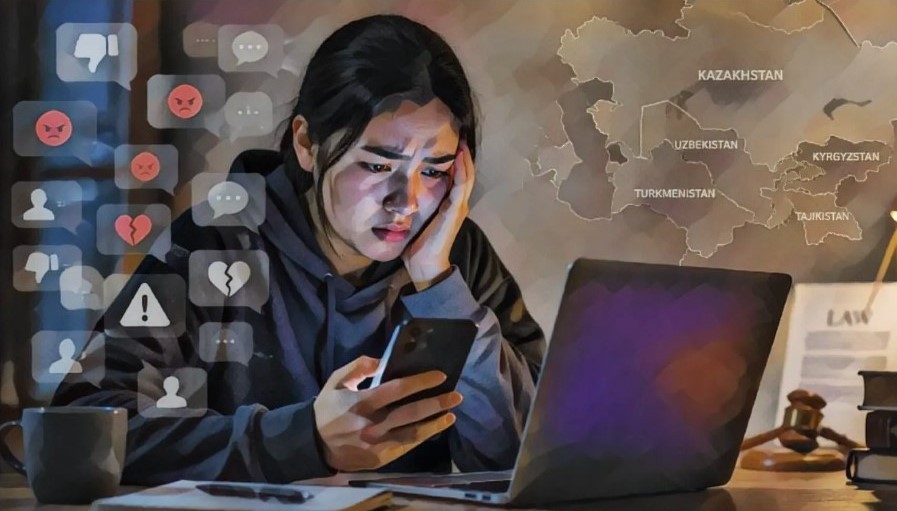

Cyberbullying in Central Asia: What Legal Protections Are There?

Cyberbullying has long ceased to be merely an argument on the internet. Insults, harassment in chats, the publication of humiliating photos and videos, coordinated mockery, threats, and the spread of false information can cause harm comparable to offline violence. In Central Asia, the problem is becoming increasingly visible, but legal responses still vary significantly. As of 2026, Kazakhstan and Uzbekistan have incorporated bullying and cyberbullying into legislation more directly, while Kyrgyzstan, Tajikistan, and Turkmenistan continue to address such cases mainly through general provisions on insult, defamation, threats, child protection, and internet regulation. Kazakhstan has taken the most explicit legislative approach to cyberbullying. The law introduced an official definition: cyberbullying is understood as systematic actions, that is, actions committed two or more times of a humiliating nature against a child, including persecution and intimidation using internet resources. The law also grants a citizen or the legal representative of a child the right to submit a complaint to the authorized body regarding instances of cyberbullying against a child, specifying the relevant internet resource. At the same time, laws on children’s rights and education have formally incorporated the concept of child bullying, including acts committed through media and telecommunications networks. A further step was taken in 2024, when Article 127-2 (“Bullying of a Minor”) was added to Kazakhstan’s Code of Administrative Offenses. It provides for a warning or a fine, with higher penalties for repeated violations within a year. In December 2024, Kazinform reported that Kazakhstan became the first country in Central Asia to establish specific liability for the bullying and cyberbullying of children in a separate legal provision, which entered into force on June 16, 2024. It is also significant that the provision is now being applied in practice. According to data released in February 2026 by the Deputy Chair of the Committee for the Protection of Children’s Rights, around 200 cases of bullying and cyberbullying against children had been recorded in 2025. This figure is important not only in itself; it indicates that the state has begun systematically recording such incidents and that victims and their families are more likely to seek protection. The main strength of the Kazakh model is its clarity. The law explicitly defines the problem, outlines complaint procedures, and establishes specific liability. Its main limitation lies in implementation: as with domestic violence legislation, effectiveness depends on how prepared schools, parents, law enforcement, and online platforms are to apply it in practice. Uzbekistan: Cyberbullying Within the Child Protection Framework In Uzbekistan, there is no separate legal provision titled “cyberbullying,” but the country has taken a significant step in terms of child protection. The Law “On the Protection of Children from All Forms of Violence,” adopted on November 14, 2024, and in force since May 15, 2025, explicitly recognizes bullying as a form of violence against children. The law defines such violence as actions, including those carried out through telecommunications networks and the internet, that cause or may cause physical or psychological harm. The definition of bullying explicitly includes...