


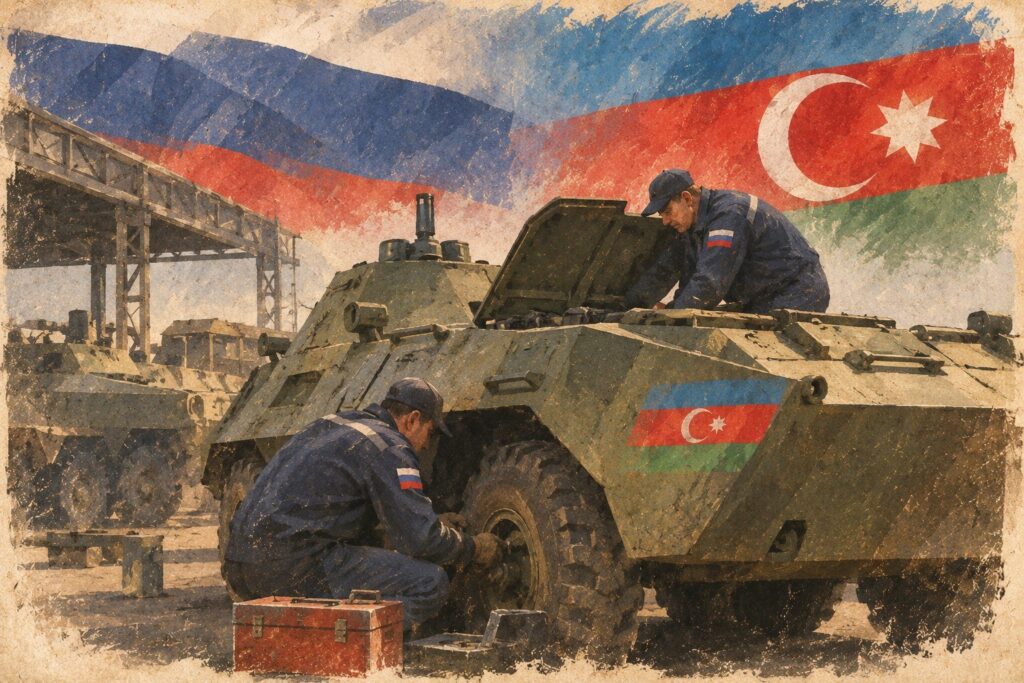
Russia–Azerbaijan Military Cooperation Expands Amid Baku–Ankara Tensions
Russia and Azerbaijan have signed a program to build and modernize facilities for repairing armored vehicles used by the Azerbaijani military. The agreement was announced on November 1, two days after the Organization of Turkic States (OTS) summit in Ankara, which Azerbaijani President Ilham Aliyev did not attend amid growing tensions with Turkey. "An entire program has been signed that provides for the modernization and construction of facilities to repair armored vehicles in service with the Azerbaijani army," Dmitry Shugayev, director of Russia’s Federal Service for Military-Technical Cooperation, told Zvezda television. Shugayev also mentioned the possibility of future deliveries of Pantsir-S1 air defense systems. Arms Supplies and the Karabakh Wars Russian defense companies have long supplied equipment to Azerbaijan’s armed forces. Azerbaijan has purchased T-90S tanks, BMP-3 infantry fighting vehicles, BTR-82A armored personnel carriers, artillery, and air defense systems. Maintaining this equipment requires spare parts, specialized facilities, and technical documentation. Russia supplied weapons to both sides of the Armenian-Azerbaijani conflict. According to the Stockholm International Peace Research Institute (SIPRI), Russian equipment accounted for approximately 60% of Azerbaijan’s imports of major weapons and 94% of Armenia’s between 2011 and 2020. Deliveries became more difficult after Russia launched its full-scale invasion of Ukraine. In December 2024, Aliyev spoke about delays in fulfilling existing contracts because Russian defense manufacturers were occupied with orders for their own armed forces. Baku nevertheless intended to continue purchasing Russian weapons. Weapons from other suppliers played a significant role in Azerbaijan’s military operations during the 2020 war. Turkey supplied Bayraktar TB2 armed drones as well as TRG-300 guided missiles. Israel provided Hermes drones and Harop loitering munitions, which are designed to crash into targets. It also supplied Spike anti-tank missiles, LORA (Long-Range Artillery) ballistic missiles, and Barak-8 air defense systems. Drones were used for reconnaissance and strikes against Armenian military equipment, artillery, and air defense positions. According to SIPRI, Israel accounted for approximately 69% of Azerbaijan’s imports of major weapons between 2016 and 2020. Military cooperation between Azerbaijan and Turkey expanded following Baku’s victory in the 2020 war. In September 2023, Azerbaijan established control over the entire territory of Nagorno-Karabakh. Following the military operation, almost the entire ethnic Armenian population of the region, approximately 100,000 people, fled to Armenia. In February 2024, Aliyev visited an airbase where Turkish-made Bayraktar Akıncı heavy combat drones were displayed. These aircraft can carry heavier weapons than the TB2. Why Baku and Ankara Are at Odds In October, a dispute erupted between Baku and Ankara over school uniform rules introduced in Azerbaijan in September. Restrictions on wearing hijabs drew criticism from Turkish politicians and public figures. Azerbaijani authorities regarded the criticism as interference in domestic affairs and barred 31 Turkish citizens from entering the country. In comments on X reported by The National on October 17, Vasif Huseynov of Azerbaijan’s state-run Center for Analysis of International Relations and Multiculturalism said the restrictions on religious clothing reflected Baku’s efforts to protect the state’s secular character and counter external ideological influence, particularly from Iran. In...
