• KZT/USD = 0.00216
  • TJS/USD = 0.10800
  • UZS/USD = 0.00009
  • TMT/USD = 0.29850
  • KZT/USD = 0.00216
  • TJS/USD = 0.10800
  • UZS/USD = 0.00009
  • TMT/USD = 0.29850
  • KZT/USD = 0.00216
  • TJS/USD = 0.10800
  • UZS/USD = 0.00009
  • TMT/USD = 0.29850
  • KZT/USD = 0.00216
  • TJS/USD = 0.10800
  • UZS/USD = 0.00009
  • TMT/USD = 0.29850
  • KZT/USD = 0.00216
  • TJS/USD = 0.10800
  • UZS/USD = 0.00009
  • TMT/USD = 0.29850
  • KZT/USD = 0.00216
  • TJS/USD = 0.10800
  • UZS/USD = 0.00009
  • TMT/USD = 0.29850
  • KZT/USD = 0.00216
  • TJS/USD = 0.10800
  • UZS/USD = 0.00009
  • TMT/USD = 0.29850
  • KZT/USD = 0.00216
  • TJS/USD = 0.10800
  • UZS/USD = 0.00009
  • TMT/USD = 0.29850
19 August 2026

Viewing results 1 - 6 of 2

Opinion: Tajikistan’s Digital Finance Boom Faces Its Next Challenge – Keeping Money Digital

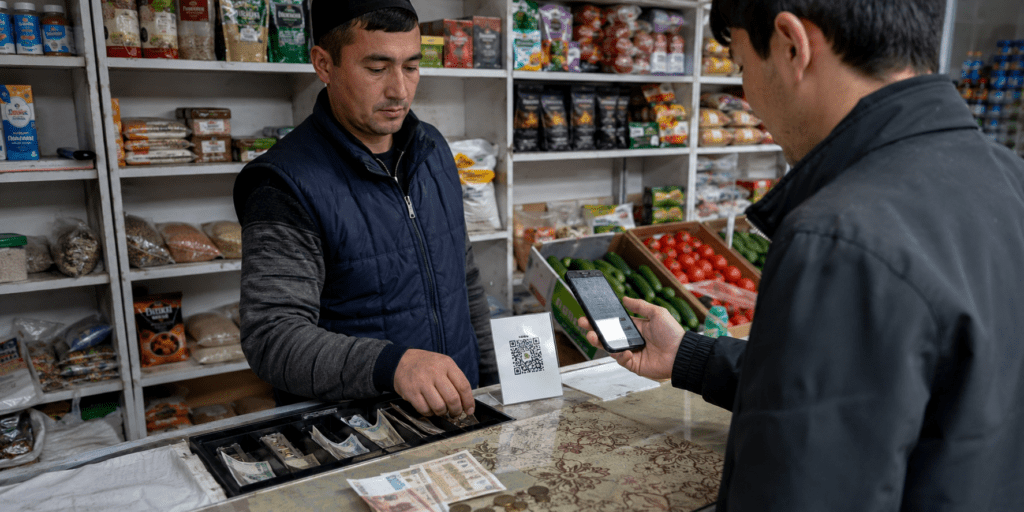
Tajikistan’s e-wallet numbers are striking. As of June 30, 2026, 28 credit financial institutions reported 19.8 million electronic wallets, up 25.9% from a year earlier. In the first half of 2026, e-wallets were used for 14.6 million non-cash transactions worth 3.6 billion somoni. But those figures should not be read as if 19.8 million people are actively using wallets. The National Bank of Tajikistan’s published aggregate data do not state how many wallets belong to unique users or how many are active. Nor do they show how usage is distributed among them. Without that denominator, the headline figure tells us much less about actual use. Tajikistan has clearly expanded digital access. It now needs a clearer picture of usage and stronger reasons for people and businesses to keep money inside the digital system. I call this the shift from digital access to digital retention. The headline number is 19.8 million wallets out of an official population of 10.721 million as of January 1, 2026. The more useful number would be how many are meaningfully active. Do Not Confuse Registration With Usage A registered wallet is an access point, not proof of financial behavior. One person may hold several wallets, and some may sit dormant. Usage may also be concentrated among a smaller group of frequent users. Without active-wallet and unique-user data, none of those possibilities should be assumed as fact. What we can say is that non-cash activity is growing. The National Bank reports that cashless payments for goods and services made with electronic payment instruments reached 41% in the first half of 2026, 13 percentage points higher than a year earlier. It also reports 9,425 POS terminals at trade and service points and 33,620 QR codes. That 41% figure covers electronic payment instruments, including bank cards and e-wallets. It is not an e-wallet usage rate. To understand how wallets are actually being used, Tajikistan needs a clearer view of active wallets, transaction frequency, and what happens to money after it enters a digital account. Trust Is Part of the Infrastructure For many people, the move from cash to bank cards was already a significant behavioral change. They learned to trust money represented by a balance on a screen rather than notes in a hand. Wallets, QR payments and app-based financial services require another layer of trust. Users need to know where their money is and whether a payment went through. They also need a clear route when something goes wrong. Fees should be easy to understand. This is why simplicity is part of financial trust, not merely user experience. Tajikistan’s Financial Literacy Program for 2026–2030 makes the same connection at a policy level. It links financial literacy and consumer protection with public confidence as digital financial services expand. A good digital-finance service should be usable by ordinary people without making money feel harder to understand. Users should not need fintech expertise to trust the product. Merchants Need a Reason Not to Cash Out Consumers are only one part of...

How Digital Public Services Are Changing Daily Life in Central Asia

Kazakhstan, Uzbekistan, and Kyrgyzstan have moved from queues at public service centers to passports in mobile apps in just a few years, compressing a transition that took many countries decades. Behind the impressive figures, however, are questions the region is still trying to answer. Not so long ago, obtaining a certificate in Central Asia meant a trip to a government office, a queue, and a stack of papers. Today, a resident of Almaty can renew a driver’s license by phone, an entrepreneur in Tashkent can register a company without leaving the office, and a doctor in Bishkek can issue an electronic sick leave certificate. The digitalization of public services has moved beyond strategic documents and become part of everyday life for tens of millions of people. The scale of change is reflected in international assessments. In the United Nations E-Government Development Index (EGDI) for 2024, Asia showed the fastest growth of any region. Kazakhstan, Uzbekistan, and Kyrgyzstan all improved their positions, each at its own pace, and each with its own model. Kazakhstan: From eGov to a Platform State Kazakhstan remains one of the region’s leaders in digital governance. In the 2024 EGDI ranking, the country rose to 24th place globally, ahead of a number of developed economies. Today, around 90% of more than 1,300 public services are available online, while the eGov.kz portal and eGov Mobile app offer access to a growing range of services. The figures speak for themselves. According to Kazakhstan’s e-government portal, citizens received more than 25.7 million services through eGov.kz in 2025, while the eGov Mobile audience exceeded 11.7 million users. The “Digital Documents” section is especially popular: the app provides access to 39 types of documents, from identity cards to driver’s licenses and student IDs. The expansion has continued. In 2025, Kazakhstan launched eGovBusiness, a single-window service for entrepreneurs that allows them to register companies, apply for subsidies, and check risks. The authorities have also moved to consolidate fragmented government apps into the unified eGov and Aitu platforms. The next frontier is artificial intelligence. In 2025, Kazakhstan established the Ministry of Artificial Intelligence and Digital Development. Through the National AI Platform, the country is developing sovereign infrastructure intended to support the use of generative AI in government and keep citizens’ data within national systems. Uzbekistan: The Fastest Leap Forward If Kazakhstan sets the regional benchmark, Uzbekistan has shown some of the fastest momentum. Over six years, the country climbed 24 positions in the EGDI ranking, from 87th place in 2018 to 63rd in 2024, and entered the category of countries with a “very high” level of e-government development for the first time. At the center of this transformation is the unified portal my.gov.uz, through which citizens and businesses access public services. More than 760 services are available on the platform, while the mobile app offers more than 540. In the first half of 2025 alone, more than 16 million services were provided through the system. The direction is set by the Digital Uzbekistan 2030...