• KGS/USD = 0.01144 0%
  • KZT/USD = 0.00205 0%
  • TJS/USD = 0.10729 0.37%
  • UZS/USD = 0.00008 0%
  • TMT/USD = 0.28490 0%
  • KGS/USD = 0.01144 0%
  • KZT/USD = 0.00205 0%
  • TJS/USD = 0.10729 0.37%
  • UZS/USD = 0.00008 0%
  • TMT/USD = 0.28490 0%
  • KGS/USD = 0.01144 0%
  • KZT/USD = 0.00205 0%
  • TJS/USD = 0.10729 0.37%
  • UZS/USD = 0.00008 0%
  • TMT/USD = 0.28490 0%
  • KGS/USD = 0.01144 0%
  • KZT/USD = 0.00205 0%
  • TJS/USD = 0.10729 0.37%
  • UZS/USD = 0.00008 0%
  • TMT/USD = 0.28490 0%
  • KGS/USD = 0.01144 0%
  • KZT/USD = 0.00205 0%
  • TJS/USD = 0.10729 0.37%
  • UZS/USD = 0.00008 0%
  • TMT/USD = 0.28490 0%
  • KGS/USD = 0.01144 0%
  • KZT/USD = 0.00205 0%
  • TJS/USD = 0.10729 0.37%
  • UZS/USD = 0.00008 0%
  • TMT/USD = 0.28490 0%
  • KGS/USD = 0.01144 0%
  • KZT/USD = 0.00205 0%
  • TJS/USD = 0.10729 0.37%
  • UZS/USD = 0.00008 0%
  • TMT/USD = 0.28490 0%
  • KGS/USD = 0.01144 0%
  • KZT/USD = 0.00205 0%
  • TJS/USD = 0.10729 0.37%
  • UZS/USD = 0.00008 0%
  • TMT/USD = 0.28490 0%

Viewing results 1 - 6 of 3

Uzbekistan Begins Construction of First Nuclear Power Plant

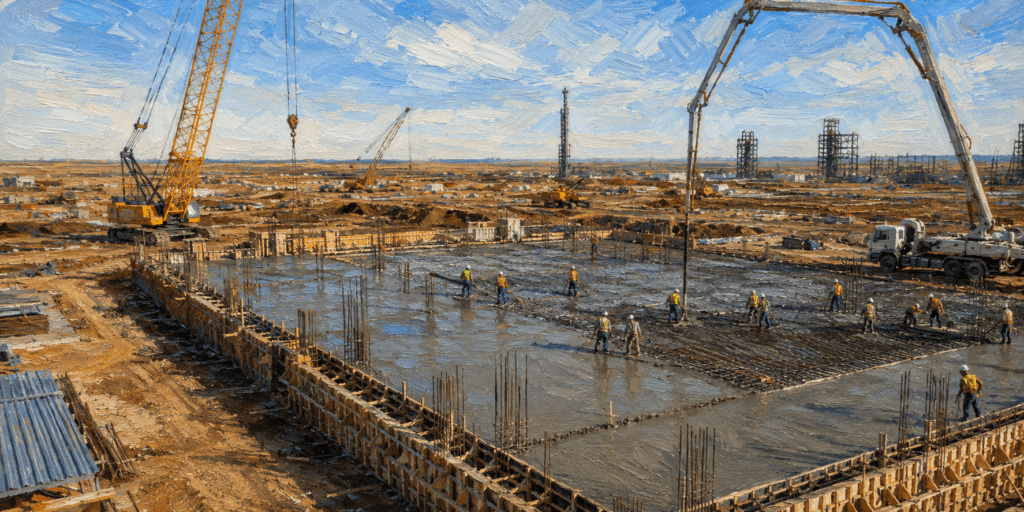
Uzbekistan has started building its first nuclear power plant, turning a project discussed for nearly a decade into one of the largest energy commitments in the country's post-Soviet history. President Shavkat Mirziyoyev and Russian President Vladimir Putin launched construction on June 4 by video link from Saint Petersburg. The plant site in the Forish district of the Jizzakh region was connected to the ceremony. Rafael Mariano Grossi, director general of the International Atomic Energy Agency, also took part. The first concrete pour began overnight from June 4 to June 5 for the foundation slab of the plant's first small modular unit. The first stage used 133 cubic meters of concrete. The full pour is expected to exceed 10,000 cubic meters. Uzatom gave the site the official status of a nuclear power plant under construction under IAEA standards. The plan is no longer the modest small-reactor scheme agreed in 2024. The current design combines two large VVER-1000 reactors with two smaller RITM-200N units. Together, they would give the Jizzakh plant more than 2.1 GW of installed capacity. The small and large units will share one site and supporting infrastructure. That shift raised both the scale and the financial and regulatory stakes. This design is the latest version of a plan that has changed several times. Uzbekistan and Russia signed an intergovernmental agreement on peaceful nuclear cooperation in 2017. In 2018, Rosatom was expected to build two VVER-1200 reactors. The focus later shifted to Jizzakh. In May 2024, Uzbekistan and Rosatom signed a contract for a 330 MW small nuclear plant with six RITM-200N reactors. The plan changed again in 2025, when Tashkent and Moscow settled on the larger mixed-reactor format now under construction. The timetable shows how long the project will take before Uzbekistan gets power from it. The first RITM-200N unit is listed for criticality in late 2029, with the two larger VVER-1000 reactors expected in 2033 and 2035. The push reflects Uzbekistan's fast-rising demand for power. The International Energy Agency says the country's 2020-2030 electricity concept aims to lift generation from 63.6 billion kWh to 120.8 billion kWh by 2030, while cutting gas use in power generation. Uzbekistan produced 86.7 billion kWh in 2025. Renewable power is growing, but officials want a steady baseload supply for industry and cities. Uzbek and Russian estimates put full annual output at about 17 billion kWh. Putin put the future share at up to 15% of Uzbekistan's electricity use, with Reuters also placing the expected contribution at around 15% of demand. Those figures depend on the timing of each unit and on future consumption, which is still rising. Financing is now one of the central questions. Uzatom director Azim Akhmedkhadjaev put the project's base price at $9.5 billion and described that figure as the maximum contract amount. The estimate does not include planned localization, which Uzbekistan wants to raise to 30%. Tashkent wants loans to cover 85-90% of the project and may discuss funding with the New Development Bank and other partners. Russia...

Kyrgyzstan Eyes Role in Trans-Caspian Green Power Route

Kyrgyzstan has signaled interest in taking part in the Central Asia-Azerbaijan Green Energy Corridor, a regional initiative aimed at expanding renewable electricity links across the Caspian region. The issue was discussed during a meeting between Azerbaijan’s Energy Minister Parviz Shahbazov and Kyrgyzstan’s Energy Minister Taalaibek Ibraev on the sidelines of Baku Energy Week on June 1. The ministers said the project would help integrate regional energy systems, strengthen energy security, and facilitate access to new markets for electricity generated from renewable sources. Ibraev said Kyrgyzstan’s hydropower potential and its role within the Unified Energy System of Central Asia made it a logical participant in the initiative. He added that Kyrgyzstan’s involvement would enhance the sustainability and reliability of green electricity supplies along the Caspian route. Kyrgyzstan currently faces seasonal electricity shortages and relies on imports to meet domestic demand. However, authorities expect the country to generate significant exportable surpluses once several large hydropower projects, including the long-delayed Kambarata-1 dam, are completed. The ministers also discussed fuel cooperation. The Kyrgyz side proposed increasing imports of Azerbaijani diesel as the country seeks alternatives amid rising prices for fuel traditionally supplied from Russia. The Central Asia-Azerbaijan Green Energy Corridor is one of several flagship projects aimed at strengthening energy connectivity between Central Asia, the South Caucasus, and European markets. Speaking at the Investment Forum on Energy Transition in Central Asia, held during Baku Energy Week and organized jointly by the International Renewable Energy Agency and Azerbaijan’s Energy Ministry, Shahbazov described the initiative as a key component of regional energy integration. According to Shahbazov, a strategic partnership agreement previously signed by Azerbaijan, Kazakhstan, and Uzbekistan laid the foundation for the development of a Trans-Caspian Energy Corridor. “The establishment of the strategically important Trans-Caspian energy corridor, which will interconnect the power systems of our countries, is fully aligned with the key priorities of this policy,” Shahbazov said. He added that the project could also strengthen the Middle Corridor by creating a green energy link connecting Europe with Asia and China via the Caspian Sea. Shahbazov said the feasibility study for the Caspian-Black Sea-Europe Green Energy Corridor is expected to be completed by July 2026, while the feasibility study for the Central Asia-Azerbaijan Green Energy Corridor is scheduled for completion in May 2027.

Kazakhstan Plans to Power New Alatau City With Gas and Renewable Energy

Kazakhstan plans to power the future megacity of Alatau City near Almaty through a combination of gas-fired generation and renewable sources, as authorities seek to address chronic electricity shortages in the country’s south while creating a low-carbon “smart city” model. Deputy Prime Minister Kanat Bozumbayev outlined the government’s energy strategy for the project during a briefing in Astana. According to him, Alatau City’s population could reach between 2.8 million and 3 million people by 2050, roughly equivalent to the current population of Almaty. “We expect that Alatau City will rely primarily on gas generation, given the area’s relatively low population density, along with renewable energy facilities,” Bozumbayev said. The new city is being developed on the site of the village of Zhetygen, approximately 50 kilometers from Almaty. The project will also encompass the settlements of Enbek, Zhanaarna and Kuigan, as well as parts of Konaev and the Talgar district in the Almaty Region. Authorities envision Alatau City as a future hub for technology companies, logistics and export-oriented industry. Under the current concept, the city will be divided into four functional districts: the financial and business-oriented Gate District, the educational and medical Golden District, the industrial Growing District, and the entertainment-focused Green District. The government expects rapid growth in both population and industrial activity to drive a sharp increase in electricity consumption. According to official estimates, electricity demand in Alatau City could reach 1.45 gigawatts by 2030 and rise further to 1.7 gigawatts by 2040. For comparison, Almaty’s electricity consumption in 2024 stood at approximately 982 megawatts. During the initial phase over the next three years, the city is expected to require around 50-100 megawatts of electricity. However, once industrial facilities become operational, demand could rise to between 500 and 1,000 megawatts, Bozumbayev said. Authorities have already prepared an infrastructure plan that includes the construction of transmission lines, substations, and new generating facilities. The government’s emphasis on gas-fired power generation is aimed at reducing southern Kazakhstan’s dependence on electricity transfers from northern Kazakhstan and neighboring countries. According to Bozumbayev, the launch of new power plants in Kyzylorda, Turkestan, and other southern regions should eventually create an electricity surplus in southern Kazakhstan, which currently remains energy deficient. The development of Alatau City is also part of Kazakhstan’s effort to modernize its power system and gradually increase the share of renewable energy in the national mix. In recent years, the country has expanded solar and wind power projects while remaining heavily dependent on coal-fired generation. Alongside energy infrastructure, authorities are promoting Alatau City as a testing ground for advanced transportation technologies. Bozumbayev said preliminary estimates suggest that air taxi rides in the city could cost around $1 per kilometer. “As competition develops in the market, prices could decrease,” the deputy prime minister said. He added that the testing of the air taxi system is expected to be completed by 2026, with commercial services potentially launching in 2027. However, Almaty Region Governor Marat Sultangaziev previously stated that full commercial operation of air taxi services...