• KZT/USD = 0.00223
  • TJS/USD = 0.10830
  • UZS/USD = 0.00009
  • TMT/USD = 0.29850
  • KZT/USD = 0.00223
  • TJS/USD = 0.10830
  • UZS/USD = 0.00009
  • TMT/USD = 0.29850
  • KZT/USD = 0.00223
  • TJS/USD = 0.10830
  • UZS/USD = 0.00009
  • TMT/USD = 0.29850
  • KZT/USD = 0.00223
  • TJS/USD = 0.10830
  • UZS/USD = 0.00009
  • TMT/USD = 0.29850
  • KZT/USD = 0.00223
  • TJS/USD = 0.10830
  • UZS/USD = 0.00009
  • TMT/USD = 0.29850
  • KZT/USD = 0.00223
  • TJS/USD = 0.10830
  • UZS/USD = 0.00009
  • TMT/USD = 0.29850
  • KZT/USD = 0.00223
  • TJS/USD = 0.10830
  • UZS/USD = 0.00009
  • TMT/USD = 0.29850
  • KZT/USD = 0.00223
  • TJS/USD = 0.10830
  • UZS/USD = 0.00009
  • TMT/USD = 0.29850
07 October 2026

Viewing results 1 - 6 of 438

The Turkic States Are Quietly Building a Geoeconomic Power Base

The Organization of Turkic States (OTS) has spent the past years assembling itself not through declarations or summit communiqués, but through shared transport and logistics, harmonized customs procedures, and coordinated capital flows. What began in 2009 as the Turkic Council, a lightly institutional and rhetorically cohesive forum for shared identity, has evolved, following its 2021 transformation into the OTS, into a logistical and regulatory organism. Its under-the-radar evolution has been systematized through agreed documents, deployed capital, and materialized infrastructure. The OTS has entered a phase of procedural coordination and structural intent. Its cooperation is now practical, strategic, and functionally embedded. This evolution has not followed a single arc, nor has it merely responded to outside pressures. Instead, it has progressed through an uneven sequence of internal adjustments, sometimes slow and technical, sometimes accelerated by external jolts such as the recent disruption in Azerbaijani–Russian relations. But such jolts only intensified a trajectory already underway. Member states had been converging long before this most recent bilateral crisis by aligning their policies, testing instruments, and developing the practical grammar of multilateral coordination. The current phase of renewed cooperation is not a reactive surge but a prepared transition that expresses an underlying structural shift in Eurasian geoeconomics at large. Digital Infrastructure and Networked Cooperation If there is a single domain where institutional convergence becomes immediately visible, this would be digital logistics. Once-fractured national processes — disjointed customs systems, mismatched permits, bureaucratic duplication — have begun to fold into a shared administrative architecture (including eTIR, eCMR, and ePermit) structured by international conventions that have been adapted to fit the particular alignments now emerging in the Turkic sphere. These procedures are no longer pilot projects but live systems. They digitize paperwork, synchronize border procedures, and build the kind of operational rhythms that trade corridors need in order to function. Negotiations continue, meanwhile, on a Free Trade in Services Agreement, targeted not at deregulation but at harmonization, viz., the alignment of technical and professional standards across a disparate set of economies. Kazakhstan and Azerbaijan, for example, are already piloting a Simplified Customs Corridor. Its eventual integration with the multimodal Uzbekistan–Türkiye axis is not a matter of if, but of how soon. Official observer states to the OTS are also beginning to move, with Hungary being the clearest case. Its $100 million injection into the Turkic Investment Fund made headlines, but the real story is downstream: Hungarian infrastructure now receives Azerbaijani gas via Türkiye. That is not diplomacy; that is energy dependence, structurally routed. Turkmenistan, long the holdout, has started to engage, first through planning meetings and now through signed agreements. Its ports, once idle in regional plans, are being fitted into the wider Caspian logistics network. The Turkish Republic of Northern Cyprus (TRNC), formally recognized only by Türkiye, is also a functional participant through educational exchanges, shared language, and soft institutions. Reciprocal Trade and Development The shift underway is as much geographic as it is institutional. Central Asia is no longer on the margins of the OTS...
Tajikistan’s Energy Paradox

Tajikistan stands out among developing countries for having achieved near-universal access to electricity by 2022. This milestone, documented in the international SDG7-2025 report by the UN, World Bank, WHO, IEA, and IRENA, places the country alongside Eastern European and South Caucasus states in electrification. However, beneath this achievement lie persistent vulnerabilities, particularly in rural and mountainous regions, where winter brings regular power outages due to seasonal dips in hydropower generation and surging demand. Firewood and Coal Still Dominant Despite near-total electrification, Tajikistan remains significantly behind in access to clean cooking fuels. Fewer than 40% of the population use modern, safe technologies. In villages, the majority of households still rely on coal, firewood, or even manure for heating and cooking, practices that pose serious environmental and health risks, especially for women and children. Tajikistan’s power sector is heavily dependent on hydropower, which accounts for over 90% of electricity production. While this results in low CO₂ emissions, it also creates structural vulnerabilities. Climate change and glacial retreat threaten the reliability of this single energy source. Meanwhile, the potential of solar and wind energy remains largely untapped due to a lack of investment, insufficient institutional frameworks, and limited support for decentralized energy projects. Lagging in Energy Efficiency Tajikistan is one of the most energy-intensive countries in the region. Aging heating systems, poorly insulated buildings, and inefficient technologies in agriculture and industry all contribute to this inefficiency. The SDG7 report emphasizes the need to upgrade buildings and adopt energy-saving technologies. Some progress has been made: with assistance from the European Bank for Reconstruction and Development (EBRD), thermal upgrades are underway in schools and hospitals. In 2021, Tajikistan received approximately $100 million in international support for energy projects, most of it allocated to hydropower. Major donors include the World Bank, the Asian Development Bank (ADB), and various UN agencies. However, investment in solar and wind energy, as well as broader energy efficiency initiatives, remains negligible. Experts are urging international partners to revise their priorities and fund projects that directly improve living standards, particularly in remote and rural areas. A Regional Disparity in Investment The pace of energy transition varies across Central Asia. While electrification is largely complete, access to clean cooking fuels remains uneven. Tajikistan and Kyrgyzstan are notably behind in this area. In contrast, Uzbekistan has emerged as a regional leader, securing the bulk of international energy investment. Uzbekistan, on the contrary, entered the top five world leaders in attracting investments in green energy. Globally, progress toward Sustainable Development Goal 7 (SDG 7) is slowing. As of 2022, 91% of the world’s population had access to electricity, but over two billion people still rely on harmful fuels for cooking. Energy efficiency improvements are lagging, advancing at just one-quarter of the pace needed to meet 2030 targets. Charting a Path Forward Experts recommend three immediate priorities for Tajikistan. First, scaling up decentralized solar and wind energy projects. Second, investing in the energy efficiency of buildings and infrastructure. Third, expanding access to clean cooking fuels through...

Tokayev: Kazakhstan Ready to Supply Oil, Gas, and Uranium to Slovakia

Kazakhstan is prepared to begin supplying hydrocarbons and nuclear raw materials to Slovakia, President Kassym-Jomart Tokayev announced following talks with Slovak Prime Minister Robert Fico in Astana. Speaking at a joint press briefing, Tokayev reaffirmed Kazakhstan’s commitment to strengthening ties with Slovakia across both bilateral and multilateral platforms, with particular emphasis on expanding economic cooperation. In 2024, trade between the two countries reached $140 million. According to Tokayev, new opportunities are emerging in sectors such as energy, industrial production, agriculture, logistics, digitalization, critical raw materials, education, and tourism. “Kazakhstan is ready to export oil, gas, uranium, food products, and other goods to Slovakia,” Tokayev said. According to Kazakhstan’s Ministry of Energy, the country exported 68.6 million tons of oil to foreign markets in 2024. This year, exports are projected to increase to 70.5 million tons. The bulk of these exports, 57.05 million tons, will be shipped via the Caspian Pipeline Consortium (CPC). Additional routes include the Atyrau-Samara pipeline (8.8 million tons), the Druzhba pipeline to Germany (1.2 million tons), and the Atasu-Alashankou route to China (1 million tons). Kazakhstan also plans to ship 3.6 million tons of oil through the port of Aktau, with 1.5 million tons continuing via the Baku-Tbilisi-Ceyhan pipeline. Following his meeting with Fico, Tokayev also highlighted potential cooperation in military-technical fields. The two leaders discussed leveraging the Trans-Caspian International Transport Corridor, which links China and Europe through Kazakhstan. “I invited our Slovak partners to participate in this project, which could open new horizons for bilateral trade,” Tokayev said. Prime Minister Fico expressed interest in deepening cooperation in both the oil and nuclear energy sectors. “We have five reactors, and a sixth will soon be operational. We’re also planning to purchase a 1.5 MW nuclear power plant. If our Kazakh colleagues are interested, we’re ready to cooperate,” Fico stated. He also noted discussions on utilizing the Druzhba pipeline corridor through Russia and Belarus to supply oil to Slovakia. Meanwhile, Kazakhstan is moving forward with plans for its first nuclear power plant. As previously reported by The Times of Central Asia, the country’s Atomic Energy Agency is expected to announce by the end of this month which foreign company will be awarded the construction contract.

Kazakhstan Second Only to Russia in CIS for Gasoline Purchasing Power

Kazakhstan ranks 36th out of 124 countries in a global gasoline affordability index based on average monthly earnings, according to recent data from Numbeo and analysis by Energyprom.kz. The study assesses how many liters of gasoline a person can buy with an average monthly salary and compares this indicator across the Commonwealth of Independent States (CIS) and globally. Kazakhstan Among CIS Leaders in Fuel Affordability According to the report, the average Kazakhstani can purchase approximately 1,100 liters of gasoline per month based on their salary. This places Kazakhstan second among CIS countries, trailing only Russia, where the average salary covers about 1,140 liters, ranking 34th worldwide. Belarus follows with 801.3 liters, then Azerbaijan (677.9 liters), Kyrgyzstan (483.9 liters), Moldova (476.6 liters), Uzbekistan (461.3 liters), Armenia (450.3 liters), Ukraine (341.4 liters), and Tajikistan (223.8 liters). Globally, Libya leads with a staggering 10,100 liters, followed by Kuwait (8,900 liters) and Qatar (6,600 liters). In contrast, Syria ranks last, where the average salary can buy just 22.1 liters. Cuba (28.5 liters) and Côte d'Ivoire (112.3 liters) also rank among the lowest. Global Gasoline Prices: Kazakhstan Remains Among the Most Affordable Kazakhstan is also one of the countries with the lowest fuel prices, around $0.50 per liter. Cheaper fuel is found in Libya ($0.03), Egypt and Algeria ($0.30), Kuwait ($0.40), and Malaysia ($0.50). By comparison, the most expensive gasoline is in Hong Kong at $3.10 per liter, followed by Iceland ($2.40), and Singapore, the Netherlands, and Switzerland (all around $2.20). Price Trends in Kazakhstan In April 2025, gasoline prices in Kazakhstan rose by 0.4% compared to the previous month and by 2.2% year-on-year. Prices for premium grades, AI-95/96 and AI-98, increased by 0.1% month-over-month, while AI-92 rose by 0.4%. On an annual basis, AI-92 increased by 1.8%, AI-98 by 3.2%, and AI-95/96 by 4.3%. The Zhambyl region saw the highest monthly increase at 1%, followed by the Abai and Turkestan regions and Shymkent (all at 0.8%). North Kazakhstan recorded the smallest increase (0.1%), while prices remained unchanged in Aktobe, Ulytau, and Almaty. The West Kazakhstan region saw a slight price decline of 0.1%. Year-on-year, the highest price growth was observed in West Kazakhstan (4.8%), Aktobe (4.1%), and Shymkent (3.1%). The most modest increases were recorded in Almaty (0.9%), Akmola (1.1%), and Zhetysu (1.7%). Production, Pricing, and Export Data In April 2025, the average price per liter of AI-92 was 205 KZT ($0.40), AI-95/96 stood at 264 KZT ($0.52), and AI-98 at 299 KZT ($0.59). The highest AI-92 prices were in Petropavlovsk ($0.41), and the lowest in Atyrau ($0.38). Taldykorgan had the most expensive AI-95/96 ($0.54), while Atyrau offered the lowest ($0.48). AI-98 was priciest in Almaty ($0.62) and cheapest in Aktobe ($0.56). In the first two months of 2025, domestic producers met 99.99% of the nation’s gasoline demand. Kazakhstan produced 1.1 million tons of gasoline, a 20.8% year-on-year increase. Imports totaled only 101.8 tons, down 8.1%. The country exported 6,700 tons of gasoline during this period, all to Uzbekistan. Supplies to the domestic market...

Kazakhstan Faces Record Power Deficit as Electricity Shortfall Hits 2.4 Billion kWh

Kazakhstan has experienced its most significant electricity imbalance in recent years. According to data from Energyprom.kz, the gap between electricity production and consumption reached 2.4 billion kilowatt-hours (kWh) in 2024, an increase of 200 million kWh from 2023, when the shortfall stood at 2.2 billion kWh. While the country’s total generation amounted to 117.9 billion kWh, domestic consumption exceeded 120.4 billion kWh. Imports Offset Domestic Shortfalls To address this growing energy deficit, Kazakhstan primarily imports electricity from Russia. Smaller volumes are supplied by Kyrgyzstan, although these are typically part of Russian transit deliveries to Kyrgyz consumers. Despite these imports, domestic electricity generation continues to grow at a modest pace. In 2024, total generation rose by 4.2%, with a 3% year-on-year increase recorded in the first two months of 2025. Nevertheless, the production boost has not been sufficient to meet demand, necessitating continued reliance on external suppliers. Decline in Coal Dependence One notable trend is the gradual reduction in Kazakhstan’s dependence on coal-fired thermal power plants (TPPs), traditionally among the most polluting energy sources. In 2024, the share of coal-fired generation declined from 77.4% to 74.9%, equivalent to approximately 88.4 billion kWh of total output. In contrast, the share of alternative power sources increased. Hydroelectric power plants (HPPs) contributed 9.5% of total generation, up 1.8 percentage points year-on-year, while gas turbine power plants (GTPPs) accounted for 10.1%, a 0.3-point increase. Renewable energy sources, including wind, solar, and biogas, produced 6.4 billion kWh, representing 5.4% of total electricity output. Revised Forecasts and Growing Challenges The Ministry of Energy of the Republic of Kazakhstan has updated its projections to reflect the sector’s challenges. As of early 2025, officials estimate the country’s electricity deficit could grow to 5.7 billion kWh by year-end. This revision stems from downgraded forecasts for generation volumes, which are now projected at 117.1 billion kWh, down from an earlier estimate of 121.8 billion kWh. Expectations for the commissioning of new generation capacity have also been lowered, further exacerbating the shortfall. Nonetheless, government planners remain cautiously optimistic. If several large-scale energy projects move forward on schedule, the deficit could shrink to 2.6 billion kWh by the end of 2026. A full build-out of planned capacity could even lead to a surplus. New Capacity and Long-Term Plans The government has outlined plans to construct 59 new energy facilities with a combined capacity of 26.4 gigawatts (GW). These include both new builds and upgrades to existing plants. Major initiatives involve constructing a nuclear power plant (2.4 GW) and a third state district power station (GRES-3) with 2.6 GW of capacity. Additionally, 11 regional centers are set to receive combined-cycle gas turbines with a total capacity of 4.5 GW. Renewable energy is also a key focus. By 2029, Kazakhstan aims to commission four large wind power plants equipped with energy storage systems, totaling 3.8 GW in capacity. These projects are being developed through intergovernmental agreements with investors from the United Arab Emirates, France, and China.

Turkish Company Reaffirms Commitment to Kyrgyzstan’s Energy Projects

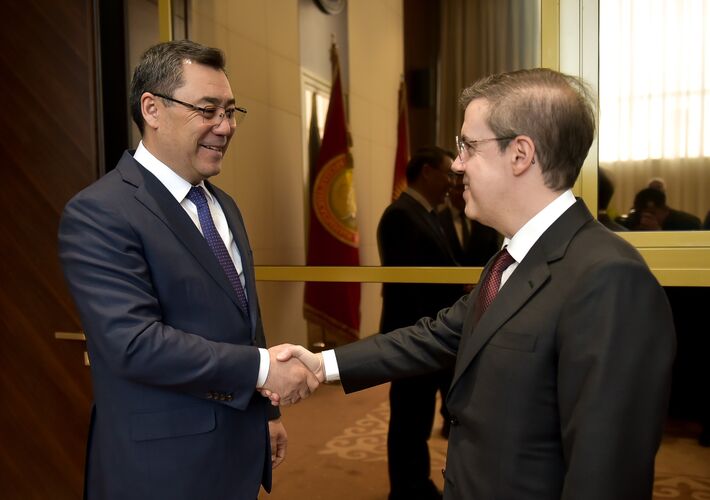
At a meeting on April 16 with Kyrgyz President Sadyr Japarov in Bishkek, Ahmet Mücahid Ören, Chairman of the Board of Directors of Turkey’s İhlas Holding, reaffirmed his company’s commitment to implementing two major energy projects in Kyrgyzstan: the construction of the Kazarman cascade of hydroelectric power plants (HPPs) on the Naryn River, and a 250 MW natural gas-fired combined heat and power plant (CHPP-2) in Bishkek. İhlas Holding has previously established an open joint-stock company, Orta Asya Investment Holding (Central Asian Investment Holding), to facilitate its operations in Kyrgyzstan. “We consider these projects in the fields of hydropower and thermal power generation as strategically important and a priority. We are confident that their implementation will serve as the basis for the sustainable development of the country's energy sector and create conditions for subsequent investment initiatives,” Ören stated, according to the Kyrgyz president’s press service. Japarov noted that preliminary research has been completed at the construction sites for the Kazarman cascade in the Jalal-Abad region. The studies were conducted by Central Asian Investment Holding in cooperation with the Kyrgyzhydroproject Institute. In February 2025, Kyrgyzstan’s Ministry of Energy and Central Asian Investment Holding signed a protocol of intent to build the Kazarman cascade, which will have a total capacity of 912 MW. The Turkish company has committed to constructing three hydropower plants as part of the project: Ala-Buga HPP – 600 MW Kara-Bulun-1 HPP – 149 MW Kara-Bulun-2 HPP – 163 MW Combined, these plants are expected to generate 3.746 billion kWh of electricity annually, significantly bolstering Kyrgyzstan’s power supply. The meeting also addressed the construction of a second thermal power plant in Bishkek. Japarov emphasized that once operational in 2028, the new 250 MW natural gas-fired CHPP-2 will improve not only the capital’s heating and electricity supply but also its environmental conditions. The new facility aims to reduce reliance on the city’s aging coal-fired Thermal Power Plant, which currently serves as the primary source of electricity and heating. Once completed, CHPP-2 is expected to meet Bishkek’s growing heating demands and reduce the risk of energy shortages.