• KGS/USD = 0.01144 0%
  • KZT/USD = 0.00205 0%
  • TJS/USD = 0.10782 0%
  • UZS/USD = 0.00008 0%
  • TMT/USD = 0.28490 0%
  • KGS/USD = 0.01144 0%
  • KZT/USD = 0.00205 0%
  • TJS/USD = 0.10782 0%
  • UZS/USD = 0.00008 0%
  • TMT/USD = 0.28490 0%
  • KGS/USD = 0.01144 0%
  • KZT/USD = 0.00205 0%
  • TJS/USD = 0.10782 0%
  • UZS/USD = 0.00008 0%
  • TMT/USD = 0.28490 0%
  • KGS/USD = 0.01144 0%
  • KZT/USD = 0.00205 0%
  • TJS/USD = 0.10782 0%
  • UZS/USD = 0.00008 0%
  • TMT/USD = 0.28490 0%
  • KGS/USD = 0.01144 0%
  • KZT/USD = 0.00205 0%
  • TJS/USD = 0.10782 0%
  • UZS/USD = 0.00008 0%
  • TMT/USD = 0.28490 0%
  • KGS/USD = 0.01144 0%
  • KZT/USD = 0.00205 0%
  • TJS/USD = 0.10782 0%
  • UZS/USD = 0.00008 0%
  • TMT/USD = 0.28490 0%
  • KGS/USD = 0.01144 0%
  • KZT/USD = 0.00205 0%
  • TJS/USD = 0.10782 0%
  • UZS/USD = 0.00008 0%
  • TMT/USD = 0.28490 0%
  • KGS/USD = 0.01144 0%
  • KZT/USD = 0.00205 0%
  • TJS/USD = 0.10782 0%
  • UZS/USD = 0.00008 0%
  • TMT/USD = 0.28490 0%

Viewing results 1 - 6 of 4

Tokayev Proposes Employing Top Foreign Graduates in Kazakhstan

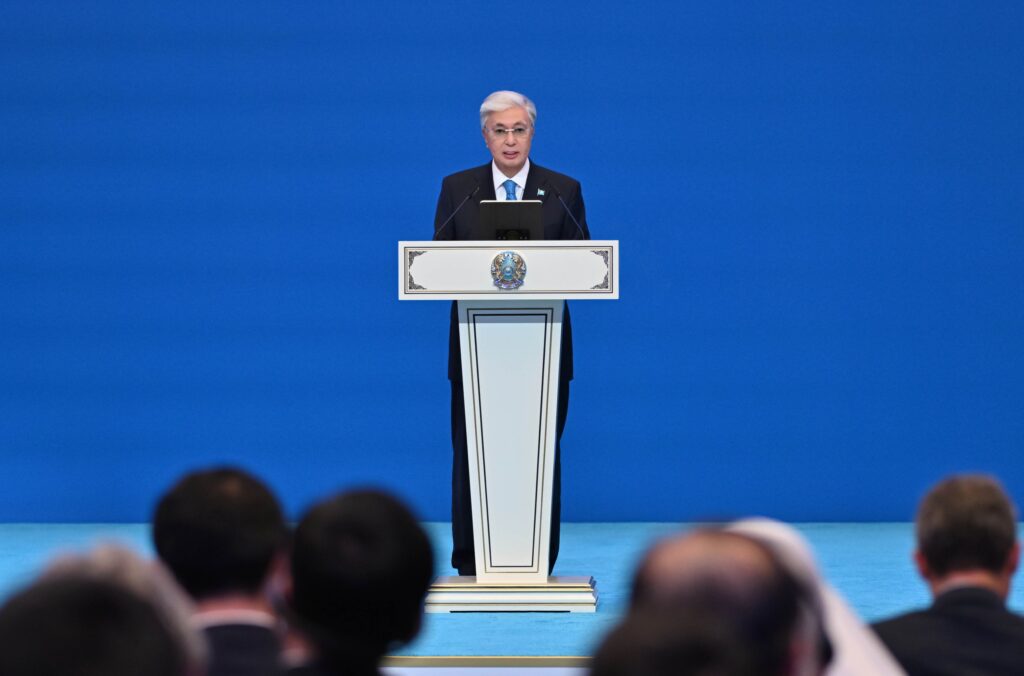
President Kassym-Jomart Tokayev has proposed launching a program to employ the most talented foreign graduates of Kazakh universities, allowing them to begin their professional careers within the country. He announced the initiative during the Strategic Partners Forum, Kazakhstan - Territory of Academic Education. According to Tokayev, over 31,000 foreign students are currently studying at Kazakh universities, a national record. The government aims to increase this figure to 100,000 by 2029 through visa liberalization and improved learning conditions. The employment program will enable top-performing international graduates to stay in Kazakhstan, contributing to the national economy. Simultaneously, the country plans to expand the number of foreign university branches in Kazakhstan, with a particular focus on technical disciplines. “The opening of branches of foreign universities is fully in line with our goal of developing engineering and IT education,” Tokayev said. Kazakhstan currently hosts three Lu Ban workshops, which serve as centers for applied engineering training. Special emphasis is being placed on preparing skilled personnel for the nuclear energy sector. “Our task is to ensure a direct link between education and science and the real sector of the economy. There are already successful examples: the partnership between Kozybayev University and the University of Arizona has led to the development of a technology to convert sulfur into innovative polymers. This is a vital project for our country, which has significant sulfur reserves. It will spur growth in the chemical industry and contribute to solving environmental challenges,” Tokayev noted. Since 2019, Kazakhstan has tripled its investment in education and science. Five Kazakh universities have been included in the Times Higher Education global rankings, and higher education institutions now enjoy greater autonomy. Tokayev emphasized that investment in education is an investment in Kazakhstan’s future. He said the country sees the demographic potential of Central Asia and neighboring regions as an opportunity to grow its higher education sector and attract international students. “Kazakhstan has set itself the ambitious goal of becoming part of the global knowledge market. To this end, we have partnered with 40 leading universities worldwide and opened 33 foreign university branches. Many of these institutions offer courses in English, Russian, and Chinese. Multilingualism is the key to openness and competitiveness for both universities and nations,” he said. To help foreign students better understand local culture, all foreign university branches are required to offer mandatory courses in the Kazakh language and the history of Kazakhstan. Tokayev also named digital state development and the integration of artificial intelligence (AI) technologies among the country's top priorities. He noted that by 2030, AI is projected to contribute over $15 trillion to global GDP, and Kazakhstan intends to play an active role in this transformation. “Since the beginning of the year, we have launched the AI-Sana program, completed by more than 540,000 students. Courses on artificial intelligence have become mandatory in all schools and universities. An AI university is currently in development,” Tokayev said. He cited agreements reached with OpenAI during his September visit to the United States, under which...

Central Asian Students Face Uncertainty at U.S. Universities Under Trump Administration Policies

The situation for students from Central Asia studying in the United States has grown increasingly precarious following a controversial move by the Trump administration to restrict foreign student admissions at Harvard University, a decision that has sparked legal and diplomatic reactions. Administrative Ban Targets Foreign Students On May 23, U.S. Secretary of Homeland Security Kirstjen Nielsen ordered the termination of Harvard University's certification for its student and exchange visitor program. The Department of Homeland Security (DHS) cited Harvard’s alleged refusal to submit records on the conduct of its foreign students, requested the previous month. “Harvard can no longer accept foreign students, and existing foreign students must transfer or lose their legal status,” the DHS said in a statement. The university is currently challenging the decision in court. The administration attributes the crackdown to ideological concerns. Officials have cited a determination to confront anti-Semitic rhetoric amid campus protests related to the war between Israel and Hamas. They also oppose Diversity, Equity, and Inclusion (DEI) initiatives, which the administration has condemned as “illegal and immoral discrimination.” Harvard representatives reported that 6,793 international students were enrolled in the 2024-2025 academic year, comprising 27.2% of the student body. The loss of international students, they argue, could jeopardize not only Harvard’s standing but also the broader U.S. academic landscape. Beyond Harvard, the administration has intensified scrutiny of foreign students' social media activity, suspended hundreds of millions of dollars in funding to universities, revoked thousands of student visas, and initiated deportations. In response, Harvard filed a lawsuit, and on May 30, a federal court in Boston temporarily blocked the enforcement of the ban, according to Bloomberg. Nonetheless, the outlook remains uncertain. Kazakhstan Responds with Contingency Planning According to Kazakhstan’s Ministry of Science and Higher Education, seven students are currently studying at Harvard under the state-funded Bolashak program. Additional students may be enrolled privately or through other sponsorships. Minister of Science and Higher Education Sayasat Nurbek described the situation as "difficult" and stated that the ministry is awaiting the final court decision. In the event of an unfavorable outcome, Bolashak students would be offered transfer opportunities to other Ivy League institutions, all of which maintain partnerships with the scholarship program. Bolashak Program: Opportunity and Criticism Founded in 1993, the Bolashak (Future) program offers state-funded scholarships for international education in priority sectors of Kazakhstan’s economy. In return, graduates are required to work in Kazakhstan for a specified period. Despite its aims, the program has faced criticism for alleged elitism. Critics claim it disproportionately benefits children of influential families and that many graduates fail to fulfill their service obligations or remain abroad. Among its alumni is former Minister of National Economy Kuandyk Bishimbayev, who was educated in the U.S. under Bolashak and later served as chairman of the Bolashak Association. He was subsequently convicted twice, first for corruption, and later for the murder of his common-law wife, Saltanat Nukenova, in a case that attracted international attention. Nevertheless, official statistics indicate that more than 13,000 individuals have benefited from the...