
• KGS/USD = 0.01144 0%
  • KZT/USD = 0.00191 0%
  • TJS/USD = 0.10850 0%
  • UZS/USD = 0.00008 0%
  • TMT/USD = 0.28490 0%
  • KGS/USD = 0.01144 0%
  • KZT/USD = 0.00191 0%
  • TJS/USD = 0.10850 0%
  • UZS/USD = 0.00008 0%
  • TMT/USD = 0.28490 0%
  • KGS/USD = 0.01144 0%
  • KZT/USD = 0.00191 0%
  • TJS/USD = 0.10850 0%
  • UZS/USD = 0.00008 0%
  • TMT/USD = 0.28490 0%
  • KGS/USD = 0.01144 0%
  • KZT/USD = 0.00191 0%
  • TJS/USD = 0.10850 0%
  • UZS/USD = 0.00008 0%
  • TMT/USD = 0.28490 0%
  • KGS/USD = 0.01144 0%
  • KZT/USD = 0.00191 0%
  • TJS/USD = 0.10850 0%
  • UZS/USD = 0.00008 0%
  • TMT/USD = 0.28490 0%
  • KGS/USD = 0.01144 0%
  • KZT/USD = 0.00191 0%
  • TJS/USD = 0.10850 0%
  • UZS/USD = 0.00008 0%
  • TMT/USD = 0.28490 0%
  • KGS/USD = 0.01144 0%
  • KZT/USD = 0.00191 0%
  • TJS/USD = 0.10850 0%
  • UZS/USD = 0.00008 0%
  • TMT/USD = 0.28490 0%
  • KGS/USD = 0.01144 0%
  • KZT/USD = 0.00191 0%
  • TJS/USD = 0.10850 0%
  • UZS/USD = 0.00008 0%
  • TMT/USD = 0.28490 0%
10 November 2025

Viewing results 1 - 6 of 9

Opinion: The Twelfth Summit of the Organization of Turkic States – A Turning Point for Regional Peace and Integration

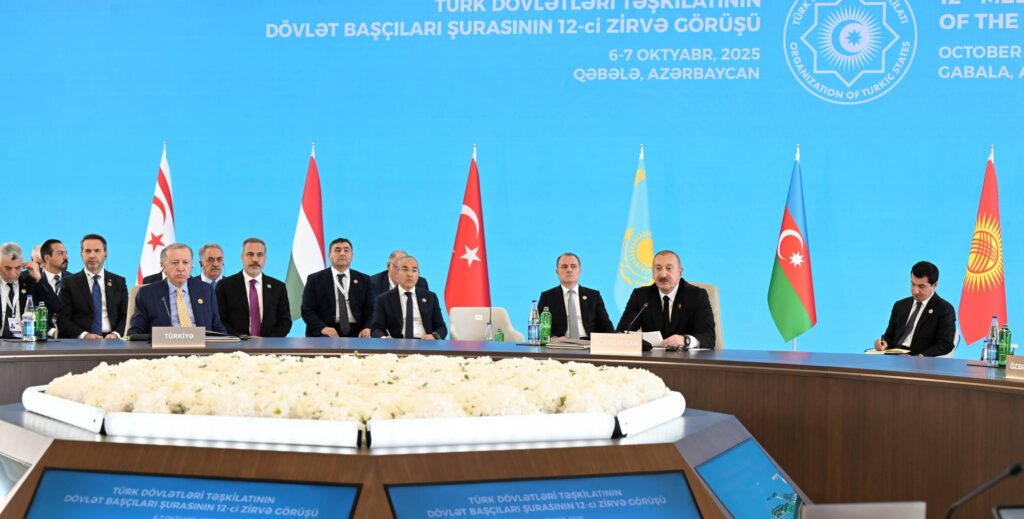
The Twelfth Summit of the Organization of Turkic States (OTS) was held on October 6–7, 2025, in Gabala, Azerbaijan, under the theme “Regional Peace and Security,” and was hosted by the President of the Republic of Azerbaijan, Ilham Aliyev. Attending the summit were Kassym-Jomart Tokayev, President of the Republic of Kazakhstan; Sadyr Japarov, President of the Kyrgyz Republic; Recep Tayyip Erdoğan, President of the Republic of Turkey; Shavkat Mirziyoyev, President of the Republic of Uzbekistan; and Viktor Orbán, Prime Minister of Hungary, participating as an observer. Turkmenistan, represented by Gurbanguly Berdimuhamedov, and the Turkish Republic of Northern Cyprus, represented by Ersin Tatar, also attended the summit as observer members. Among the central topics discussed was support for the Joint Declaration signed between Azerbaijan and Armenia on August 8, 2025, in Washington, D.C. The OTS member states regard this declaration as an important step toward lasting peace and stability in the South Caucasus. The summit also emphasized the need for a collective Turkic effort to sustain peace in the region. In his address, President Aliyev noted that one of the outcomes of the Washington Summit was progress on the Zangezur Corridor, describing it as a new transportation route of great importance within both the Middle Corridor and the North–South Corridor. Speaking before the 80th session of the United Nations General Assembly, Armenian Prime Minister Nikol Pashinyan had countered the use of the term “Zangezur Corridor,” which does not appear in the signed documents and was never used in negotiations. Despite these objections, however, Aliyev again used the term at the OTS Summit, reaffirming his intention to move forward under that framework. The New York meeting on September 22, 2025, between the foreign ministers of Azerbaijan and Armenia, where both sides agreed to continue dialogue based on the outcomes of the Washington Declaration, has been widely considered a constructive step toward normalization of relations between the two parties. Another highlight of the summit was President Erdoğan’s call to develop the ‘Turkish Large Language Model.’ “To catch up with global developments in artificial intelligence and to preserve our cultural richness, we need to accelerate the development of the Turkish Large Language Model,” Erdoğan said. “[In] Türkiye, we are taking the first step on the common alphabet issue by printing a work about Chingiz Aitmatov and the Oghuznames in the common alphabet. Today, we are also presenting a copy of this to the leaders.” The initiative reflects the vision for greater cultural, scientific, and digital integration among Turkic states, and it was included as part of the broader digital transformation and innovation agenda outlined in the Gabala Declaration, which followed the summit. Kazakh President Tokayev described the Organization of Turkic States as an “authoritative structure uniting friendly Turkic peoples,” capable of addressing shared challenges, and expressed support for establishing an “OTS+” format to expand cooperation and global visibility. President Aliyev, meanwhile, highlighted growing military collaboration between Azerbaijan and Turkey, referencing more than 25 joint exercises held within one year - although this figure has...

Leaders of Turkic States Meet in Azerbaijan

The 12th Summit of the Heads of State of the Organization of Turkic States (OTS) convened in Gabala, Azerbaijan, bringing together leaders from Azerbaijan, Kazakhstan, Kyrgyzstan, Turkey, Uzbekistan, Hungary, Turkmenistan, and the Turkish Republic of Northern Cyprus. Discussions focused on regional stability, economic integration, and strengthening fraternal ties among Turkic nations. Aliyev: The OTS Is Becoming a Major Geopolitical Center Opening the summit, Azerbajani President Ilham Aliyev welcomed participants to Gabala and thanked Kyrgyzstan for its prior chairmanship. “Today, the Organization of Turkic States is not merely a platform for cooperation; it is forming as one of the serious geopolitical centers,” Aliyev said. He announced Azerbaijan’s $2 million contribution to support OTS activities and emphasized shared historical roots and cultural values across Turkic nations. Addressing peace and security, Aliyev added, “In light of modern geopolitical challenges, it is crucial that Turkic states act as a unified center of power,” and proposed hosting joint military exercises of OTS member states in 2026. South Caucasus Peace and Economic Connectivity Aliyev highlighted the recent peace agreement initialed between Azerbaijan and Armenia in Washington as a breakthrough for the South Caucasus: “This will turn the region into a space of peace.” He also noted Azerbaijan’s growing role in regional logistics: “Since 2022, cargo volumes along the Middle Corridor have increased by nearly 90%. Our Caspian fleet, the Alat Port, the Baku-Tbilisi-Kars railway, and nine international airports have made Azerbaijan a leading transport hub.” He stressed the importance of the Zangezur Corridor, intended to connect Azerbaijan with Nakhchivan and Central Asia, and cited Azerbaijan’s energy diversification, exporting natural gas to 14 countries and a projected 40% share of renewables in its energy mix by 2030. Unity and Vision from the Turkic Leaders Kyrgyz President Sadyr Japarov praised the summit location and the symbolic timing: “Gabala is an ancient city with a 2,000-year history, and it is no coincidence we gathered here.” He called the joint peace declaration with Armenia a historic step toward trust in the South Caucasus. Kazakh President Kassym-Jomart Tokayev echoed support: “This historic document has ended a conflict that had remained unresolved for more than 30 years.” He quoted poet Bakhtiyar Vagabzade: “A Turk has no right to be hostile to another Turk.” Turkish President Recep Tayyip Erdoğan called for developing a “Common Turkic Language Model” to protect cultural heritage and advance artificial intelligence research. “We once again demonstrate that the Turkic states, driven by solidarity, mutual respect, and brotherhood, are confidently looking to the future,” he said. Uzbek President Shavkat Mirziyoyev credited Aliyev’s leadership: “This peace declaration became possible thanks to your political will and is a common achievement of the Turkic world.” Turkmenistan and Hungary on Brotherhood and Energy Gurbanguly Berdimuhamedov, Chairman of Turkmenistan’s Halk Maslahaty, described the OTS as a unifying platform for brotherly nations with shared culture and language, committed to promoting cooperation at regional and international levels. Hungarian Prime Minister Viktor Orbán underscored Azerbaijan’s value to Europe: “Your incredible achievements, economic development, and investments in renewable energy...

Gabala 2025: What the Turkic World Will Discuss Amid Global Turbulence

On October 7, leaders of the Organization of Turkic States (OTS) will gather in Gabala, Azerbaijan, for the 12th summit under the theme “Regional Peace and Security.” At first glance, it may look like another routine engagement. Yet against the backdrop of overlapping global crises, the forum is increasingly a test of the OTS’s maturity and relevance. The summit unfolds amid a turbulent international landscape. Afghanistan continues to cast a shadow over Central Asia: economic volatility, migration risks, and the activity of extremist groups remain sources of concern for OTS members. The ongoing war in Ukraine, meanwhile, is reshaping Eurasian transit routes, placing the bloc’s states in delicate positions between East and West. At the same time, violence in the Middle East is adding to the pressures on Turkey’s already complex foreign policy environment. The Middle Corridor at the Center A key theme in Gabala will be the advancement of the Middle Corridor, formally known as the Trans-Caspian International Transport Route. This east–west route connects China with Europe via Kazakhstan, the Caspian ports of Aktau and Kuryk, Azerbaijan, Georgia, and Turkey. Investments are moving forward across the chain: Kazakhstan is expanding port and rail capacity, Azerbaijan is modernizing the Port of Baku in Alat, Georgia is upgrading its railway hubs, and Turkey is reinforcing the Baku–Kars line. Once a logistical project, the corridor is evolving into a strategic framework that ties together economic, environmental, and security considerations. Customs harmonization, digital tracking systems, and sustainability standards are now discussed as much as cargo volumes. Security, Coordination, and Soft Power Security will also be on the table, though framed in practical rather than military terms. Issues such as counter-terrorism cooperation, cyber resilience, disaster response, and the safety of emerging transit corridors are likely to feature. In this sense, security is increasingly seen as the foundation for trade and investment rather than a standalone agenda. Beyond infrastructure, OTS continues to develop soft power tools. Educational exchanges, cultural cooperation, green energy initiatives, and water management projects are part of efforts to build intra-regional trust. The recently inaugurated UN Regional Center for the SDGs in Almaty provides another anchor, aligning the Turkic bloc with global sustainability frameworks. A Turning Point for the Turkic Council? Founded in 2009 primarily as a cultural and humanitarian forum, the OTS is now edging toward a broader role. By coordinating infrastructure projects, harmonizing regulations, and cautiously addressing security concerns, it is positioning itself as a relevant player in Eurasian affairs. Much will depend on whether Gabala produces more than communiqués. Concrete steps on the Middle Corridor, digital customs corridors, joint water initiatives, or disaster coordination could demonstrate that the OTS is maturing into a platform for practical solutions. While major breakthroughs are unlikely, even incremental progress would signal that the Turkic Council is becoming a pillar of regional stability and integration.
