


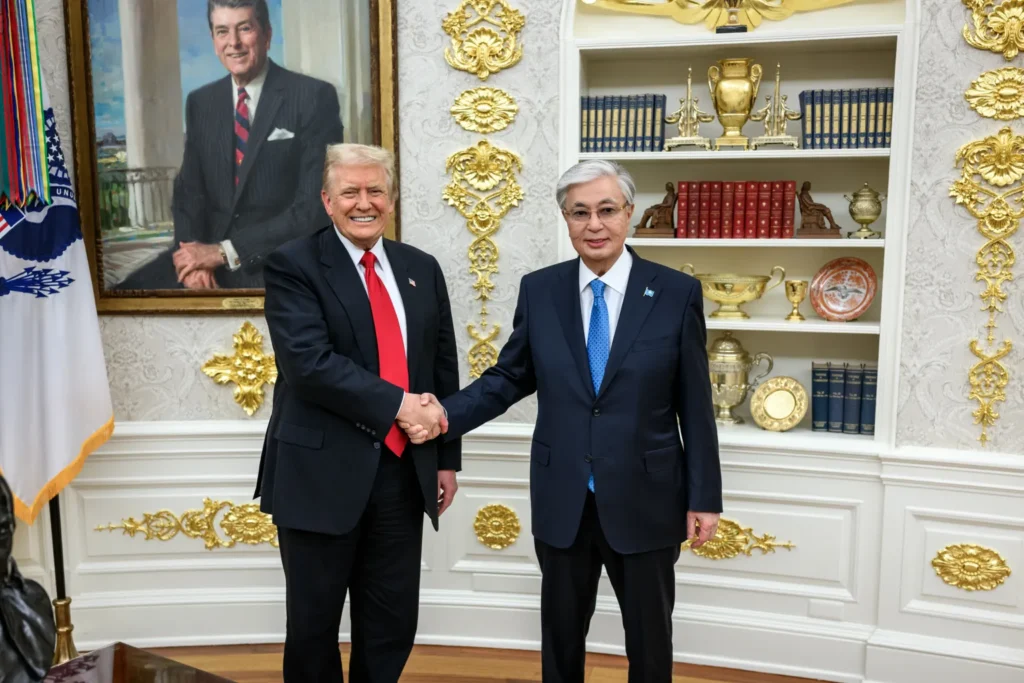
Tokayev Aligns Kazakhstan With Trump’s Board of Peace Initiative
Kazakh President Kassym-Jomart Tokayev has agreed to join a new international body initiated by U.S. President Donald Trump that is intended to address post-war governance and reconstruction in Gaza, with the possibility of later expanding its remit to other global conflicts. Tokayev’s press secretary, Ruslan Zheldibay, said President Tokayev has accepted Trump’s invitation and sent a letter expressing his readiness to participate. The “Board of Peace” is a structure initiated by Trump as part of his broader Middle East agenda. Draft documents outline a body that would coordinate political oversight, reconstruction funding, and security arrangements in Gaza following the current conflict. They describe Trump as chair of the board on a permanent basis and outline different membership terms for participating states. Kazakhstan was invited as an early participant and is expected to be among the first countries to formally join. The decision aligns with Kazakhstan’s long-standing foreign policy approach, which emphasizes engagement with major powers and participation in multilateral diplomatic initiatives. Astana has previously hosted negotiations on regional security issues and has sought a visible role in international conflict mediation. The Board of Peace emerged from a U.S.-backed plan announced in late 2025 to stabilize Gaza following months of war. The plan was presented as a mechanism to oversee reconstruction and governance while preventing renewed conflict. Invitations to join the board were sent to roughly 60 countries, spanning Europe, Asia, the Middle East, and Africa. A draft charter reviewed by several governments sets out a tiered membership structure. Countries may serve on the board for an initial three-year term without a financial contribution. Longer participation is tied to a $1 billion payment to a central fund within the first year of the charter’s entry into force. The funding clause links longer participation to large upfront contributions, although U.S. officials have disputed that the payment would be mandatory in practice. The board’s initial focus is Gaza, but the charter allows for expansion to other conflicts if members agree. The documents describe responsibilities that include oversight of reconstruction projects, coordination with regional actors, and engagement with international financial institutions. The charter does not grant the board enforcement powers, leaving its authority dependent on political support from participating states. Kazakhstan’s participation follows earlier expressions of support for Trump’s Gaza initiative. In October 2025, Tokayev welcomed the U.S. peace plan as a potential step toward restoring stability and rebuilding trust among states involved in the conflict. The move places Kazakhstan alongside a diverse group of invited countries. Russia has confirmed receipt of an invitation for President Vladimir Putin to join the board, and Moscow has said it is examining the proposal and seeking clarification through diplomatic channels. Several other governments have acknowledged invitations, while responses have varied. Some countries have indicated interest in participation, while others have expressed reservations about the board’s structure and its relationship to existing international institutions. Concerns have focused on governance, accountability, and the potential overlap with United Nations-led mechanisms for peacekeeping and reconstruction. The United Nations remains central to...

