• KGS/USD = 0.01144 0%
  • KZT/USD = 0.00205 0%
  • TJS/USD = 0.10784 0%
  • UZS/USD = 0.00008 0%
  • TMT/USD = 0.28490 0%
  • KGS/USD = 0.01144 0%
  • KZT/USD = 0.00205 0%
  • TJS/USD = 0.10784 0%
  • UZS/USD = 0.00008 0%
  • TMT/USD = 0.28490 0%
  • KGS/USD = 0.01144 0%
  • KZT/USD = 0.00205 0%
  • TJS/USD = 0.10784 0%
  • UZS/USD = 0.00008 0%
  • TMT/USD = 0.28490 0%
  • KGS/USD = 0.01144 0%
  • KZT/USD = 0.00205 0%
  • TJS/USD = 0.10784 0%
  • UZS/USD = 0.00008 0%
  • TMT/USD = 0.28490 0%
  • KGS/USD = 0.01144 0%
  • KZT/USD = 0.00205 0%
  • TJS/USD = 0.10784 0%
  • UZS/USD = 0.00008 0%
  • TMT/USD = 0.28490 0%
  • KGS/USD = 0.01144 0%
  • KZT/USD = 0.00205 0%
  • TJS/USD = 0.10784 0%
  • UZS/USD = 0.00008 0%
  • TMT/USD = 0.28490 0%
  • KGS/USD = 0.01144 0%
  • KZT/USD = 0.00205 0%
  • TJS/USD = 0.10784 0%
  • UZS/USD = 0.00008 0%
  • TMT/USD = 0.28490 0%
  • KGS/USD = 0.01144 0%
  • KZT/USD = 0.00205 0%
  • TJS/USD = 0.10784 0%
  • UZS/USD = 0.00008 0%
  • TMT/USD = 0.28490 0%

Viewing results 1 - 6 of 48

IMF Links High Inflation in Kazakhstan to Overheating Economy

The International Monetary Fund (IMF) has attributed rising inflation in Kazakhstan to signs of an overheated economy. In a mission conducted in early November, the IMF concluded that the country's GDP growth is exceeding its real potential, thereby fueling inflationary pressure. While economic activity remains robust, prices continue to climb. According to the IMF’s forecast, Kazakhstan’s real GDP is expected to grow by just over 6% in 2025, up from 5% in 2024. The main growth drivers are increased oil production and elevated domestic demand. The IMF estimates that inflation could reach nearly 13% by the end of the year. Kazakhstan’s fiscal policy remains expansionary. Transfers from the National Fund are a key contributor: in 2024, more than $12.1 billion was withdrawn from the fund, including $10.8 billion in direct transfers to the republican budget and $1.3 billion for the purchase of shares and bonds of Kazakhstani issuers. In 2025, the government plans to cut withdrawals from the National Fund nearly in half to $5.2 billion. However, the IMF warns that the non-oil budget deficit could still exceed 8% of GDP. Elevated demand, particularly from state-owned enterprises, has also contributed to a widening current account deficit, projected at 4% of GDP. Despite a slowdown in consumer lending and stabilization in oil production, domestic demand is expected to remain high in 2026. The IMF forecasts GDP growth at 4.5%. Over the medium term, the new Tax Code is expected to help bring inflation down to the 5% target, while GDP growth moderates to a sustainable level of around 3.5%. According to the National Statistics Bureau, year-on-year inflation in Kazakhstan stood at 12.9% in September 2025, easing slightly to 12.6% in October. Monthly inflation was reported at 0.5%. The IMF highlighted several risks that could exacerbate inflationary pressures. These include falling oil prices, slower economic growth among key trading partners, potential disruptions to crude exports via the Caspian Pipeline Consortium (CPC), delays in infrastructure projects, and sluggish fiscal consolidation. Nevertheless, Kazakhstan continues to maintain one of the lowest levels of public debt in the world. At 24.8% of GDP, the country ranks 25th globally in terms of debt burden.

Uzbekistan Revises 2024 GDP to $121.4 Billion

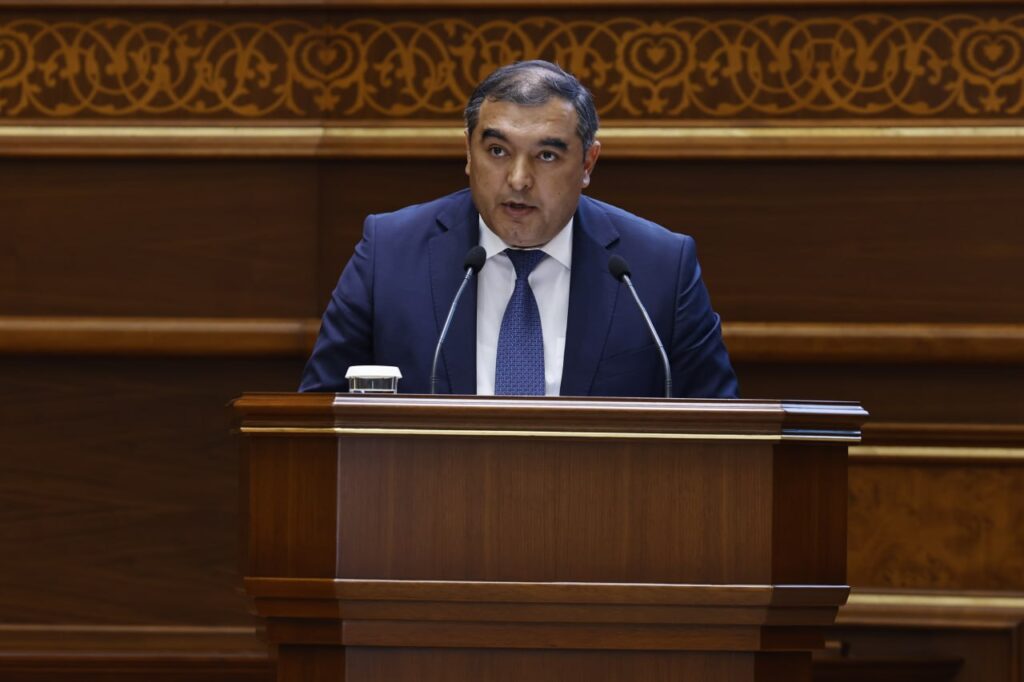
Uzbekistan’s gross domestic product (GDP) for 2024 has been revised upward to $121.4 billion, according to Behzod Hamroyev, Chair of the National Statistics Committee. The new figure was announced on November 17 during an international conference in Tashkent, as reported by the Statistika channel. Hamroyev explained that the revision reflects newly identified value added across key sectors of the economy. According to the final calculations, Uzbekistan’s nominal GDP for 2024 rose from 1,454.6 trillion soums to 1,535.4 trillion soums, an increase of 80.9 trillion soums, or 5.6%. In dollar terms, this marks an upward revision from the previously reported $115.0 billion to $121.4 billion. Following the recalculation, GDP per capita in 2024 reached 41.3 million soums. Hamroyev highlighted that full coverage of state budget execution led to the identification of 36.4 trillion soums in additional newly created value. Sector-specific revisions also contributed significantly: added value in industry rose by 12.7 trillion soums, agriculture by 5.6 trillion soums, construction by 10.3 trillion soums, and services by 16.3 trillion soums. Earlier this year, presidential spokesperson Sherzod Asadov reported that Uzbekistan’s GDP grew by 6.5% in 2024, reaching $115 billion before the revision. He also noted that foreign investment increased by 1.6 times to $34.9 billion, with 242 large and medium-sized projects worth $10 billion launched. National exports reached a record $27 billion.

National Bank of Kyrgyzstan Reports Profit Surge in 2025

The National Bank of the Kyrgyz Republic (NBKR), the country’s central bank, reported a net profit of 33.2 billion soms (about $380.7 million) for the first nine months of 2025, nearly 13 times higher than in the same period last year. The sharp increase was driven by gains from monetary gold transactions, the revaluation of foreign currency reserves, and overall asset appreciation. According to the central bank, gold now accounts for around $5 billion of its total assets, a 2.5-fold rise from 2024. Gold holdings currently represent about half of the NBKR’s total assets. Officials attributed the growth to the bank’s risk-diversification strategy and higher global gold prices. The NBKR also reported a rise in household investment in government securities, reflecting stronger public confidence in domestic financial instruments. While the overall asset structure remains stable, several notable shifts have occurred. The volume of nonmonetary gold and bullion has declined to $1.1 billion, reflecting strong demand from the jewelry industry and increased gold exports. Gold continues to be a key contributor to Kyrgyzstan’s export portfolio. The commercial banking sector is also expanding. The total loan portfolio reached $2 billion, up from $1.5 billion a year earlier. As previously reported by The Times of Central Asia, Kyrgyzstan’s GDP grew by 11.5% in January–July 2025, supported by strong investment in finance, manufacturing, and construction. Construction firms have been borrowing more from local banks, which are expanding lending to meet rising demand from businesses.

World Bank: Central Asia to Lead Regional Growth in 2025 Despite Global Slowdown

Economic growth in Europe and Central Asia (ECA) is slowing but remains resilient amid global and regional challenges, according to the World Bank’s latest Europe and Central Asia Economic Update: Jobs and Prosperity, released on October 7, 2025. The report projects GDP growth in the region at 2.4% in real terms this year, down from 3.7% in 2024. The slowdown is primarily attributed to weaker growth in Russia. However, excluding Russia, which accounts for about 40% of the region’s total economic output, growth is expected to hold steady at approximately 3.3% in both 2025 and 2026. “Developing economies in the region need bold reforms to turn resilience into stronger growth in productivity, output, and jobs,” said Antonella Bassani, World Bank Vice President for Europe and Central Asia. She stressed the importance of strengthening the private sector, improving education systems, and attracting more private investment to generate quality employment and address demographic changes. Central Asia remains the fastest-growing subregion for the third consecutive year, with growth expected to rise from 5.7% in 2024 to 5.9% in 2025. The World Bank attributes this momentum to increased oil production in Kazakhstan, higher remittance inflows, and rising public and private investment. Turkey and Poland are also highlighted for their strong performance, with forecast growth rates of 3.5% and 3.2%, respectively, supported by solid consumer demand and capital investment. Despite these positive signals, the World Bank warns that sluggish growth and weak reform momentum are exacerbating challenges in the labor market. While employment across the ECA region has expanded by 12% over the past 15 years, particularly in the services sector, many of the new jobs are low-skilled and offer limited income potential. Demographic shifts pose another challenge. The region’s working-age population is projected to shrink by 17 million in the coming decades, especially in Eastern and Central Europe and the Western Balkans. In contrast, Central Asia and Turkey are expected to see population growth, intensifying the need to generate sufficient employment opportunities. The report recommends that countries invest in infrastructure, education, and private-sector development to improve productivity. “Each country can tailor its approach to best use its assets, human talent, physical infrastructure, institutions, and natural resources,” said Ivailo Izvorski, World Bank Chief Economist for Europe and Central Asia. In Central Asia, economic growth is expected to be driven by expansion in agrifood and livestock processing, transport and logistics along Eurasian trade corridors, renewable energy investment, and tourism development. The World Bank notes that these sectors, supported by the region’s cultural and natural heritage, could help position Central Asia as one of the world’s most dynamic emerging markets.

Experts Say Kazakhstan Must Boost Manufacturing to Tame Inflation

Inflation is steadily eroding incomes in Kazakhstan, depleting savings and undermining government efforts in the social sector. The Times of Central Asia previously noted that surging economic growth could be a contributing factor to Kazakhstan’s inflation problem. But despite rising prices, the government has no plans to apply the brakes. On the contrary, officials point to promising GDP growth driven by sectors beyond oil. Meanwhile, independent experts argue that only large-scale industrial development can provide a lasting solution to inflation. Persistent Price Pressures Inflation continues to outpace official projections. In August, annual inflation hit 12.2%, and by the end of 2025 it is expected to reach 14%, well above the National Bank of Kazakhstan’s target range of 5-6%. Economists say the country’s dependence on imports is a key driver. Kazakhstan imports large volumes of food, fuel, medicine, equipment, and consumer goods. Wage and pension increases are failing to keep pace with the surge in prices. President Kassym-Jomart Tokayev has acknowledged that high inflation poses a serious challenge, warning it is “eating away at economic growth and household incomes.” Government efforts to stabilize prices have yet to show meaningful results. On September 23, Minister of Trade and Integration Arman Shakkaliev announced that Kazakhstan will gradually phase out price controls on socially significant food products (SZPT) in favor of targeted digital support for consumers. The SZPT list currently includes 19 essential items. At the same time, Prime Minister Olzhas Bektenov instructed agencies to crack down on unjustified price hikes for basic goods, ordering strict enforcement of available price control tools. Growth at a Cost Inflation, according to Deputy Prime Minister and Minister of National Economy Serik Zhumangarin, is being fueled by economic expansion. He warned that efforts to restrain inflation could hinder growth. “Since 2023, GDP has grown by 5%, and in 2024 we grew without the contribution of oil. This year is a turning point. From 2026, oil will no longer influence GDP growth,” Zhumangarin said. Although Kazakhstan’s economy has long relied on oil revenues, the minister believes this trend is now shifting. “Economic growth is always accompanied by high inflation,” he said. “More than $12 billion in investments have already been attracted, and the target for the year is $24 billion. The government will soon announce a new strategy for economic growth. We must follow the path of Asian countries but with modern technologies.” Call for Industrialization Independent analysts argue that real progress against inflation requires mass domestic production across a wide range of goods. Political analyst Gaziz Abishev stressed the urgency of moving beyond megaprojects toward practical, infrastructure-linked industry. “Kazakhstan needs real production, not fairy-tale megaprojects. Industry tied to infrastructure, logistics, human resources, and markets solves many issues,” he wrote. “It creates well-paid jobs, stimulates small and medium-sized businesses, reduces reliance on imports, supports the tenge, and addresses budget deficits.” Abishev also called for openness to foreign industrial investment, regardless of origin. His comments appear to push back against public concerns over the influence of Russia, China, and Western...

Kazakhstan Tops Central Asia for GDP per Capita, Surpassing Russia and China

Kazakhstan has emerged as the regional leader in gross domestic product (GDP) per capita, overtaking both Russia and China, according to the International Monetary Fund (IMF). IMF data shows that in 2025 Kazakhstan’s GDP per capita reached $14,770, compared to $14,260 in Russia and $13,690 in China. Within Central Asia, Turkmenistan followed with $13,340, while Uzbekistan posted $3,510, Kyrgyzstan $2,750, and Tajikistan $1,430. Kazakhstan also leads among Commonwealth of Independent States (CIS) members, ahead of Georgia ($9,570), Armenia ($8,860), Moldova ($8,260), Belarus ($7,880), Azerbaijan ($7,600), and Ukraine ($6,260). Only the Baltic states recorded higher figures: Estonia ($32,760), Lithuania ($30,840), and Latvia ($24,370). Ireland remained Europe’s leader with $108,920 per capita. The IMF calculates GDP per capita at current prices, offering a snapshot of purchasing power and overall economic wellbeing. Its analysts attribute Kazakhstan’s strong performance to vast mineral resources, with energy and mineral exports continuing to drive growth. Recent years have also seen expansion in raw material processing and production of high value-added goods. The report cites ongoing business reforms, foreign investment inflows, and infrastructure upgrades as key factors enhancing competitiveness. Significant spending is going into transport, logistics, technology, education, healthcare, and social services, bolstering domestic demand and labor productivity. Kazakhstan’s strategic position on trade routes linking Europe and Asia, participation in the Belt and Road Initiative, and active engagement with Russia, China, the EU, and other partners are also seen as growth drivers. The IMF notes that macroeconomic stability is supported by low inflation, a steady tenge exchange rate, and a balanced budget. “The policies of the National Bank and the government are helping to maintain economic stability even amid global challenges,” the report states. The Times of Central Asia previously reported that, according to IMF forecasts, Central Asian economies are expected to grow faster than the global average in 2025.