• KGS/USD = 0.01144 0%
  • KZT/USD = 0.00199 0%
  • TJS/USD = 0.10552 0%
  • UZS/USD = 0.00008 0%
  • TMT/USD = 0.28490 0%
  • KGS/USD = 0.01144 0%
  • KZT/USD = 0.00199 0%
  • TJS/USD = 0.10552 0%
  • UZS/USD = 0.00008 0%
  • TMT/USD = 0.28490 0%
  • KGS/USD = 0.01144 0%
  • KZT/USD = 0.00199 0%
  • TJS/USD = 0.10552 0%
  • UZS/USD = 0.00008 0%
  • TMT/USD = 0.28490 0%
  • KGS/USD = 0.01144 0%
  • KZT/USD = 0.00199 0%
  • TJS/USD = 0.10552 0%
  • UZS/USD = 0.00008 0%
  • TMT/USD = 0.28490 0%
  • KGS/USD = 0.01144 0%
  • KZT/USD = 0.00199 0%
  • TJS/USD = 0.10552 0%
  • UZS/USD = 0.00008 0%
  • TMT/USD = 0.28490 0%
  • KGS/USD = 0.01144 0%
  • KZT/USD = 0.00199 0%
  • TJS/USD = 0.10552 0%
  • UZS/USD = 0.00008 0%
  • TMT/USD = 0.28490 0%
  • KGS/USD = 0.01144 0%
  • KZT/USD = 0.00199 0%
  • TJS/USD = 0.10552 0%
  • UZS/USD = 0.00008 0%
  • TMT/USD = 0.28490 0%
  • KGS/USD = 0.01144 0%
  • KZT/USD = 0.00199 0%
  • TJS/USD = 0.10552 0%
  • UZS/USD = 0.00008 0%
  • TMT/USD = 0.28490 0%
25 February 2026

Viewing results 1 - 6 of 4

Tajikistan Revises Export Duties to Boost Domestic Processing

The government of Tajikistan has approved revised export duties on raw materials and semi-processed goods, a move that has prompted considerable discussion within the business community. The changes, which directly affect exporters and producers, are intended to stimulate domestic processing and reduce the export of unrefined resources. The key reform replaces fixed tariffs with duties calculated as a percentage of a product’s market value. Previously, export duties were set at: €300 per ton for leather 20% or €100 per ton for silk and cocoons 10% for cotton fiber Under the new rules, export duties fluctuate with global market prices, allowing for more adaptive regulation. According to the Ministry of Economic Development and Trade, the reform is designed to promote higher-value production within Tajikistan. “The goal of this resolution is to reduce the export of raw materials and support the production of high-value goods,” said First Deputy Minister of Economic Development and Trade Ashurboy Solekhzoda. The revised duties apply to a range of commodities including cotton fiber, leather, silk, cocoons, minerals, concentrates, plant juices, and other semi-processed goods. However, around 34 categories of raw materials remain exempt from export duties. Tajikistan’s approach mirrors policies implemented in neighboring states. Kazakhstan imposes export duties on 44 product categories, including leather, wool, scrap metal, sunflower seeds, and oil. In Uzbekistan, export duties apply to over 86 types of goods, with some rates reaching as high as 100%. Such measures aim to reduce reliance on raw material exports, stimulate domestic value-added industries, and enhance export competitiveness. Economists and industry observers say the new policy could incentivize companies to expand local processing operations and reduce dependence on commodity exports. It may also enhance Tajikistan’s attractiveness to foreign investors interested in long-term, value-driven partnerships. Over time, the revised export framework is expected to help strengthen the national economy and integrate Tajikistan more deeply into regional supply chains across Central Asia.

World Bank Warns of Slowing Tajikistan Economy

Tajikistan’s economic growth may slow in the coming years due to mounting foreign policy and regional risks, according to a new report from the World Bank.  Vulnerability to External Shocks The report highlights several external vulnerabilities that could impact Tajikistan’s economy. These include shifts in Russia’s migration policies, heightened global instability, and ongoing armed conflicts.  “Tighter migration policies and restrictions on Tajik workers in Russia threaten to significantly reduce remittance flows, leading to lower economic growth, increased poverty, and worsening fiscal and external balances,” the World Bank stated. Growing global protectionism is also expected to raise Tajikistan’s foreign trade costs. The report notes that recent U.S. tariff increases on imports from several of Dushanbe’s key trading partners have triggered retaliatory measures from countries like China. These developments could drive up import costs and intensify logistical pressures. Additionally, volatility in global commodity prices is expected to impact Tajik exports. While falling oil and raw material prices could reduce export earnings, especially for aluminum, zinc, and ores, high global gold prices in 2025 may provide a partial offset through increased revenues. Impact of Regional Conflicts The World Bank also warns that ongoing conflicts in Ukraine and the Middle East could further disrupt global supply chains, raising energy and logistics costs. These challenges would translate into higher import prices for Tajikistan. Conversely, the report suggests that a potential easing of sanctions and normalization of relations between the U.S. and Russia could destabilize Central Asian economies. However, the implications of such a shift remain uncertain and difficult to forecast. Medium-Term Outlook Despite these headwinds, the World Bank expects Tajikistan’s economy to remain stable, albeit with a decelerating growth trajectory: 8.4% in 2024 7.0% in 2025 4.9% in 2026 4.7% in 2027 The projected slowdown is gradual and not expected to result in a recession. Similar concerns have been echoed by other institutions. The Asian Development Bank and the Eurasian Fund for Stabilization and Development have also forecast a gradual slowdown in Tajikistan’s economic growth over the medium term.

President Tokayev: Kazakhstan Prepared for Global Market Turbulence

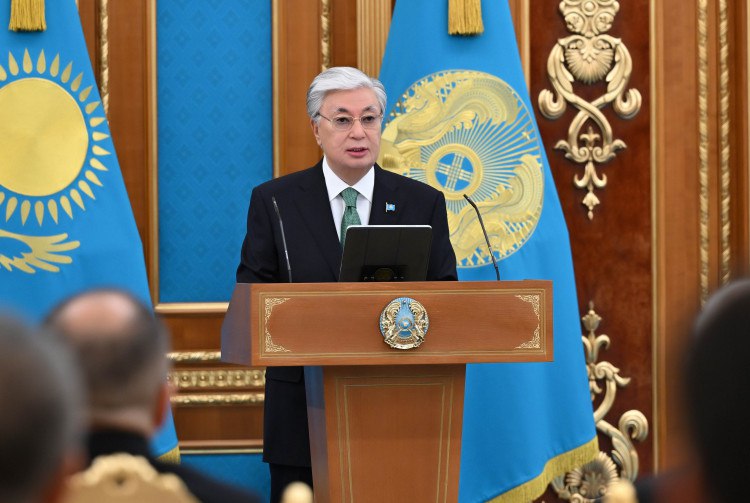
Kazakh President Kassym-Jomart Tokayev has stated that Kazakhstan is prepared to confront the consequences of what he described as one of the most severe global economic crises in recent decades. Speaking at a meeting with the country’s scientific community, Tokayev emphasized that while the international environment is turbulent, there is no reason for panic, noting that Kazakhstan has prior experience in navigating such challenges. “Due to the onset of a ‘tariff war of all against all,’ we are witnessing the breakdown of production and trade chains, the collapse of markets, and heightened volatility in raw material prices. These developments will inevitably affect all nations, including Kazakhstan,” Tokayev warned. Despite these external shocks, he assured that the country will stay the course on its development agenda. All priority infrastructure projects, he confirmed, will continue to receive full financing and will be implemented as planned. In light of growing global uncertainty, Tokayev underlined the fierce competition for investment that lies ahead. “We need to be in very good shape. We must be ready for all scenarios. We must act pragmatically and confidently. Crises are beneficial in that they reveal the presence or absence of managerial talent and give rise to new opportunities,” the president stated. A day earlier, Tokayev had convened a meeting with key figures from the government’s economic and financial sectors to assess the situation following a steep decline in global prices for energy resources and essential commodities. As previously reported by The Times of Central Asia, Kazakhstan’s economy has recently received a temporary boost thanks to increased demand and rising prices for several key exports. This trend followed the U.S. suspension of additional tariffs on various countries, including Kazakhstan.

Kazakhstan Strengthens Position in Global Critical Minerals Market

Kazakhstan has the potential to ensure a stable supply of critical minerals essential for the global energy transition and the expansion of the electric vehicle market, according to analysts at the Astana International Financial Center (AIFC)​. An AIFC study highlights Kazakhstan’s competitive advantages in exporting copper, zinc, aluminum, silver, and lead. Additionally, nickel, gold, lithium, and rare earth metals are seen as promising sectors for export expansion​. Kazakhstan holds a 5% share of the global zinc market, ranking seventh in reserves with 6.7 million tons. In 2022, Turkey, Russia, and China accounted for 70% of Kazakhstani zinc exports. The country also controls about 4% of the global copper market, with 20 million tons in reserves, placing it 11th worldwide. Its main copper buyers in 2022 were China, Turkey, and the UAE​. Kazakhstan ranks eighth globally in lead reserves (2 million tons) and 12th in production, with 40,000 tons mined in 2021. Global lead demand is projected to rise from 11.6 million tons in 2022 to 13.4 million tons by 2031. In the silver market, Kazakhstan holds the third-largest reserves, accounting for 2.7% of global supply​. In 2023, Kazakhstan ranked 11th in global bauxite reserves (160 million tons) and 10th in production (4.3 million tons), though its aluminum market share remains below 1%. The primary destinations for aluminum exports are Turkey, Italy, and Greece. Meanwhile, Kazakhstan is among the world’s top 20 nickel-producing countries, holding reserves of approximately 1.5 million tons, or 2% of global reserves, though its market share remains small​. The country is also actively exploring lithium deposits in collaboration with companies from Germany, the UK, and South Korea. In March 2024, South Korean specialists discovered a lithium deposit in East Kazakhstan with a content of 5.3%, valued at an estimated $15.7 billion. Kazakhstan has also strengthened its position in the critical minerals market through international agreements. It recently signed a contract with the European Union worth €3 million for the supply of essential raw materials​.