
• KGS/USD = 0.01144 0%
  • KZT/USD = 0.00216 0%
  • TJS/USD = 0.10659 0%
  • UZS/USD = 0.00008 0%
  • TMT/USD = 0.28530 0%
  • KGS/USD = 0.01144 0%
  • KZT/USD = 0.00216 0%
  • TJS/USD = 0.10659 0%
  • UZS/USD = 0.00008 0%
  • TMT/USD = 0.28530 0%
  • KGS/USD = 0.01144 0%
  • KZT/USD = 0.00216 0%
  • TJS/USD = 0.10659 0%
  • UZS/USD = 0.00008 0%
  • TMT/USD = 0.28530 0%
  • KGS/USD = 0.01144 0%
  • KZT/USD = 0.00216 0%
  • TJS/USD = 0.10659 0%
  • UZS/USD = 0.00008 0%
  • TMT/USD = 0.28530 0%
  • KGS/USD = 0.01144 0%
  • KZT/USD = 0.00216 0%
  • TJS/USD = 0.10659 0%
  • UZS/USD = 0.00008 0%
  • TMT/USD = 0.28530 0%
  • KGS/USD = 0.01144 0%
  • KZT/USD = 0.00216 0%
  • TJS/USD = 0.10659 0%
  • UZS/USD = 0.00008 0%
  • TMT/USD = 0.28530 0%
  • KGS/USD = 0.01144 0%
  • KZT/USD = 0.00216 0%
  • TJS/USD = 0.10659 0%
  • UZS/USD = 0.00008 0%
  • TMT/USD = 0.28530 0%
  • KGS/USD = 0.01144 0%
  • KZT/USD = 0.00216 0%
  • TJS/USD = 0.10659 0%
  • UZS/USD = 0.00008 0%
  • TMT/USD = 0.28530 0%

Viewing results 1 - 6 of 9

Uzbekistan’s Islamic Civilization Center Enters Guinness World Records as Largest Museum

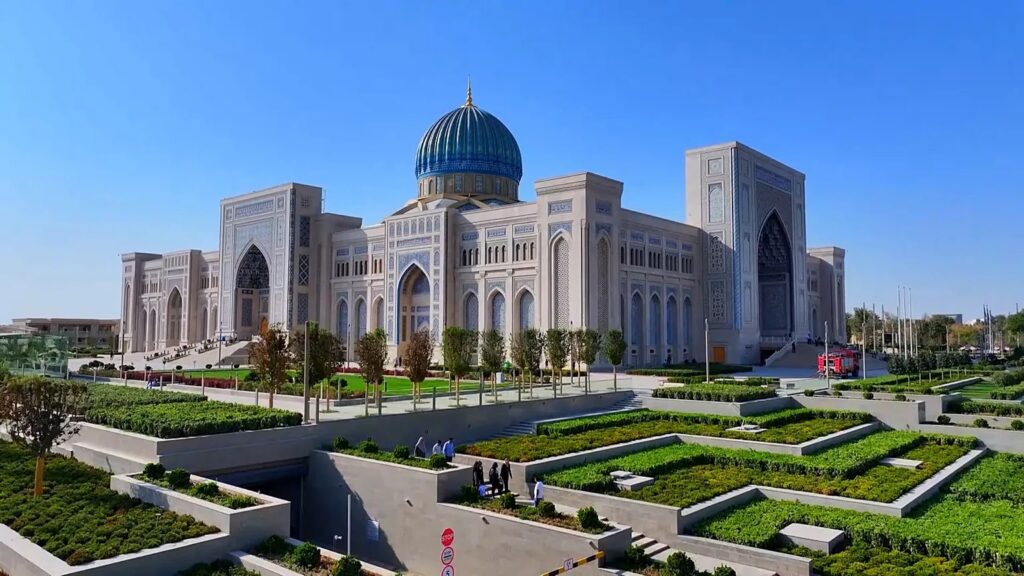
The Center of Islamic Civilization in Uzbekistan has been officially recognized as the world’s largest museum dedicated to Islamic civilization, receiving a Guinness World Records title on April 13. The recognition was confirmed by Guinness World Records adjudicator Şeyda Subaşı Gemici, who attended the ceremony alongside project architects, designers, and members of the Center’s Scientific Council. The award followed a detailed verification process. The recognition comes as Uzbekistan continues to invest in large-scale cultural infrastructure as part of a broader effort to present its historical narrative and reshape its international image. “As an official Guinness World Records adjudicator, I can state that every corner of the museum and every exhibit possesses its own uniqueness and cultural value,” Gemici said. “The evaluation process strictly followed established procedures… every exhibit was recorded and verified by specialists in Islamic archaeology, art, and science.” She added that the scale and depth of the project left a strong impression, describing it as “an outstanding achievement” and, in Guinness terminology, “Officially Amazing.” The Center is a large-scale scientific, educational, and museum complex initiated in 2017 under the leadership of President Shavkat Mirziyoyev and completed on March 17, 2026. It was conceived as a platform combining research, cultural heritage, and modern technologies, aimed at showcasing the history and contributions of Islamic civilization. The project reflects a wider policy under Mirziyoyev of positioning Uzbekistan not only as a historical center of Islamic scholarship but as a modern platform for its study and interpretation. Chief architect, Abdukakhor Turdiev, said the project reflects Uzbekistan’s historical and cultural legacy. “The uniqueness of the Center lies in the fact that its architecture reflects the rich culture and heritage of Uzbekistan,” he said, adding that the country is increasingly positioning itself as an active participant in global cultural dialogue. Across Central Asia, governments have increasingly used large cultural projects to reinforce national identity and attract international attention, but Uzbekistan has placed particular emphasis on linking heritage with scholarship and global engagement. According to officials, the complex has quickly become one of the most visited cultural sites in the region, receiving up to 5,000 visitors daily, including both locals and international tourists. That scale suggests the Center is intended not only as a museum, but as a flagship institution shaping how both domestic and international audiences understand the region’s intellectual and cultural history. Director Firdavs Abdukhalikov described the award as recognition of years of work by hundreds of specialists. He said the Center’s primary goal is to support scientific and educational projects while preserving and promoting Uzbekistan’s cultural heritage. Beyond its record-setting size, the Center reflects Uzbekistan’s broader effort to reclaim and reinterpret its place in the history of Islamic civilization. By combining scholarship, state backing, and public accessibility, it positions cultural heritage as both a foundation of national identity and a tool of international engagement.

Opening the Islamic Civilization Center in Tashkent: A New Landmark of Memory, Scholarship, and National Identity

With its public opening scheduled for March 17, 2026, the Islamic Civilization Center in Tashkent is emerging as one of the most consequential cultural projects in contemporary Uzbekistan. Conceived under President Shavkat Mirziyoyev’s initiative first announced in 2017, the Center presents itself not simply as a museum but as a national statement about memory, scholarship, and identity. The Center’s own mission describes it as a bridge between the Golden Age and New Uzbekistan, linking a rich spiritual and scientific inheritance with the country’s modern aspirations. In that sense, the opening is not only an institutional debut; it is a carefully staged declaration of civilizational confidence. The setting reinforces that message. The complex rises in Tashkent’s historic Hast-Imam area, at Karasaray 47 in the Almazar district, where architecture itself is part of the narrative. The official site says the building’s 65-meter dome and four portals symbolize the unity of Uzbekistan’s regions, turning the Center into a monument as much as a museum. From the outside, the structure is meant to signal national scale; from the inside, it is designed to draw visitors into a journey through faith, science, and statehood. The opening therefore introduces not just a new institution, but a new symbolic landmark for the capital. What makes the Center distinctive is the scope of its ambition. Official descriptions emphasize that it is more than an exhibition venue: alongside museum halls, it includes a library, restoration and digitization laboratories, research departments, and archival storage. That institutional mix matters. Rather than treating Islamic civilization as a fixed inheritance locked behind glass, the Center is built to keep knowledge active through conservation, scholarship, and public interpretation. It is a museum-research hybrid with an international educational focus, drawing inspiration from historical centers of learning such as Baghdad’s House of Wisdom, the Khorezm Ma’mun Academy, and Ulugh Beg’s madrasah in Samarkand. At the spiritual and architectural core of the complex is the Qur’an Hall. The official website describes it as the largest and most majestic section of the building, as well as the conceptual heart of the entire project. At its center stands the 7th-century Mushaf of Uthman, preserved beneath the great dome and recognized by UNESCO’s Memory of the World Register. The hall also features a gallery of 114 Qur’ans tracing the evolution of Islamic calligraphy, and the Center says the space is designed not only for display but also for contemplation, with continuous Qur’an recitation planned inside. The result is an opening centered on reverence as much as spectacle. Beyond the Qur’an Hall, the Center organizes Uzbekistan’s civilizational story along a long historical arc. Its exhibition program moves from pre-Islamic heritage through the First and Second Renaissances and into New Uzbekistan, combining rare objects with replicas, models, 3D technologies, audiovisual tools, and other modern display formats. The Hall of Honor, one of the site’s highlighted spaces, contains 14 arches depicting key events in Central Asian history and interactive panels linked to a digital platform with avatars of more than one hundred thinkers...

Seventeenth-Century Gilded Vessel Joins Permanent Exhibition at Uzbekistan’s Islamic Civilization Center

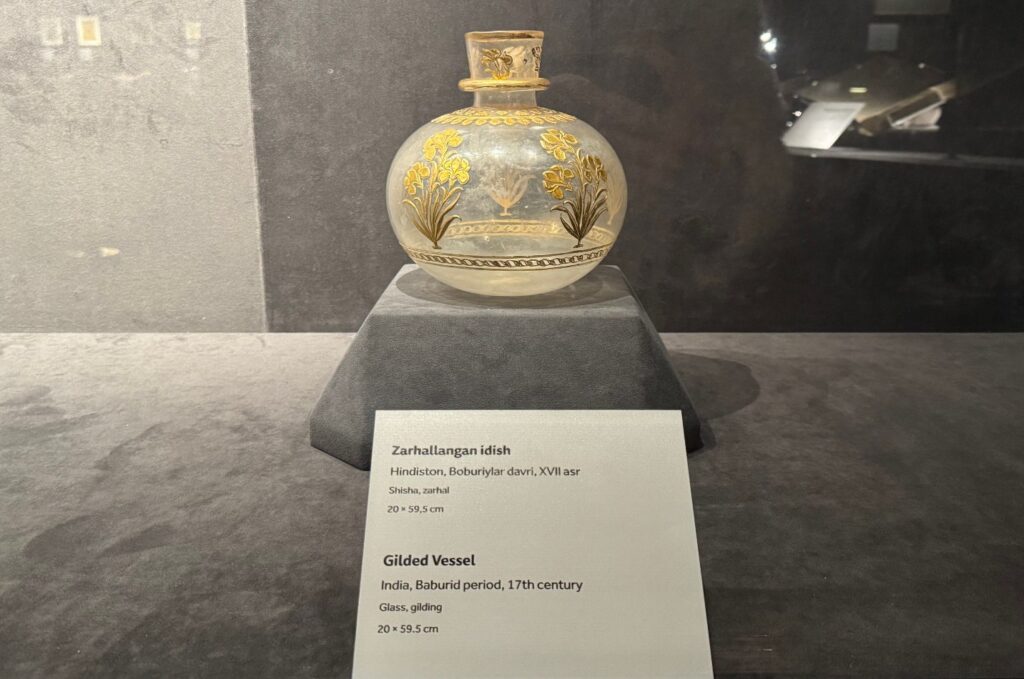
A rare gilded decorative vessel dating to the seventeenth century has been added to the permanent exhibition of the Islamic Civilization Center in Uzbekistan, the Center announced. Acquired from the British auction house Christie’s at the initiative of the president, the artifact is being presented to the public for the first time in Tashkent. According to the Islamic Civilization Center, the vessel is notable for its refined form, gold-leaf ornamentation, and exceptional craftsmanship, offering insight into the aesthetic sensibilities of its time. Experts describe it as a rare luxury object intended for elite or courtly use, rather than for everyday function. Rustam Jabborov, Scientific Secretary of the Center, said the vessel is approximately 400 years old and features a carefully balanced design. “The object has a spherical body with cylindrical workmanship. The lower section is adorned with a braided floral ornamental band, while five blooming yellow lotus flowers are arranged above it in a circular pattern to create compositional unity,” Jabborov explained. He noted that the surface of the vessel was polished and gilded, with gold-leaf decorations that have retained their artistic appeal over centuries. “The gilding enhances both the sense of splendor and the impression of antiquity. The yellow lotus flower, used as the central decorative motif, adds both symbolic and aesthetic meaning to the overall composition,” he said. According to Jabborov, the manufacturing technique, ornamental style, and state of preservation all attest to the object’s historical significance. The Islamic Civilization Center stated that the inclusion of the vessel in its exhibition reinforces its status as a rare cultural artifact recognized at the international level. In February last year, the Center announced plans to host an international exhibition in Tashkent featuring Uzbek cultural masterpieces housed in Italian museums and private collections. The event is scheduled to coincide with the opening of the Center for Islamic Civilization. As part of those preparations, a delegation led by the Center’s director, Firdavs Abdukhalikov, visited Italy, where they held talks with museum representatives and private collectors who expressed support for the project. Elmira Gul, scientific coordinator of the Cultural Heritage of Uzbekistan in the Collections of the World project, noted that collections of Uzbek artifacts in Italian museums have already been documented in published volumes, reflecting the global reach of Uzbekistan’s cultural legacy.
