Tokayev in Berlin: Ukraine, Putin, and Germany’s Growing Economic Interest in Kazakhstan
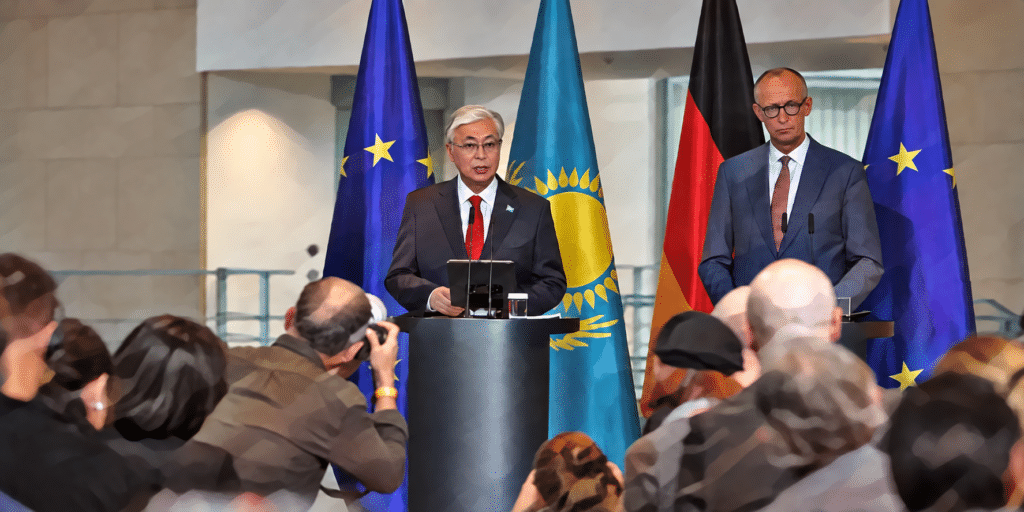
The war in Ukraine, Kazakhstan’s relations with Russia, energy, and Germany’s growing interest in Central Asia’s raw materials were all on the agenda during Kassym-Jomart Tokayev’s visit to Berlin on September 29. The Kazakh president again called for a freeze on hostilities in Ukraine before moving toward diplomacy, while emphasizing Kazakhstan’s close ties with Russia. Chancellor Friedrich Merz said Moscow had so far shown no willingness to engage in substantive peace talks. The two sides also discussed increasing supplies of Kazakh oil, critical minerals, German investment, and transport routes between Asia and Europe. After the meeting, Chancellor Friedrich Merz said the two leaders had discussed Russia and its war against Ukraine “very intensively.” Berlin’s position is that Moscow must end the war and enter serious negotiations involving Ukraine and European states. “The aim of such peace negotiations must be a sovereign Ukraine in a secure Europe,” Merz said. Until Russia is ready for such a peace, he added, Germany will continue to support Kyiv. Reiterating his position, Tokayev advocated a different sequence. He said he did not consider a rapid end to the war realistic under current conditions and called for first freezing hostilities in Ukraine and then moving toward diplomacy and negotiations. The Kazakh president also reaffirmed his commitment to the UN Charter and respect for the territorial integrity of states, while stressing his respect for the Ukrainian people, their culture, history, traditions, and language. A similar position was set out in a joint declaration by Tokayev and German President Frank-Walter Steinmeier. The two expressed support for a comprehensive, just, and lasting peace in Ukraine in accordance with the UN Charter and underscored their respect for the sovereignty, independence, and territorial integrity of states. At the press conference with Merz, however, Tokayev also emphasized Kazakhstan’s close relationship with Moscow. He said he had “very good contact” with Putin, and described the Russian president as an “outstanding political figure.” Tokayev also explained Kazakhstan’s relationship with Russia in geographical and demographic terms. The two countries share a border of more than 7,500 kilometers, and Kazakhstan has a large ethnic Russian population. “Whatever may happen on the territory of Ukraine, we never forget that both Russia and Ukraine are our good friends,” Tokayev said. Merz thanked Kazakhstan for helping prevent the circumvention of sanctions against Russia, describing this as “work for peace.” Kazakhstan has not joined Western sanctions against Russia, but has repeatedly said it will not allow its territory to be used to circumvent them. For the European Union, controls on re-exports through third countries have taken on greater importance since 2022, as Russia’s trade with several Central Asian states increased sharply. Oil featured prominently in the economic discussions. Merz said Germany was interested in receiving more crude from Kazakhstan to replace Russian oil. “We are looking for ways to diversify our supply relationships, and Kazakhstan is an important building block in this region of the world,” the chancellor said. Kazakhstan began supplying crude to the PCK refinery in Schwedt in...