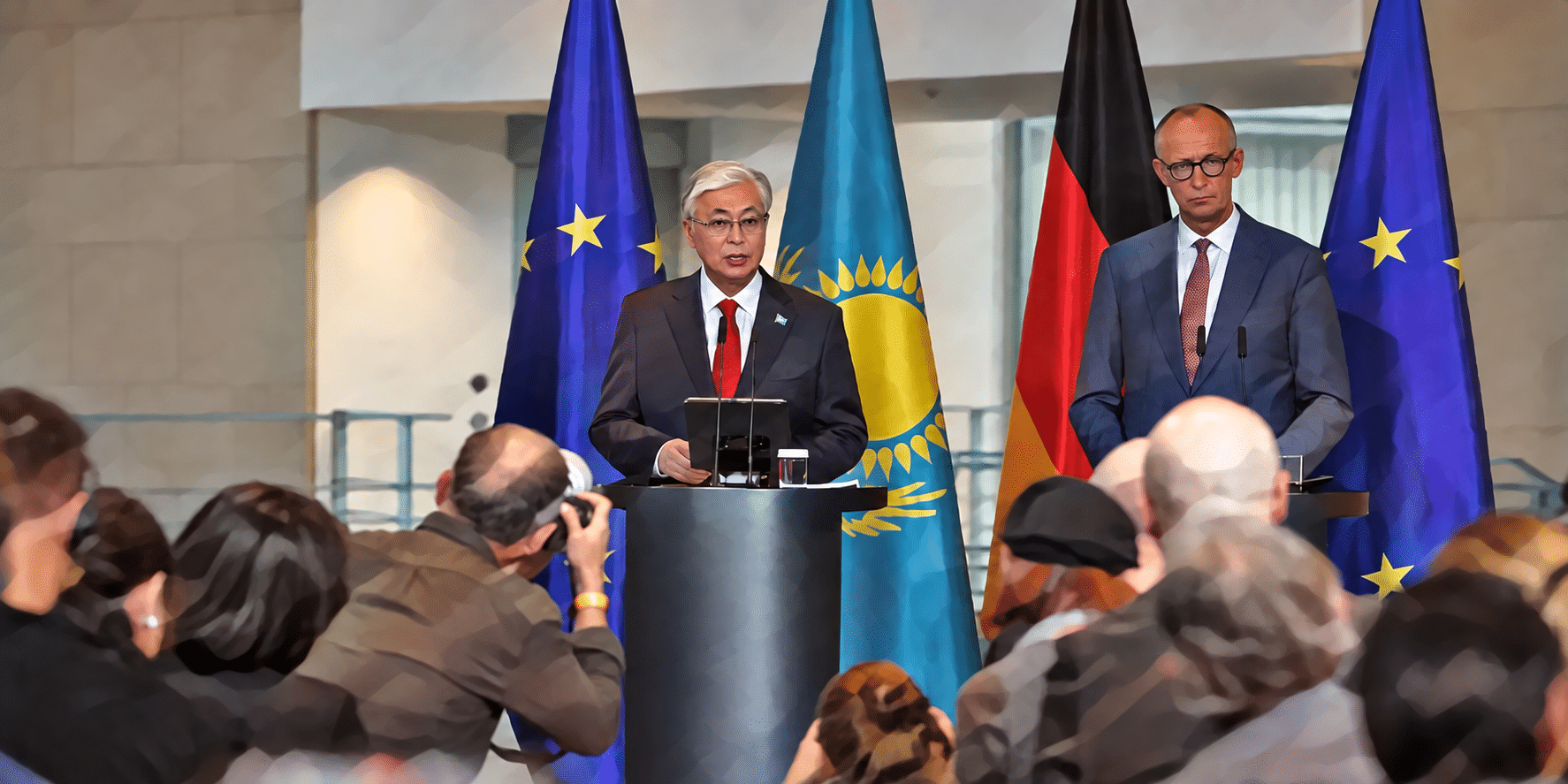
The war in Ukraine, Kazakhstan’s relations with Russia, energy, and Germany’s growing interest in Central Asia’s raw materials were all on the agenda during Kassym-Jomart Tokayev’s visit to Berlin on September 29. The Kazakh president again called for a freeze on hostilities in Ukraine before moving toward diplomacy, while emphasizing Kazakhstan’s close ties with Russia. Chancellor Friedrich Merz said Moscow had so far shown no willingness to engage in substantive peace talks. The two sides also discussed increasing supplies of Kazakh oil, critical minerals, German investment, and transport routes between Asia and Europe.
After the meeting, Chancellor Friedrich Merz said the two leaders had discussed Russia and its war against Ukraine “very intensively.” Berlin’s position is that Moscow must end the war and enter serious negotiations involving Ukraine and European states.
“The aim of such peace negotiations must be a sovereign Ukraine in a secure Europe,” Merz said. Until Russia is ready for such a peace, he added, Germany will continue to support Kyiv.
Reiterating his position, Tokayev advocated a different sequence. He said he did not consider a rapid end to the war realistic under current conditions and called for first freezing hostilities in Ukraine and then moving toward diplomacy and negotiations.
The Kazakh president also reaffirmed his commitment to the UN Charter and respect for the territorial integrity of states, while stressing his respect for the Ukrainian people, their culture, history, traditions, and language.
A similar position was set out in a joint declaration by Tokayev and German President Frank-Walter Steinmeier. The two expressed support for a comprehensive, just, and lasting peace in Ukraine in accordance with the UN Charter and underscored their respect for the sovereignty, independence, and territorial integrity of states.
At the press conference with Merz, however, Tokayev also emphasized Kazakhstan’s close relationship with Moscow. He said he had “very good contact” with Putin, and described the Russian president as an “outstanding political figure.” Tokayev also explained Kazakhstan’s relationship with Russia in geographical and demographic terms. The two countries share a border of more than 7,500 kilometers, and Kazakhstan has a large ethnic Russian population.
“Whatever may happen on the territory of Ukraine, we never forget that both Russia and Ukraine are our good friends,” Tokayev said.
Merz thanked Kazakhstan for helping prevent the circumvention of sanctions against Russia, describing this as “work for peace.” Kazakhstan has not joined Western sanctions against Russia, but has repeatedly said it will not allow its territory to be used to circumvent them.
For the European Union, controls on re-exports through third countries have taken on greater importance since 2022, as Russia’s trade with several Central Asian states increased sharply.
Oil featured prominently in the economic discussions. Merz said Germany was interested in receiving more crude from Kazakhstan to replace Russian oil.
“We are looking for ways to diversify our supply relationships, and Kazakhstan is an important building block in this region of the world,” the chancellor said.
Kazakhstan began supplying crude to the PCK refinery in Schwedt in eastern Germany in 2023. Shipments reached 2.146 million metric tons in 2025. In Berlin, Tokayev said Kazakhstan intended to increase oil supplies to Germany.
Kazakh crude had reached Germany through Russia’s Druzhba pipeline system, but Russia suspended transit in May 2026, citing technical constraints. Energy Minister Yerlan Akkenzhenov said deliveries would not resume during September, October, or November.
More than 80% of Kazakhstan’s oil exports travel through another route crossing Russia – the Caspian Pipeline Consortium system – to a terminal near Novorossiysk on the Black Sea. Tanker attacks disrupted loadings several times in July. In August, Kazakh oil exports through the CPC rebounded to 5.7 million metric tons.
For now, Kazakhstan’s other export routes, including supplies to Germany, cannot handle volumes comparable to those moving through the CPC. KazMunayGas CEO Askhat Khasenov put it more directly in August: “There is currently no alternative to the CPC in terms of economics or volumes.”
The company continues to examine other options, including greater use of the Kazakhstan-China oil pipeline.
Critical minerals were another major topic. Germany imports much of the raw material required by its automotive, chemical, energy, and electronics industries. On September 14, Germany’s National Security Council included the diversification and resilience of critical raw material supplies among measures aimed at reducing the country’s strategic dependencies.
Kazakhstan produces uranium, chromium, titanium, and many other materials used by European industry. Astana is offering foreign partners projects not only in extraction, but also in processing critical raw materials inside Kazakhstan. In Berlin, Tokayev made a specific appeal to Germany’s Mittelstand – its small and medium-sized industrial companies – to establish production facilities in Kazakhstan. For years, much of Kazakhstan’s foreign investment has been concentrated in extractive industries.
According to figures cited by Tokayev, cumulative German investment in Kazakhstan exceeds $8 billion. Around 40 joint projects worth more than $4 billion are currently being implemented. Among the German companies operating in Kazakhstan, he named CLAAS, Siemens, Linde, Goldbeck, and Rhenus.
Ahead of the German-Kazakh Economic Forum, the Ost-Ausschuss said 37 bilateral projects worth around €1.8 billion were planned for signing. They cover raw materials, energy, industry, transport and logistics. The two countries also agreed on an economic cooperation roadmap for 2026-28 covering industry, technology, raw materials, supply chain analysis, and business conditions.
The Middle Corridor, or Trans-Caspian International Transport Route, which runs from Central Asia across the Caspian Sea, Azerbaijan, and Georgia toward Europe without passing through Russia, was another subject of the talks.
The route predates the war in Ukraine, but since 2022 it has attracted greater attention from the EU and European businesses. For Kazakhstan, it serves as both an export route and as a transit corridor linking China and Central Asia with Europe.
Cargo must cross the Caspian Sea and several national borders, shifting between rail and maritime transport. Delivery times and costs therefore depend on port capacity, vessel availability, rail infrastructure, tariffs, and border procedures.
In an earlier interview with The Times of Central Asia, Nurgul Zhakupova, Secretary General of the Trans-Caspian International Transport Route Association, said reducing delivery times and synchronizing the work of ports, railways, and terminals remained priorities.
Container traffic along the Middle Corridor increased by 11% in the first eight months of 2026 to 53,574 TEU. Around 80% of containers were moving westward, and only 20% in the opposite direction. In Berlin, Tokayev said Kazakhstan wanted to increase freight volumes along the route to 20 million metric tons. He invited German transport and logistics companies to participate in its development, including projects involving the port of Aktau.
Stefan Meister, an expert on Central Asia, has pointed to some of the constraints facing German businesses in Kazakhstan. In an interview ahead of Tokayev’s visit, he noted the country’s relatively small domestic market: a company considering a large industrial plant needs to know where its output will ultimately be sold. He also cited the rule of law, transparency, and the overall business climate as factors affecting investment decisions.
Meister also sees a problem on the German side. In his assessment, Berlin lacks a long-term vision for its relationship with Central Asia, while German companies are more cautious in the region than some of their competitors and need stronger political backing.
Germany’s interest gives Kazakhstan an opportunity to attract more investment into processing and manufacturing at home. For Astana, closer ties with Berlin could mean exporting more of what it makes, alongside what it extracts.