
• KGS/USD = 0.01144 0%
  • KZT/USD = 0.00201 0%
  • TJS/USD = 0.10568 -0.09%
  • UZS/USD = 0.00008 0%
  • TMT/USD = 0.28571 0%
  • KGS/USD = 0.01144 0%
  • KZT/USD = 0.00201 0%
  • TJS/USD = 0.10568 -0.09%
  • UZS/USD = 0.00008 0%
  • TMT/USD = 0.28571 0%
  • KGS/USD = 0.01144 0%
  • KZT/USD = 0.00201 0%
  • TJS/USD = 0.10568 -0.09%
  • UZS/USD = 0.00008 0%
  • TMT/USD = 0.28571 0%
  • KGS/USD = 0.01144 0%
  • KZT/USD = 0.00201 0%
  • TJS/USD = 0.10568 -0.09%
  • UZS/USD = 0.00008 0%
  • TMT/USD = 0.28571 0%
  • KGS/USD = 0.01144 0%
  • KZT/USD = 0.00201 0%
  • TJS/USD = 0.10568 -0.09%
  • UZS/USD = 0.00008 0%
  • TMT/USD = 0.28571 0%
  • KGS/USD = 0.01144 0%
  • KZT/USD = 0.00201 0%
  • TJS/USD = 0.10568 -0.09%
  • UZS/USD = 0.00008 0%
  • TMT/USD = 0.28571 0%
  • KGS/USD = 0.01144 0%
  • KZT/USD = 0.00201 0%
  • TJS/USD = 0.10568 -0.09%
  • UZS/USD = 0.00008 0%
  • TMT/USD = 0.28571 0%
  • KGS/USD = 0.01144 0%
  • KZT/USD = 0.00201 0%
  • TJS/USD = 0.10568 -0.09%
  • UZS/USD = 0.00008 0%
  • TMT/USD = 0.28571 0%
24 February 2026

Viewing results 1 - 6 of 7

Kazakhstan Increases State Control Over Uranium Industry

Kazakhstan has introduced significant amendments to its Subsoil Use Code, reinforcing the role of the national atomic company Kazatomprom in the uranium sector and tightening state control over exploration and production rights. Kazatomprom, the world’s largest uranium producer, accounted for approximately 21% of global primary uranium output in 2024. Signed into law by President Kassym-Jomart Tokayev on December 26, 2025, the amendments grant Kazatomprom priority rights to obtain exploration licenses in prospective areas, as well as the authority to reserve blocks containing uranium mineralization and deposits. If uranium is discovered within solid mineral blocks licensed to other subsoil users, those licenses may only be extended if the relevant blocks are returned to the State. Importantly, private subsoil users who discover uranium deposits within their licensed areas will not receive priority rights for uranium production. If Kazatomprom is awarded a new subsoil use agreement, any transfer of that agreement is now limited to entities in which the company holds a direct or indirect stake of over 75%. This is a marked tightening from the previous threshold of 50%. These changes apply only to newly issued agreements and do not retroactively affect existing ones. Extensions of existing subsoil use agreements or increases in approved production volumes and reserves, are now permitted only if Kazatomprom holds at least a 90% stake in the joint venture. As an alternative, foreign partners may fulfill this condition by transferring uranium conversion and enrichment technologies to Kazatomprom or to a jointly established legal entity. Such transfers must include the construction of a processing facility and a guaranteed offtake contract covering at least 50% of its output over the life of the extended agreement. The revised legislation also expands the grounds for early termination of subsoil use agreements. These now include the depletion of uranium reserves and failure to meet obligations related to Kazatomprom’s ownership share or the required transfer of nuclear fuel cycle technologies. Additionally, the exclusive right to conduct further exploration at existing uranium deposits is reserved for Kazatomprom or entities in which it holds at least a 90% stake. The strengthened regulatory framework is widely seen as part of Kazakhstan’s strategy to assert greater state control over its uranium sector, as the country seeks to grow its presence in global nuclear fuel markets, particularly in Asia and Europe and advance domestic plans to build a nuclear power plant. In contrast, the same legal amendments introduced a more investor-friendly contract regime for hydrocarbon exploration and production in underexplored territories, as previously reported by The Times of Central Asia. According to the World Nuclear Association, Kazakhstan holds approximately 14% of the world’s uranium resources and produced about 23,270 tons of uranium in 2024. The country became the leading global uranium producer in 2009 and currently accounts for over 40% of worldwide output. Of Kazakhstan’s 13 uranium mining projects, three are wholly owned by Kazatomprom, while the remaining 10 are joint ventures with foreign partners. In 2024, Kazatomprom’s share of national uranium production totaled 12,286 tons.

Kazakhstan to Supply Uranium to Slovakia Under New Memorandum

Kazakhstan’s national nuclear company, Kazatomprom, has signed a memorandum of understanding with Slovenské elektrárne a.s. (SEAS), Slovakia’s largest electricity producer, paving the way for future uranium exports to the Central European country. According to a company statement, the memorandum outlines the potential supply of natural uranium concentrate and, eventually, uranium dioxide (UO₂), to fuel Slovakia’s nuclear reactors. The agreement also sets the stage for identifying additional areas of long-term cooperation between the two energy firms. SEAS operates Slovakia’s two nuclear power plants, Bohunice and Mochovce, which collectively run five VVER-440 reactors. The company generates over 70% of Slovakia’s electricity. A controlling 66% stake in SEAS is held by Slovak Power Holding, with the remaining 34% owned by the Slovak government. “With the signing of this memorandum, we are taking an important step towards strengthening cooperation with our European partners,” said Meirzhan Yusupov, Chairman of the Board of Kazatomprom. “Slovakia is one of the countries where nuclear energy plays a key role in ensuring a sustainable energy supply. We hope this agreement lays the foundation for strong and mutually beneficial relations.” Branislav Stricek, CEO and Chairman of SEAS, emphasized the importance of diversifying nuclear fuel sources and expressed confidence in the long-term potential of partnering with the world’s largest uranium producer. Kazatomprom maintained its position as the leading global producer of natural uranium in 2024, accounting for 21% of total output, up from 20% in 2023. The company’s net profit reached $2.1 billion in 2024, marking a 95% increase year-on-year. Kazakh uranium is currently exported to markets across China, Southeast Asia, Europe, and the Americas. This new agreement with SEAS follows several recent deals with European energy providers. In February 2025, Kazatomprom signed its first uranium supply contract with Swiss firms Axpo Power AG and Kernkraftwerk Leibstadt AG to fuel the Beznau and Leibstadt nuclear power plants. In April, The Times of Central Asia, reported that the company had also entered into a similar agreement with Czech energy giant ČEZ.

Kazakh Uranium to Power Czech Nuclear Plants

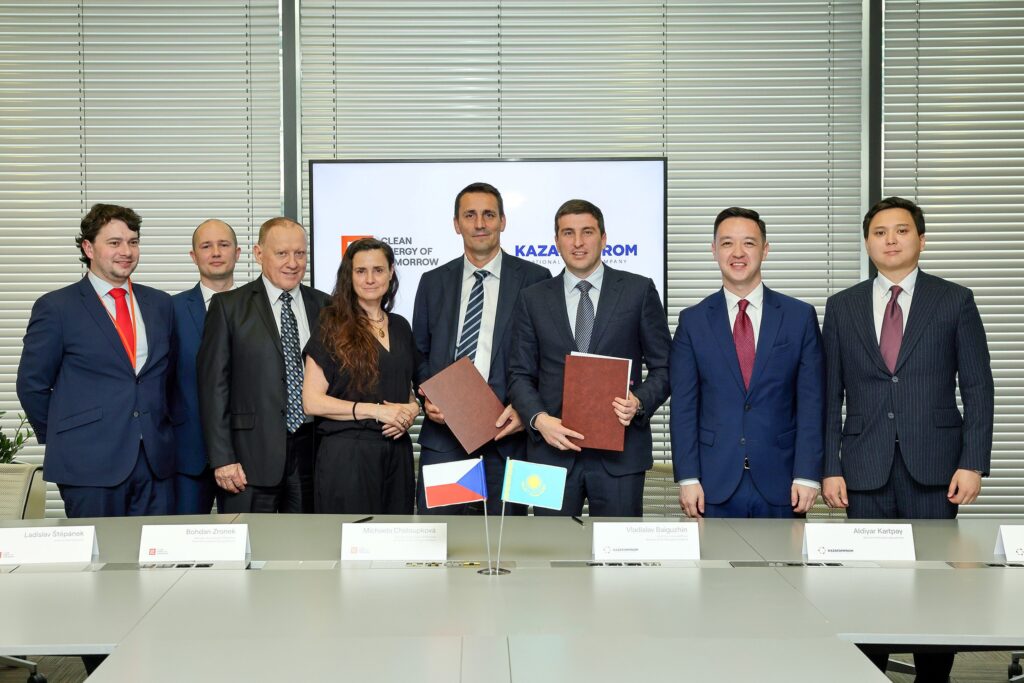
Kazakhstan’s National Atomic Company Kazatomprom has signed a contract with Czech energy giant ČEZ a.s. to supply natural uranium for the country’s nuclear power plants. The agreement marks a significant step in strengthening energy cooperation between Kazakhstan and the European Union. Expanding European Reach The contract, signed at ČEZ’s headquarters in Prague, represents a key milestone in the expansion of Kazatomprom’s uranium supply footprint in Europe. Under the seven-year deal, Kazakhstan will provide approximately one-third of the uranium needed for Westinghouse fuel assemblies used at the Temelín Nuclear Power Plant. Both parties emphasized the agreement’s importance for regional energy security and environmental sustainability. “With the signing of this agreement, Kazatomprom continues to expand its presence in Europe and strengthen its strategy to diversify its sales portfolio. This is another important milestone on our way to becoming the preferred partner for the global nuclear power industry,” said Vladislav Baiguzhin, Kazatomprom’s Chief Commercial Officer. Bogdan Zronek, head of ČEZ’s nuclear division, highlighted the strategic value of the partnership: “The partnership with Kazatomprom diversifies our supplier portfolio and is of strategic importance for ČEZ and the Czech Republic. It provides a stable and reliable source of fuel for our nuclear power plants.” ČEZ and the Czech Nuclear Sector ČEZ is Central Europe’s leading energy company, operating six nuclear reactors at the Temelín and Dukovany sites. Together, these facilities supply roughly 36% of the Czech Republic’s electricity. The company is actively advancing its VIZE 2030 decarbonization strategy, aiming to secure a stable, environmentally friendly energy future. Kazatomprom’s Global Standing Kazatomprom remains the world’s largest producer of natural uranium, accounting for about 21% of global primary production in 2024. All production is carried out in Kazakhstan using in-situ leaching, an environmentally safer extraction method. The company is certified under ISO 45001 and ISO 14001 standards. Kazatomprom exports uranium globally, with key markets in China, Southeast Asia, Europe, and North America. Deliveries are made via long-term contracts and the spot market, including through its Swiss-based subsidiary, Trading House KazakAtom. Ongoing International Partnerships The agreement with ČEZ builds on a strategic relationship initiated in 2016, when the two sides signed a memorandum to cooperate on nuclear fuel cycle projects, including exploration, mining, processing, reclamation, marketing, and technological innovation. In February 2025, Kazatomprom also signed its first-ever uranium supply contract with Switzerland’s Axpo Power AG and Kernkraftwerk Leibstadt AG for the Beznau and Leibstadt nuclear power plants. The latest deal further solidifies Kazatomprom’s position in Europe’s energy market and underscores the growing role of nuclear power in the region’s shift toward clean, sustainable energy sources.

Kazakhstan to Help Jordan Assess Uranium Reserves

During Kazakh President Kassym-Jomart Tokayev’s official visit to Jordan, a memorandum of understanding was signed between Kazakhstan’s Kazatomprom National Atomic Company JSC and the Jordan Uranium Mining Company (JUMCO). The agreement outlines plans for cooperation in uranium exploration and mining in Jordan. Kazatomprom CEO Meirzhan Yusupov emphasized that the partnership with JUMCO presents new opportunities to strengthen Kazakhstan’s position in the global uranium industry. “This memorandum aligns with our strategic goals of efficiently utilizing our resource base. Additionally, studying foreign projects will provide valuable international experience and contribute to the sustainable development of both countries,” he said. Assessing Uranium Potential in Jordan The primary goal of the agreement is to evaluate the potential for uranium exploration and development in Jordan. This includes assessing reserves and analyzing the feasibility of using heap leaching technologies for extraction. Special attention will be given to environmental safety and economic viability. Based on the study results, both parties will decide on the next steps for project development. JUMCO CEO Mohammad Al-Shannagh stated that partnering with the world’s largest uranium producer could accelerate Jordan’s commercial uranium production. “Cooperation with Kazatomprom will open new horizons for us in uranium mining, allowing us to share knowledge, use advanced technologies, and jointly develop marketing strategies,” he said. Joint projects are expected to give new impetus to Jordan’s nuclear industry, creating jobs, attracting local contractors, and improving infrastructure. Kazakhstan’s Expanding Uranium Industry Kazakhstan’s collaboration with JUMCO provides an opportunity to expand its international reach, strengthen economic ties with Jordan, and enhance its influence in the global uranium sector. Kazatomprom is the world’s largest producer of natural uranium, with priority access to one of the world’s most significant resource bases. Since November 2018, Kazatomprom’s shares have been traded on the Astana International Financial Center Exchange and the London Stock Exchange.

Kazatomprom Signs First Uranium Supply Deal with Switzerland

Kazakhstan’s Kazatomprom has signed its first contract to supply natural uranium to Switzerland. The agreement was made with Axpo Power AG and Kernkraftwerk Leibstadt AG (KKL AG), with the uranium designated for use at the Beznau and Leibstadt nuclear power plants. The contract was signed during a visit by Kazatomprom’s delegation to Axpo Power AG’s headquarters in Switzerland. Vladislav Baiguzhin, Chief Commercial Officer of Kazatomprom, described the deal as a significant milestone for the company, expanding its market reach and reinforcing its position as a reliable uranium supplier. He also emphasized that the agreement aligns with Kazatomprom’s strategy to diversify sales channels while supporting global energy security and decarbonization efforts. Dr. Bruno Zimmermann, Head of Nuclear Fuel at Axpo Power AG, underscored the strategic importance of the partnership. He highlighted that nuclear energy plays a crucial role in Switzerland’s low-carbon energy goals and that securing stable fuel supplies remains a top priority. By adding Kazatomprom as a supplier, Axpo and KKL AG are strengthening their ability to ensure a reliable energy supply. Meanwhile, The Times of Central Asia previously reported that Russia’s Uranium One Group, a subsidiary of Rosatom, has withdrawn from its uranium projects in Kazakhstan. This development comes as Kazakhstan is selecting partners to help build its first nuclear power plant. Kazatomprom announced that Uranium One sold its 49.979% share in the Zarechnoye joint venture to SNURDC Astana Mining Company Limited, a firm linked to China’s State Nuclear Uranium Resources Development Co., Ltd. Kazatomprom continues to hold its own 49.979% stake in the project.
