• KGS/USD = 0.01144 0%
  • KZT/USD = 0.00191 0%
  • TJS/USD = 0.10850 0%
  • UZS/USD = 0.00008 0%
  • TMT/USD = 0.28490 0%
  • KGS/USD = 0.01144 0%
  • KZT/USD = 0.00191 0%
  • TJS/USD = 0.10850 0%
  • UZS/USD = 0.00008 0%
  • TMT/USD = 0.28490 0%
  • KGS/USD = 0.01144 0%
  • KZT/USD = 0.00191 0%
  • TJS/USD = 0.10850 0%
  • UZS/USD = 0.00008 0%
  • TMT/USD = 0.28490 0%
  • KGS/USD = 0.01144 0%
  • KZT/USD = 0.00191 0%
  • TJS/USD = 0.10850 0%
  • UZS/USD = 0.00008 0%
  • TMT/USD = 0.28490 0%
  • KGS/USD = 0.01144 0%
  • KZT/USD = 0.00191 0%
  • TJS/USD = 0.10850 0%
  • UZS/USD = 0.00008 0%
  • TMT/USD = 0.28490 0%
  • KGS/USD = 0.01144 0%
  • KZT/USD = 0.00191 0%
  • TJS/USD = 0.10850 0%
  • UZS/USD = 0.00008 0%
  • TMT/USD = 0.28490 0%
  • KGS/USD = 0.01144 0%
  • KZT/USD = 0.00191 0%
  • TJS/USD = 0.10850 0%
  • UZS/USD = 0.00008 0%
  • TMT/USD = 0.28490 0%
  • KGS/USD = 0.01144 0%
  • KZT/USD = 0.00191 0%
  • TJS/USD = 0.10850 0%
  • UZS/USD = 0.00008 0%
  • TMT/USD = 0.28490 0%
10 November 2025

Viewing results 1 - 6 of 7

Kazakhstan Explores Uranium Supply Deal with Finland

During Finnish President Alexander Stubb’s official visit to Kazakhstan, the two countries took a step toward deepening cooperation in the peaceful use of nuclear energy. In Astana, a memorandum of understanding was signed between Kazakhstan’s Atomic Energy Agency and Finland’s Radiation and Nuclear Safety Authority (STUK), laying the groundwork for potential uranium supplies to Finland. According to Almasadam Satkaliev, head of the Kazakh agency, the agreement establishes a legal framework for future deliveries of Kazakh uranium to Finnish nuclear power plants. “The possibility of supplying Kazakh uranium to Finnish nuclear power plants is currently under discussion,” Satkaliev told reporters. “We’ve made such offers before, and the Finnish side has shown serious interest. This visit is an opportunity to move toward practical negotiations on supply volumes.” The memorandum also includes provisions for sharing expertise and experience in the nuclear energy sector. Satkaliev praised Finland’s regulatory framework, describing it as a model recognized by the International Atomic Energy Agency (IAEA). “We have agreed to exchange knowledge and jointly review legislation to align our standards with international best practices,” he said. Kazakhstan, the world’s largest uranium producer, is also advancing its own nuclear power ambitions. The country plans to commission its first nuclear power plant by 2035. In 2024, a nationwide referendum showed over 71% support for nuclear energy development. As a result, the government selected Russia’s Rosatom to construct the first plant near the village of Ulken on the shores of Lake Balkhash. Two additional nuclear projects are planned in cooperation with China’s state-owned China National Nuclear Corporation (CNNC). Satkaliev said CNNC is currently assessing potential sites in the Almaty and Zhambyl regions. “A memorandum has been signed to study Chinese participation. Specific decisions will follow once site surveys are complete,” he explained. Despite its plans to develop domestic nuclear capacity, Kazakhstan remains committed to expanding uranium exports. In 2024, the state-owned company Kazatomprom sold 16,600 tons of uranium, generating a record $3.3 billion in revenue and capturing 21% of global market share. In the first half of 2025, the company sold 7,625 tons, down 2% from the same period the previous year. Kazakhstan currently exports uranium to China, Canada, the U.S., Switzerland, France, India, the Czech Republic, and Bulgaria. China remains the largest customer, accounting for approximately 60% of total shipments. In summer 2025, Kazatomprom signed a memorandum with Slovenské elektrárne (SEAS), Slovakia’s largest energy producer, potentially expanding its export geography even further.

Kazakhstan to Supply Uranium to Slovakia Under New Memorandum

Kazakhstan’s national nuclear company, Kazatomprom, has signed a memorandum of understanding with Slovenské elektrárne a.s. (SEAS), Slovakia’s largest electricity producer, paving the way for future uranium exports to the Central European country. According to a company statement, the memorandum outlines the potential supply of natural uranium concentrate and, eventually, uranium dioxide (UO₂), to fuel Slovakia’s nuclear reactors. The agreement also sets the stage for identifying additional areas of long-term cooperation between the two energy firms. SEAS operates Slovakia’s two nuclear power plants, Bohunice and Mochovce, which collectively run five VVER-440 reactors. The company generates over 70% of Slovakia’s electricity. A controlling 66% stake in SEAS is held by Slovak Power Holding, with the remaining 34% owned by the Slovak government. “With the signing of this memorandum, we are taking an important step towards strengthening cooperation with our European partners,” said Meirzhan Yusupov, Chairman of the Board of Kazatomprom. “Slovakia is one of the countries where nuclear energy plays a key role in ensuring a sustainable energy supply. We hope this agreement lays the foundation for strong and mutually beneficial relations.” Branislav Stricek, CEO and Chairman of SEAS, emphasized the importance of diversifying nuclear fuel sources and expressed confidence in the long-term potential of partnering with the world’s largest uranium producer. Kazatomprom maintained its position as the leading global producer of natural uranium in 2024, accounting for 21% of total output, up from 20% in 2023. The company’s net profit reached $2.1 billion in 2024, marking a 95% increase year-on-year. Kazakh uranium is currently exported to markets across China, Southeast Asia, Europe, and the Americas. This new agreement with SEAS follows several recent deals with European energy providers. In February 2025, Kazatomprom signed its first uranium supply contract with Swiss firms Axpo Power AG and Kernkraftwerk Leibstadt AG to fuel the Beznau and Leibstadt nuclear power plants. In April, The Times of Central Asia, reported that the company had also entered into a similar agreement with Czech energy giant ČEZ.

L’Étranger: Paris Hosts the Reclusive Leader of Turkmenistan

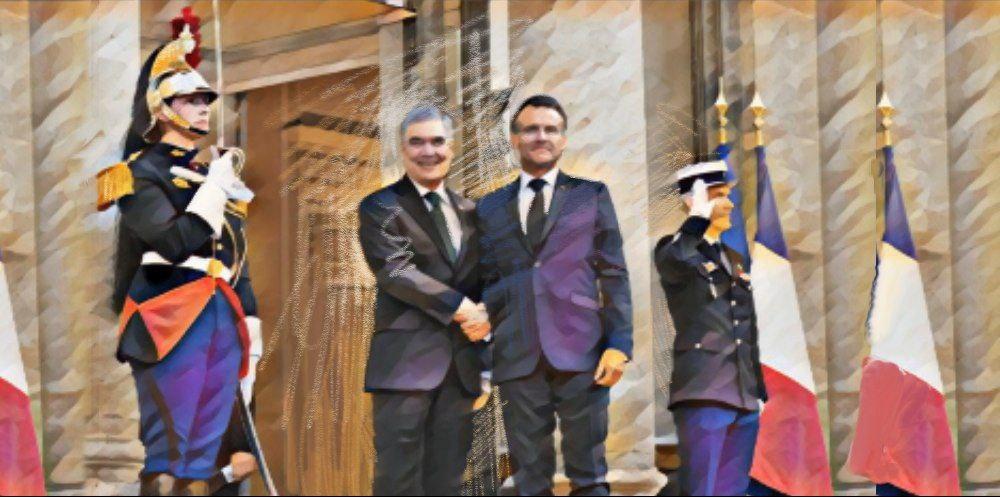
Gurbanguly Berdimuhamedov, Turkmenistan’s longtime ruler, no longer holds the title of president; that has been passed, along with much of the public burden, to his son. He now reigns from the shadows as Hero-Arkadag (“Hero-Protector”), but he retains the ability to open doors. Nearly 14 years after his last official visit, Berdimuhamedov landed at Paris’ Orly airport last Monday. He was in France ostensibly to attend the Franco-Turkmen Economic Forum, but the visit also saw him ushered into the Élysée Palace for an audience with President Emmanuel Macron. Characteristically, his presence in Paris was kept quiet, receiving very little coverage even in the French media. “It was much less discussed than the near-concurrent visit of the Syrian leader, Ahmed Al-Charaa,” Michaël Levystone, co-founder of l'Observatoire de la Nouvelle Eurasie, a Paris think tank told The Times of Central Asia. “You have to understand that Turkmenistan is a country that is virtually unknown to the general public in France – and for good reason: it goes out of its way to remain extremely discreet!” Nevertheless, the visit marks a rare moment of high-level Western diplomacy with one of the world’s most opaque regimes, as well as an extremely uncommon public diplomatic appearance from Berdimuhamedov Senior since ceding formal power in 2022. The questions are why France? And why now? What Was Discussed The two readouts of the encounter were notably different. The Élysée offered a terse summary on its website, noting vaguely that the meeting “provided an opportunity to review the bilateral relationship between Turkmenistan and France as well as regional issues.” Macron then followed this up with an equally laconic post on X, noting that the two had “signed several agreements between Turkmenistan and France in the areas of energy transition, infrastructure, education, and culture. They demonstrate the strengthening of our cooperation. We also took stock of major regional and international crises, including Russia's war of aggression against Ukraine and the situation in the Middle East.” On the other hand, the state-run news service Turkmenistan Today provided what can only be described as a detailed travelogue, noting the many dignitaries who had the pleasure of meeting the Hero-Arkadag on his whistle-stop tour of the City of Lights. According to the Turkmens, the visit yielded a flurry of agreements. A memorandum of understanding was inked between state-owned Türkmengaz and French tech firm Kayrros SAS, while France’s Thales Alenia Space Group signed a framework deal to provide Ashgabat with a second communications satellite. There were further promises of joint work on green energy, education, and archaeological research. A Foot in the Door One French company in particular is responsible for much of the engagement between the two countries. As part of his trip to Paris, Berdimuhamedov met with construction magnate Martin Bouygues, CEO of the firm that bears his family’s name. [caption id="attachment_31644" align="aligncenter" width="2560"] The Presidential Palace and ministries complex, built by the French company Bouygues; image: TCA, Stephen M. Bland[/caption] “Bouygues has built numerous monumental buildings in Ashgabat since Turkmenistan's independence,” Levystone told...

Kazakh Uranium to Power Czech Nuclear Plants

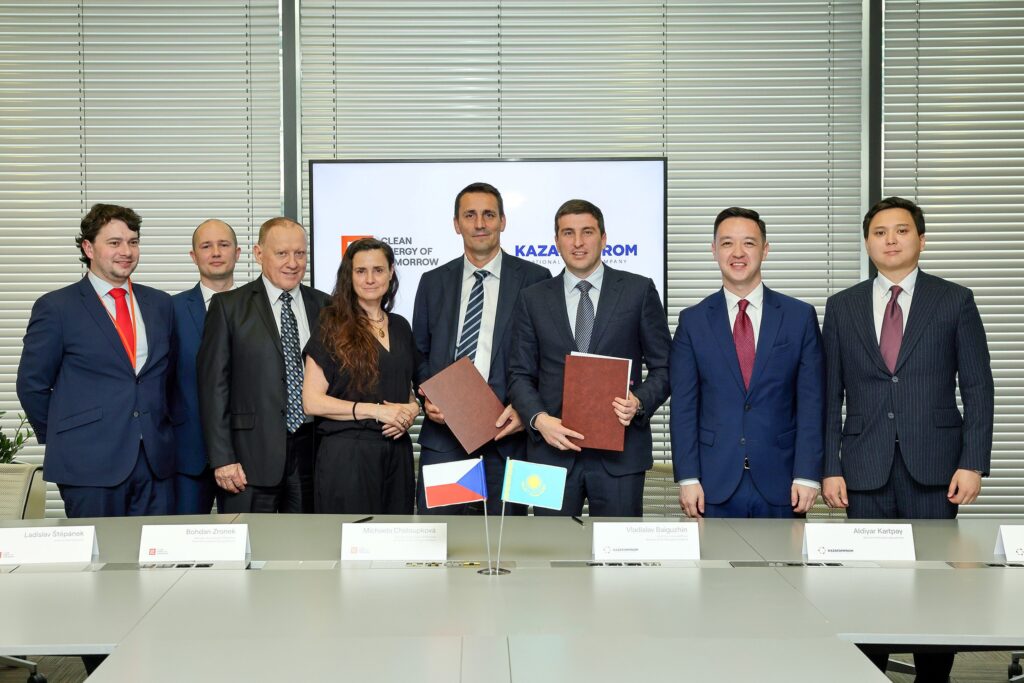
Kazakhstan’s National Atomic Company Kazatomprom has signed a contract with Czech energy giant ČEZ a.s. to supply natural uranium for the country’s nuclear power plants. The agreement marks a significant step in strengthening energy cooperation between Kazakhstan and the European Union. Expanding European Reach The contract, signed at ČEZ’s headquarters in Prague, represents a key milestone in the expansion of Kazatomprom’s uranium supply footprint in Europe. Under the seven-year deal, Kazakhstan will provide approximately one-third of the uranium needed for Westinghouse fuel assemblies used at the Temelín Nuclear Power Plant. Both parties emphasized the agreement’s importance for regional energy security and environmental sustainability. “With the signing of this agreement, Kazatomprom continues to expand its presence in Europe and strengthen its strategy to diversify its sales portfolio. This is another important milestone on our way to becoming the preferred partner for the global nuclear power industry,” said Vladislav Baiguzhin, Kazatomprom’s Chief Commercial Officer. Bogdan Zronek, head of ČEZ’s nuclear division, highlighted the strategic value of the partnership: “The partnership with Kazatomprom diversifies our supplier portfolio and is of strategic importance for ČEZ and the Czech Republic. It provides a stable and reliable source of fuel for our nuclear power plants.” ČEZ and the Czech Nuclear Sector ČEZ is Central Europe’s leading energy company, operating six nuclear reactors at the Temelín and Dukovany sites. Together, these facilities supply roughly 36% of the Czech Republic’s electricity. The company is actively advancing its VIZE 2030 decarbonization strategy, aiming to secure a stable, environmentally friendly energy future. Kazatomprom’s Global Standing Kazatomprom remains the world’s largest producer of natural uranium, accounting for about 21% of global primary production in 2024. All production is carried out in Kazakhstan using in-situ leaching, an environmentally safer extraction method. The company is certified under ISO 45001 and ISO 14001 standards. Kazatomprom exports uranium globally, with key markets in China, Southeast Asia, Europe, and North America. Deliveries are made via long-term contracts and the spot market, including through its Swiss-based subsidiary, Trading House KazakAtom. Ongoing International Partnerships The agreement with ČEZ builds on a strategic relationship initiated in 2016, when the two sides signed a memorandum to cooperate on nuclear fuel cycle projects, including exploration, mining, processing, reclamation, marketing, and technological innovation. In February 2025, Kazatomprom also signed its first-ever uranium supply contract with Switzerland’s Axpo Power AG and Kernkraftwerk Leibstadt AG for the Beznau and Leibstadt nuclear power plants. The latest deal further solidifies Kazatomprom’s position in Europe’s energy market and underscores the growing role of nuclear power in the region’s shift toward clean, sustainable energy sources.

Kazatomprom Signs First Uranium Supply Deal with Switzerland

Kazakhstan’s Kazatomprom has signed its first contract to supply natural uranium to Switzerland. The agreement was made with Axpo Power AG and Kernkraftwerk Leibstadt AG (KKL AG), with the uranium designated for use at the Beznau and Leibstadt nuclear power plants. The contract was signed during a visit by Kazatomprom’s delegation to Axpo Power AG’s headquarters in Switzerland. Vladislav Baiguzhin, Chief Commercial Officer of Kazatomprom, described the deal as a significant milestone for the company, expanding its market reach and reinforcing its position as a reliable uranium supplier. He also emphasized that the agreement aligns with Kazatomprom’s strategy to diversify sales channels while supporting global energy security and decarbonization efforts. Dr. Bruno Zimmermann, Head of Nuclear Fuel at Axpo Power AG, underscored the strategic importance of the partnership. He highlighted that nuclear energy plays a crucial role in Switzerland’s low-carbon energy goals and that securing stable fuel supplies remains a top priority. By adding Kazatomprom as a supplier, Axpo and KKL AG are strengthening their ability to ensure a reliable energy supply. Meanwhile, The Times of Central Asia previously reported that Russia’s Uranium One Group, a subsidiary of Rosatom, has withdrawn from its uranium projects in Kazakhstan. This development comes as Kazakhstan is selecting partners to help build its first nuclear power plant. Kazatomprom announced that Uranium One sold its 49.979% share in the Zarechnoye joint venture to SNURDC Astana Mining Company Limited, a firm linked to China’s State Nuclear Uranium Resources Development Co., Ltd. Kazatomprom continues to hold its own 49.979% stake in the project.