


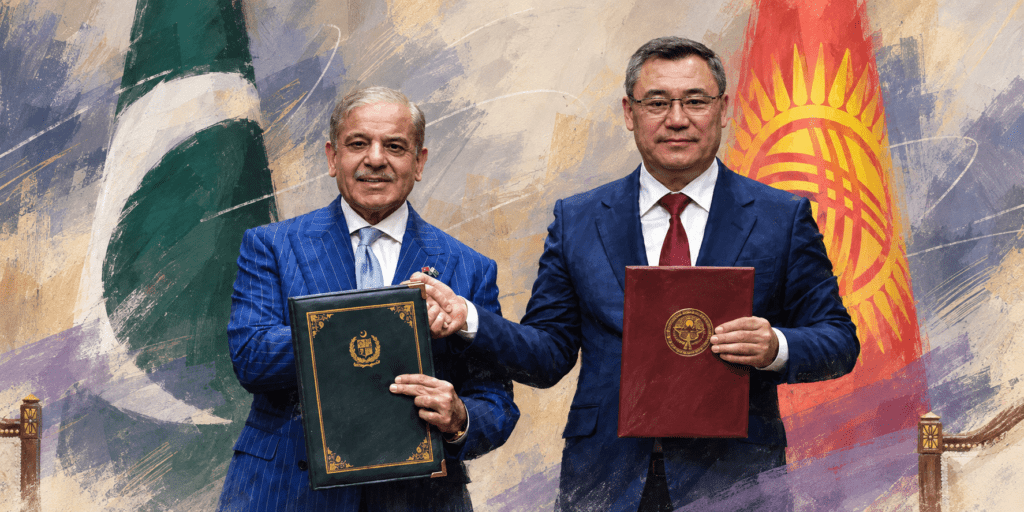
Kyrgyzstan-Pakistan Trade: 12-Fold Growth or Pipe Dream?
One of the most notable of Kyrgyzstan’s agreements at the SCO Summit in Bishkek last week may be its deal with Pakistan to boost annual bilateral trade to US$200 million within the next two years. From a base of roughly US$16 million in 2025, that would represent roughly a twelvefold increase. It's an ambitious target, made more so by associated geoeconomic undercurrents. As long as Bishkek avoids taking sides in any Indo-Pakistan unresolved border or other geopolitical disputes and sticks to trade and commercial issues, Kyrgyzstan should have little to worry about. President Sadyr Japarov emphasized the economic benefits, casting the Joint Statement with Pakistan as a means of bringing greater resources and opportunities to the Kyrgyz people. “The economy should become the foundation of the Kyrgyz-Pakistani partnership,” he told reporters after the talks. Prime Minister Sharif similarly argued that current trade was “not a patch on our friendship, our brotherhood and our very strong relations.” In other words, Sharif thinks that the level of trade between Pakistan and Kyrgyzstan is far too low compared with the strength of their political and diplomatic relationship. The Joint Statement of Japarov and Sharif reads that the two governments “agreed to expand industrial and investment cooperation in the fields of mining and processing industries, agriculture, food, textile and light industries, pharmaceuticals, the halal industry and digital technologies, with particular emphasis on establishing joint ventures, localizing production, exchanging technologies and implementing mutually beneficial investment projects.” The leaders also agreed to promote the Tamchy Special Financial Investment Territory as a platform for international investment, fintech, innovation, and global business. Kyrgyzstan has pushed this priority hard in recent years, with Tamchy SFIT Chairman and Deputy Chairman of the Cabinet of Ministers Ayaz Baetov and Tamchy SFIT Deputy Chairman and Minister of Economy and Commerce Bakyt Sydykov spearheading the effort. The Trade Picture If historical patterns are indicative of future behavior, growth in trade over the next two years points toward pharmaceuticals (already Kyrgyzstan's largest import category from Pakistan, at over $6 million of roughly $14 million U.S. dollars in 2025), textiles and ready-made garments (Pakistan's largest global export sector), dried fruit, rice and other agricultural goods, and a newer category: virtual assets and engagement in the digital and IT space. [caption id="attachment_55574" align="aligncenter" width="1500"] Trade figures: UN Comtrade via TradingEconomics.com, 2025 data.[/caption] Kyrgyzstan’s side of the ledger is thin by comparison. Its exports to Pakistan totaled $1.6 million in 2025, led by mineral fuels at about $719,000. Raw hides and leather accounted for about $341,000. It is worth being precise about what this agreement actually does. It does not describe $200 million of commerce that will simply appear. The Joint Statement seeks to spur that trade by fixing transit problems, which touch, then, on geoeconomics and unresolved territorial issues. Kyrgyz officials have emphasized improving logistics and pointed to Pakistan's Arabian Sea ports as a route to global markets. The tested route runs through western China and across the Khunjerab Pass, following the Karakoram Highway to Sost...
