


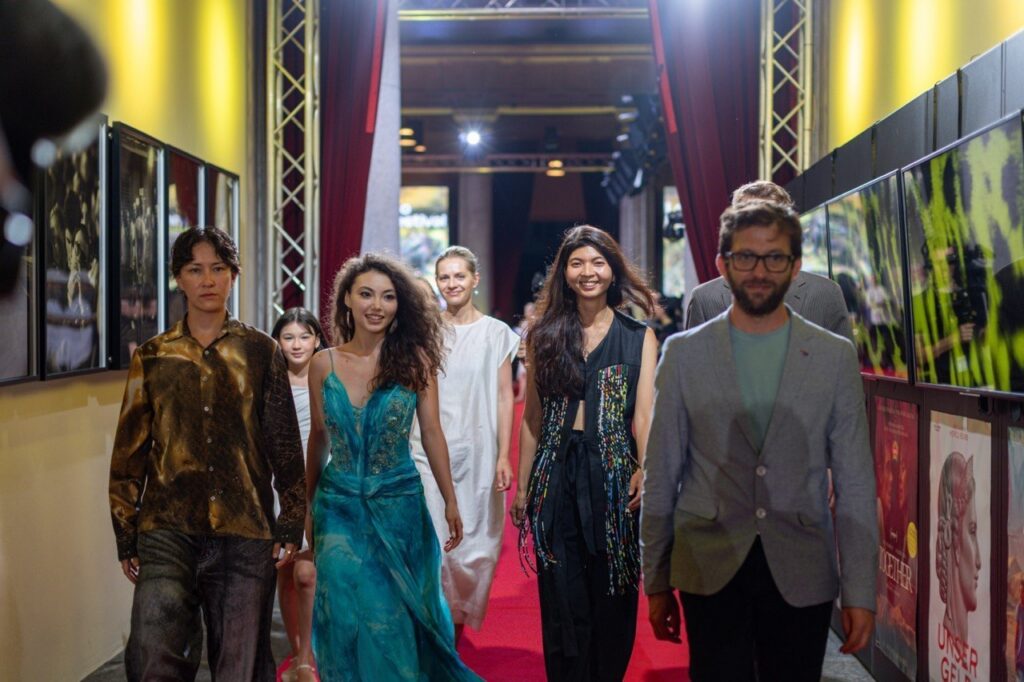
“Between Worlds”: Filmmaker Zhannat Alshanova on Migration and Identity
Kazakhstani filmmaker Zhannat Alshanova belongs to a new generation of directors whose careers have unfolded across countries and cultures. Before establishing herself as an auteur filmmaker, the London Film School graduate worked on international productions filmed in Kazakhstan, South Africa, Guatemala, Malaysia, and the United States. Her short film History of Civilization won the Silver Leopard at the Locarno Film Festival; several years later, her debut feature Becoming also premiered there. In an interview with The Times of Central Asia, Alshanova discusses migration, identity, the Western film industry, the creative vulnerability of young directors, and what it means to make cinema “between worlds.” TCA: Zhannat, would it be fair to call you a “Locarno star”? Your debut feature Becoming premiered there; before that, you won the Silver Leopard for your short A History of Civilization, and you also took part in the festival’s directing academy. Zhannat: We really have had a long relationship. Even before screening my own films there, I attended the festival as a co-producer of a South African film selected for competition. That was a year before my own participation. TCA: How did you end up working on a South African project, and what was the film about? Zhannat: It was made by people from my film school. We all studied together at London Film School, although they were a year ahead of me. It was a genuinely creative environment where everyone supported one another and worked on each other’s graduation films. Usually, productions took place in the filmmaker’s home country, so I ended up helping produce projects not only in South Africa, but also in Turkey and the United States. In Guatemala, I worked as a second assistant director. The South African project was a hybrid film, part fiction, part documentary, a road movie about a young man traveling to an audition. The entire story unfolds through that journey. It turned out to be a very beautiful film. [caption id="attachment_49166" align="aligncenter" width="1280"] From a personal photo archive[/caption] TCA: You all came to London Film School from completely different parts of the world. Were your themes similar or very different? Zhannat: Some were similar, others completely different. So many factors shape a filmmaker, the country you grew up in, your personal background, your experience of migration or travel. Some people had lived in one country their entire lives before leaving; others had moved between countries since childhood, while some had lived abroad and then returned home. Everyone carried different experiences. Some directors were interested in stories about children, others focused on people their own age, while some tried to imagine the future. The ideas were extremely varied, but all of them were vivid and personal. For me, the greatest asset of film school was access to different cultures and perspectives. Everyone brought their own cinematic baggage, films, directors and artistic traditions you might never otherwise encounter. It became a fascinating mix of global culture. TCA: What kind of film were you working on in Guatemala? Zhannat: It...
