• KZT/USD = 0.00220
  • TJS/USD = 0.10830
  • UZS/USD = 0.00008
  • TMT/USD = 0.29760
  • KZT/USD = 0.00220
  • TJS/USD = 0.10830
  • UZS/USD = 0.00008
  • TMT/USD = 0.29760
  • KZT/USD = 0.00220
  • TJS/USD = 0.10830
  • UZS/USD = 0.00008
  • TMT/USD = 0.29760
  • KZT/USD = 0.00220
  • TJS/USD = 0.10830
  • UZS/USD = 0.00008
  • TMT/USD = 0.29760
  • KZT/USD = 0.00220
  • TJS/USD = 0.10830
  • UZS/USD = 0.00008
  • TMT/USD = 0.29760
  • KZT/USD = 0.00220
  • TJS/USD = 0.10830
  • UZS/USD = 0.00008
  • TMT/USD = 0.29760
  • KZT/USD = 0.00220
  • TJS/USD = 0.10830
  • UZS/USD = 0.00008
  • TMT/USD = 0.29760
  • KZT/USD = 0.00220
  • TJS/USD = 0.10830
  • UZS/USD = 0.00008
  • TMT/USD = 0.29760
19 October 2026

Viewing results 1 - 6 of 3

Kyrgyzstan Public Debt Exceeds $10 Billion as Repayment Costs Rise

Kyrgyzstan’s public debt reached $10.16 billion by the end of July 2026, with the government expecting to spend about $1.83 billion servicing its external debt between 2027 and 2029. According to Ministry of Finance figures, external debt stood at $5.19 billion as of July 31, while domestic debt totaled $4.96 billion. External borrowing consists mainly of loans from foreign governments and international financial institutions, while domestic debt is raised primarily through government bonds. Total debt was equivalent to about 38% of the government’s projected gross domestic product (GDP) for 2026. At the end of 2025, the debt-to-GDP ratio stood at 39.5%, up from 36.2% a year earlier. The International Monetary Fund (IMF) expects the ratio to reach 41.4% by the end of 2026. The country’s debt burden is relatively high compared with those of its Central Asian neighbors. IMF figures put Kazakhstan’s public debt at 25.2% of GDP in 2025, while the equivalent figures were 28.6% for Uzbekistan and a projected 24.7% for Tajikistan. For comparison, United States government debt stood at 123.9% of GDP in 2025. China remains Kyrgyzstan’s largest foreign creditor. According to Deputy Finance Minister Umutjan Amanbaev, Bishkek owes Beijing about $1.4 billion, equivalent to 27% of its external debt. Much of the remainder is owed to international development banks and financial institutions. Most external loans were obtained on concessional terms, generally carrying low interest rates and long repayment periods. However, the country has also begun taking on more expensive commercial debt. In May 2025, the government issued its first sovereign Eurobonds, raising $700 million through five-year notes carrying an annual interest rate of 7.75%. The bonds, placed on the London Stock Exchange, now account for about 13.5% of external debt. They are due to mature in 2030, when external debt repayments are projected to reach about $1.1 billion, based on the repayment schedule for existing obligations. The draft budget for 2027–2029, published by the Ministry of Finance, allocates about $606 million to external debt servicing in 2027, $600 million in 2028, and $621 million in 2029. These payments cover principal and interest on existing debt. More than 80% are denominated in U.S. dollars, so a weaker som could increase the budget cost of meeting the same obligations. The government also expects to spend 82.2 billion soms servicing domestic debt. Public debt remains below the government’s benchmark of 70% of GDP. The Ministry of Finance expects debt sustainability to be maintained over the medium term, although exchange-rate fluctuations and economic shocks remain significant risks. The IMF also considers the debt sustainable, while assessing its risk of debt distress as moderate. However, it has warned that growing repayment costs, particularly on domestic and non-concessional borrowing, could place increasing pressure on public finances.
Uzbekistan Conducts First Dual IPO in London and Tashkent

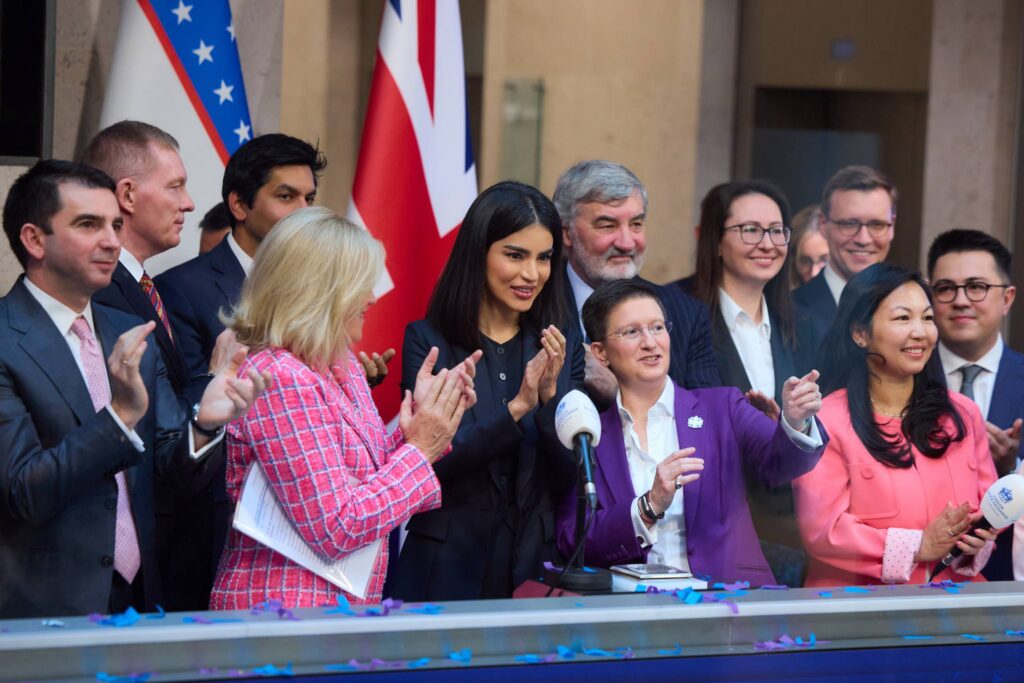
Uzbekistan has completed its first international equity offering, as the state-backed National Investment Fund of Uzbekistan (UzNIF) began trading through a dual listing on the London Stock Exchange and the Tashkent Stock Exchange. UzNIF raised $603.6 million by selling a 31% stake to international and domestic investors. The proceeds could rise to about $692 million if an overallotment option is exercised in full, bringing the total stake sold to 35%. At the offer price, the fund was valued at about $1.95 billion. The offering was managed by Franklin Templeton, while cornerstone investors included funds and accounts managed by BlackRock, Franklin Resources, and Redwheel. The shares were sold by Uzbekistan’s Ministry of Economy and Finance, so the proceeds will go to the state rather than directly to the fund. The listing attracted more than $2.8 billion in investor demand. Julia Hoggett, chief executive of the London Stock Exchange, described UzNIF as the first international IPO from Uzbekistan and the largest IPO on the exchange’s markets so far this year. Saida Mirziyoyeva, head of Uzbekistan’s presidential administration, framed the transaction as part of the country’s effort to deepen capital-market reforms and draw long-term foreign investment. Speaking at the London Stock Exchange, she said the IPO was not only about raising capital, but also about building trust in a new generation of Uzbek institutions. “Uzbekistan has become a more open and reliable partner for the global capital market,” Mirziyoyeva wrote on Telegram. Uzbek officials say the country’s economy has nearly tripled in size in recent years, while investor protections and corporate governance standards have been strengthened. The listing comes as Uzbekistan intensifies efforts to position itself as a new investment destination in Central Asia. During a visit to London, Mirziyoyeva held talks with British officials, financial executives, and investors as Tashkent seeks to expand private-sector participation and develop plans linked to a proposed Tashkent International Financial Centre. Official figures show that British businesses have already invested more than $1 billion in Uzbekistan’s economy. Trading in London opened at $25 per global depositary receipt, with shares rising roughly 12% to $28 within the first hours of trading. On the domestic market, a separate tranche was made available through the Tashkent Stock Exchange, giving Uzbek investors access to a vehicle that had primarily been aimed at international institutions. UzNIF holds stakes in 13 state-linked companies in sectors including transport, energy, banking, telecommunications, utilities, and aviation. Its major holdings include Uzbekistan Airways, Uzbektelecom, Uzbekhydroenergo, and other infrastructure and energy operators. The fund was established in 2024 as part of Uzbekistan’s broader privatization and capital-market reform program. By grouping stakes in strategic state-owned enterprises into a single listed vehicle, the government is offering investors exposure to several parts of the Uzbek economy while retaining state control over the underlying assets. For Uzbekistan, the successful dual listing is a significant market-opening moment. It gives the government a benchmark for future privatizations, broadens access to Uzbek equities, and tests whether investor interest in the country’s reform story can be...

Kyrgyzstan Raises $700 Million in Landmark Eurobond Debut on London Stock Exchange

Kyrgyzstan has successfully issued its first Eurobonds on the London Stock Exchange, raising $700 million at an annual interest rate of 7.75% with a five-year maturity. According to the Ministry of Finance, investor demand for the debut issuance exceeded the offer by a factor of three, reflecting strong international confidence in Kyrgyzstan's economic prospects. More than 100 investors from the United Kingdom, the United States, and various Asian countries participated in the placement. “The high demand confirms growing confidence in Kyrgyzstan’s macroeconomic policy, the strengthening of its financial system, and the government's commitment to transparency, fiscal discipline, and international financial integration,” the Ministry stated. Former Prime Minister Akylbek Japarov, writing on his official Facebook page, highlighted the historical significance of the move. Kyrgyzstan had been the last country in Central Asia not to issue Eurobonds, he noted, and for many years such an operation appeared unattainable. The successful launch, he added, was the result of sustained work across all levels of government, improving macroeconomic indicators, building investor trust, and elevating the country’s sovereign credit rating. Japarov proposed that the $700 million raised be directed toward strategically important sectors, including energy and mineral resources. Specifically, he recommended funding the construction of a new coal-fired thermal power plant in Naryn region and a power station in Chui region. He also emphasized the need to develop rare earth metal deposits in Chui and Issyk-Kul regions. The Eurobond issuance was a central topic at the recent Bishkek International Financial Forum, which focused on innovation, digital transformation, and sustainable development in the financial sector. In an interview with The Times of Central Asia, Medetbek Nazaraliev, former CEO of the Kyrgyz Stock Exchange (KSE), said Kyrgyzstan’s entry into global debt markets could pave the way for private sector growth. “We have been waiting for this step for a long time. Large-scale foreign investment is unlikely unless the state leads by example, demonstrating how to attract capital, fulfill international obligations, and act as a reliable partner in global financial markets,” he said.
