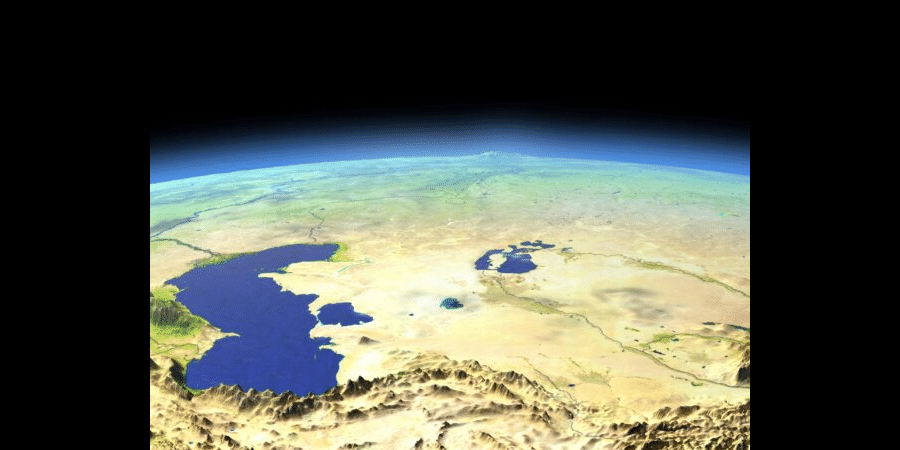
How the Shrinking Caspian Sea Affects the Middle Corridor’s Potential
Paradoxically, the Caspian Sea is becoming one of Eurasia’s most important transport hubs at a time when its falling water level is creating growing constraints on navigation. As sanctions disrupt traditional trade routes through Russia, countries are investing in the Middle Corridor as an alternative link between Asia and Europe. Yet the continuing decline in sea level is limiting shipping capacity and increasing the risks and costs associated with long-term infrastructure projects. The first Caspian Environmental Summit, held in Turkmenistan on October 9, 2026, drew attention to the scale of these changes. Between 2000 and 2025, the Caspian Sea shrank by more than 16,000 square kilometers, while in some areas the shoreline receded by tens of kilometers. How the Caspian’s Falling Water Level Affects Freight The Middle Corridor, linking China, Central Asia, the Caspian Sea, the South Caucasus, Turkey, and Europe, is seen as a promising route for diversifying international trade. Its development can reduce shippers’ dependence on individual transport routes and improve economic ties among countries in the region. According to the World Bank’s latest study, more than $25 billion in investment in the corridor’s core physical infrastructure will be needed through 2040. An additional $30 billion could be required for enabling infrastructure and services. The bank estimates that if infrastructure investment is combined with institutional reforms, freight volumes along the corridor could quadruple and travel times could fall by about two-thirds by 2040. A study by the Organisation for Economic Co-operation and Development (OECD) notes that insufficient depths are already preventing vessels from being fully loaded, reducing transport efficiency and increasing costs. Large-scale dredging was carried out at the Port of Kuryk in 2024. Over four months, around one million cubic meters of material were removed, and the depth of the operational port area was increased to 7–8 meters, according to the port operator. This made it possible to load vessels to full capacity. Meanwhile, major dredging work is underway at Aktau, where 1.3 million cubic meters of material are to be removed to increase water depths to 6–7 meters. The work is expected to be completed by the end of 2026. Dredging, however, can only maintain the operation of individual port facilities, while further declines in the sea level may require repeated work or the reconstruction of berths. Where draft restrictions prevent full loading, transport companies may need to make more voyages to carry the same volume of cargo, increasing spending on fuel, crews, maintenance, and port operations. Constraints on the maritime section can also lead to delays for railcars and containers and disrupt transshipment schedules. These disruptions reduce the predictability of deliveries along the entire route. Similar problems are emerging on the western coast of the Caspian. Falling water levels are reducing vessel cargo capacity at Azerbaijani ports and oil terminals and requiring additional dredging. Infrastructure for Decades Ahead According to the OECD study, which cites World Bank climate projections, under a high-emissions scenario in which the Caspian water level falls by about five meters between...