• KGS/USD = 0.01144 0%
  • KZT/USD = 0.00208 0%
  • TJS/USD = 0.10445 -0.57%
  • UZS/USD = 0.00008 0%
  • TMT/USD = 0.28571 0%
  • KGS/USD = 0.01144 0%
  • KZT/USD = 0.00208 0%
  • TJS/USD = 0.10445 -0.57%
  • UZS/USD = 0.00008 0%
  • TMT/USD = 0.28571 0%
  • KGS/USD = 0.01144 0%
  • KZT/USD = 0.00208 0%
  • TJS/USD = 0.10445 -0.57%
  • UZS/USD = 0.00008 0%
  • TMT/USD = 0.28571 0%
  • KGS/USD = 0.01144 0%
  • KZT/USD = 0.00208 0%
  • TJS/USD = 0.10445 -0.57%
  • UZS/USD = 0.00008 0%
  • TMT/USD = 0.28571 0%
  • KGS/USD = 0.01144 0%
  • KZT/USD = 0.00208 0%
  • TJS/USD = 0.10445 -0.57%
  • UZS/USD = 0.00008 0%
  • TMT/USD = 0.28571 0%
  • KGS/USD = 0.01144 0%
  • KZT/USD = 0.00208 0%
  • TJS/USD = 0.10445 -0.57%
  • UZS/USD = 0.00008 0%
  • TMT/USD = 0.28571 0%
  • KGS/USD = 0.01144 0%
  • KZT/USD = 0.00208 0%
  • TJS/USD = 0.10445 -0.57%
  • UZS/USD = 0.00008 0%
  • TMT/USD = 0.28571 0%
  • KGS/USD = 0.01144 0%
  • KZT/USD = 0.00208 0%
  • TJS/USD = 0.10445 -0.57%
  • UZS/USD = 0.00008 0%
  • TMT/USD = 0.28571 0%

Viewing results 1 - 6 of 14

Kazakhstan and Germany Launch Mining and Metallurgy Consortium

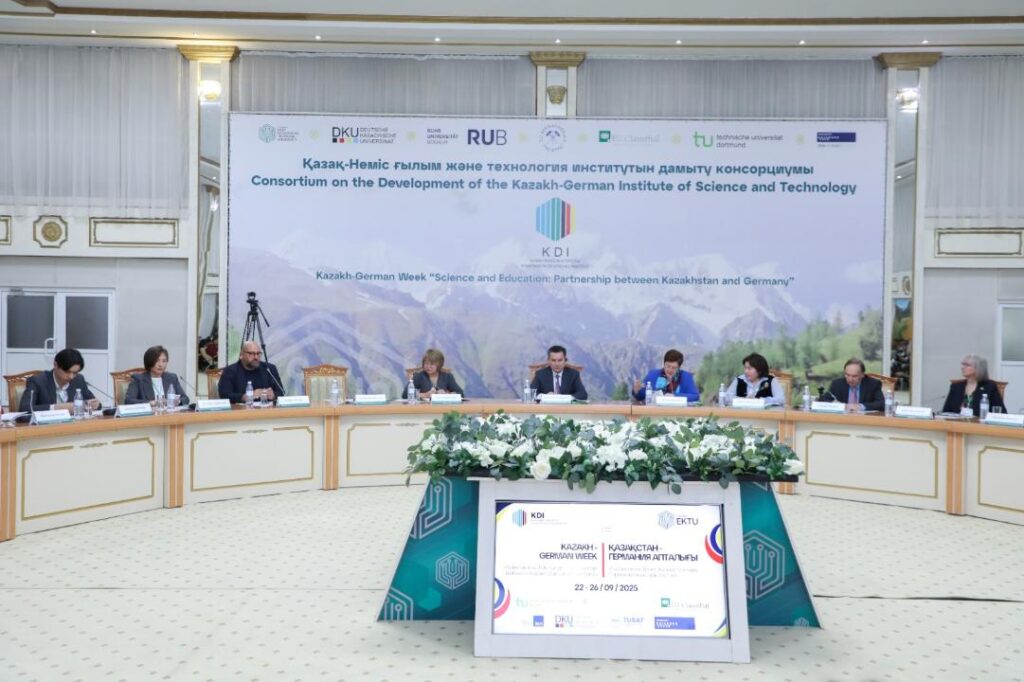
The second Kazakh-German Week, Science and Education: Partnership between Kazakhstan and Germany, opened on September 23 at Serikbayev East Kazakhstan Technical University in Oskemen (Ust-Kamenogorsk), the industrial heart of East Kazakhstan region and a key hub for the country’s mining and metallurgical sector. A major outcome of the opening ceremony was the establishment of the Consortium for the Development of the Kazakh-German Institute of Science and Technology. The institute, launched in 2024 at East Kazakhstan Technical University, focuses on specialized training for professionals in mining and metallurgy. The new Consortium brings together leading academic institutions from both countries, including Serikbayev East Kazakhstan Technical University, Kazakh-German University, Technische Universität Bergakademie Freiberg (Freiberg University of Mining and Technology), Ruhr University Bochum, Clausthal University of Technology, Technical University of Dortmund, and the University of Duisburg-Essen. Its mission is to promote joint research, academic exchange, technology transfer, and applied projects across critical industrial domains such as mining, geology, rare earth metals, energy, and environmental engineering. Key industrial players in East Kazakhstan, including Kazzinc, the Ust-Kamenogorsk Titanium and Magnesium Plant, and the Ulba Metallurgical Plant, are actively supporting the initiative through applied science and innovation partnerships. In a video address, Minister of Science and Higher Education Sayasat Nurbek emphasized that German universities remain strategic partners for Kazakhstan in developing a future-ready workforce. Officials noted that the consortium’s launch holds particular significance for East Kazakhstan, where mining and metallurgy form a cornerstone of the national industrial economy. Long-term sustainability in the sector, they said, will depend on the integration of science, innovation, and high-level technical education.

Kazakhstan’s Surge in Metallurgical Output Raises Alarm in Russia

Kazakhstan is poised to double its copper ore production to 300 million tons by 2030, with the Aidarly, Koksay, and Benkala deposits leading the expansion. This ambitious plan was announced by Deputy Minister of Industry and Construction Olzhas Saparbekov during a recent government meeting. A Strategic Shift Toward Processing Alongside copper, Kazakhstan plans to expand iron ore production by 40%, aiming for 52 million tons. This increase will be driven by enterprise modernization and new projects producing hot-briquetted iron. In 2024, metallurgical ore production grew by 7.8%, while total metal output rose by 6.9%. Authorities are shifting focus from raw extraction to deep processing and the development of medium- and high-tech industries. By 2025, copper processing is expected to double, aluminum processing will increase by 50%, lead processing will more than double, and zinc output will rise by 11%. According to Saparbekov, these efforts will allow Kazakhstan to “utilize domestic production capacities and expand the output of finished products,” including wire rod, cable and wire products, batteries, window profiles, fittings, and bimetallic radiators. New projects also aim to produce brass components and industrial batteries. Economic Impact and Investment Plans The mining and metallurgical sector currently contributes 8% to Kazakhstan’s GDP, generating over $26.4 billion annually. The industry employs approximately 224,000 people. In 2024 alone, more than $3.2 billion was invested in metallurgy, while labor productivity increased by 9.4%, reaching $102,000 per worker. In 2025, Kazakhstan plans to implement 190 industrial projects worth a combined $3 billion. Of these, 28 projects in the mining and metallurgical sector, valued at $837 million, are expected to create 6,500 new jobs. Priority initiatives include the production of seamless pipes and aluminum radiators in Karaganda, aluminum profiles in the Turkestan Region, ferroalloys in Pavlodar, and cathode copper in the Zhambyl Region. Rising Tensions with Russia However, Kazakhstan’s rapid metallurgical growth is stirring concern in neighboring Russia. In the first half of 2025, domestic steel demand in Russia fell by 14-15%, with the machine-building and energy sectors seeing a sharper decline of 25%. Severstal CEO Alexander Shevelev told Kommersant that increasing supplies from Kazakhstan, alongside imports from China, are straining Russia’s market and may force plant closures. He identified particularly intense competition in Siberia and the Russian Far East. Severstal has warned that, without protective measures under the Eurasian Economic Union (EAEU), pressure from Kazakh imports could spread to other Russian regions. In response, Russia is considering launching an anti-dumping investigation into Kazakh steel imports. Such a move could significantly impact Kazakh exporters, who are looking to increase shipments amid weak domestic demand in neighboring markets. According to the World Steel Association, Russia’s steel production declined by 5.2% between January and May 2025. The drop is attributed to low global prices, high interest rates, rising production costs, and sluggish industrial activity.

Chinese Company to Build Metallurgical Plant in Kazakhstan

Chinese metallurgical company Fujian Hengwang Investment Co., Ltd. will build a 3-million-ton capacity steel plant in the Zhibek Zholy special economic zone in Kazakhstan’s Zhambyl region. The project was discussed during a February 27 meeting between Kazakhstan’s Prime Minister Olzhas Bektenov and Fujian Hengwang Investment Chairman Zeng Zhaoqiang​. $1.2 Billion Investment and Job Creation Fujian Hengwang Investment plans to invest $1.2 billion in the project, which is expected to create 2,500 jobs. Construction Timeline and Production Capacity April 2025 - Construction is scheduled to begin. 2027 (Phase 1) - The plant will have an initial production capacity of 1 million tons of steel. 2029 (Phase 2) - Capacity will expand to 3 million tons of steel. Use of Domestic Resources The project will utilize Kazakhstani raw materials, including natural gas and iron ore sourced from the Karaganda, Kostanay, and Ulytau regions. The plant will manufacture wire rod, reinforcement steel, steel for pipe production, and angle and profile steel. Planned Power Plant As part of the second phase, a 350 MW gas turbine power plant will be built to supply energy to the metallurgical facility. Government Support Prime Minister Bektenov emphasized the strategic importance of the project, noting that it will: Boost Kazakhstan’s metallurgy sector Enhance the country’s export potential The Kazakh government has pledged full support for the initiative​.

Kazakhstan Produced Four Million Tons of Steel In 2023

In 2023 Kazakhstan’s ferrous metallurgy industry produced 4 million tons of steel, 2 million tons of ferroalloys, 2.4 million tons of rolled flat steel, 896,000 tons of reinforcement for construction, and 305,000 tons of steel pipes. Additionally, a metals plant producing fittings with a capacity of 300,000 tons was launched in Taraz. This year will see the launch of two new ferrosilicon production plants with a total production capacity of 330,000 tons. Kazakhstan’s ferrous metallurgy industry produces more than $6.6bn worth of metal products annually, exports more than $5bn worth of products, and employs about 50,000 people, the Ministry of Industry and Construction said on January 31st.  Kazakhstan produces steel, ferroalloys and steel products used in construction, mechanical engineering, energy, and transport. One of the metallurgical industry’s priorities is manufacturing products with high added value, to stimulate the processing of metals inside the country, the ministry said.

Kazakhstan and China to build steel pipe plant in Almaty

ALMATY (TCA) — A plant for the production of large-diameter welded steel pipes will be constructed in Almaty by the end of this year. The relevant investment contract was signed with the support of Kazakh Invest National Company for Investment Support and Promotion, within the framework of which the Chinese investor (a subsidiary of CNPC) jointly with Kazakhstan partners will invest USD 50 million in the project and will create more than 300 permanent jobs in the region. The total cost of the project is USD 100 million, Kazakh Invest said on April 12. This plant will be located on an area of 18.3 hectares in Industrial zone of Alatau district of Almaty. Construction of the high-technology plant will allow to ensure 70% import substitution of pipe products imported to Kazakhstan. The investor notes that up to 1000 temporary jobs will be created in the region during the construction period and more than 300 permanent jobs will be created after the launch of the plant. It is planned that the plant will supply up to 100 thousand tons of high quality pipe products per year. These welded pipes are designed for the transportation of oil, gas, water and petroleum products, and will be used in mining, chemical industry and in energy field. It is also planned to produce anti-corrosion coatings. “We plan to launch the plant in December 2018. Currently, an active construction phase is being implemented. In the future, it is planned to expand production up to 150 thousand tons per year,” Radzhan Nurmukhambetov, Communications Adviser of Asia Steel Pipe Corporation LLP, said. The diameter of steel pipes will be from 355 to 1420 mm. This project was included in the National Industrialization Map of Kazakhstan and in China’s Belt and Road Initiative. Implementation of the project for the production of welded steel pipes was made possible following the meeting of Kazakhstan President Nursultan Nazarbayev and the Chairman of the People’s Republic of China Xi Jinping in 2014, within the framework of which the Program of Complex Strategic Cooperation in oil and gas industry was signed between Kazakhstan’s national oil and gas company KazMunaiGas and China’s CNPC.

Kazakhstan: ferroalloy plant to be built in Karaganda in first half of 2019

ASTANA (TCA) — Development Bank of Kazakhstan (DBK), a subsidiary of the National Managing Holding Baiterek, on March 2 said it has opened a credit line for YDD Corporation LLP in the amount of up to KZT 24.120 billion for a period of 11 years for construction of the first stage of a plant for the production of ferrosilicon in the city of Karaganda with a production capacity of 96,000 tons per year. Continue reading