


Turkmen Scientists Develop Plan to Extinguish the Darvaza Gas Crater
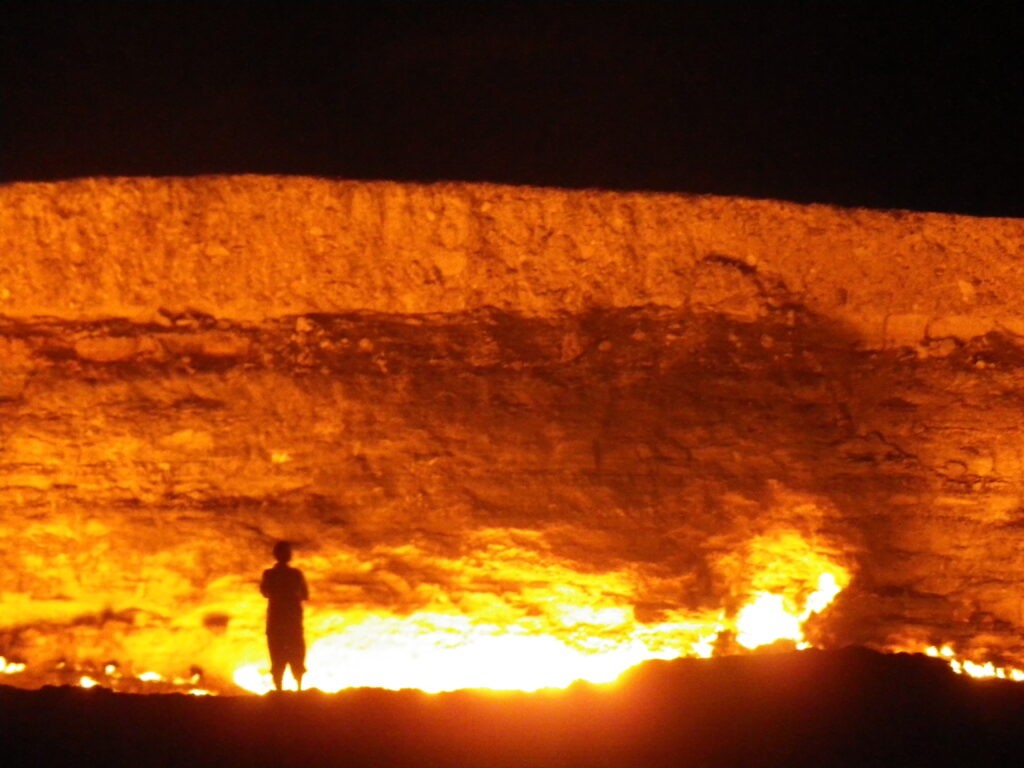
Scientists from the Scientific Research Institute of Natural Gas, under the state concern Turkmengaz, have proposed a method to extinguish the Darvaza gas crater, an uncontrolled fire that has been burning for decades in Turkmenistan’s Karakum Desert. The development was reported by Nebit-Gaz. The proposed solution involves drilling a new well to divert natural gas away from the crater. Researchers believe this strategy could significantly reduce, and eventually halt, the gas flow fueling the fire. If successful, the plan would allow Turkmenistan to mitigate environmental damage and conserve valuable energy resources. Turkmen officials have increasingly framed the Darvaza fire as both an environmental liability and an economic loss. Burning methane contributes to greenhouse gas emissions, while the continuous flare represents wasted natural gas in a country heavily dependent on energy exports for revenue. Located roughly 270 kilometers north of Ashgabat, the crater, officially named the “Glow of the Karakum”, sits atop the Chaljulba structure of the Zeagli-Darvaza group of gas fields. It measures approximately 60 meters in diameter and is 20 meters deep. The formation resulted from the collapse of an exploratory gas well. To prevent methane from harming local populations and wildlife, scientists ignited the gas, expecting the fire to burn out within days. However, the blaze has continued uninterrupted. Gas has been burning at the site since 1971, making the crater one of Central Asia’s most unusual natural and industrial spectacles. Researchers at the institute have conducted in-depth studies of the region’s geological structure, identifying a complex network of thin gas-bearing layers between 200 and 950 meters underground. These layers are interspersed with water-bearing and dense rock formations and are often hydrodynamically connected, enabling gas migration between them. Experts caution that extinguishing the fire has never been straightforward. The crater is fed not by a single reservoir but by multiple interconnected gas pockets, complicating efforts to isolate and shut off the fuel source. This interconnectivity explains why the fire persists despite the initial reservoir being relatively modest. Previous attempts to extinguish the fire included examining the crater floor to locate the original wellbore. Turkmengaz safety teams descended into the crater in hopes of installing flow-control equipment, but gas was found to be leaking from multiple surface outlets, rendering those efforts ineffective. Engineers found that sealing individual outlets risked increasing pressure elsewhere in the field, raising concerns that poorly planned interventions could trigger new leaks rather than resolve the problem. Now, using updated geological and production data, scientists have proposed drilling an operational and appraisal well in the Chaljulba field. By intensively extracting gas from the most productive reservoir, they aim to alter subsurface pressure conditions and redirect the gas away from the crater. According to Nebit-Gaz, this scientifically grounded approach offers a realistic path toward halting the fire and minimizing its environmental impact. If successful, the strategy could also allow some of the diverted gas to be captured for industrial use, potentially turning a long-standing liability into a limited economic resource. The Darvaza fire has drawn global attention...


