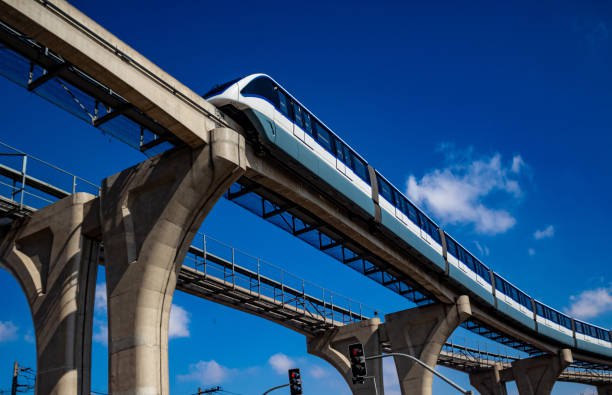
Astana Launches First Light Rail Transit Service After Years of Delay
Kazakhstan has officially launched Astana’s long-awaited light rail transit (LRT) system, connecting the capital’s international airport with Nurly Zhol railway station. President Kassym-Jomart Tokayev took part in the inauguration ceremony despite previously expressing doubts about the project’s viability. The Astana LRT project, envisioned as a high-speed elevated transport system designed to bypass road congestion, was first launched in 2011. Authorities initially planned to complete construction by 2017, ahead of the international EXPO exhibition hosted in the capital. However, the project was suspended in 2013 because of rising costs. In 2015, Astana’s city administration attempted to revive the initiative with the participation of a consortium of Chinese companies, China Railway International Group Limited and Beijing State-Owned Assets Management Co., Ltd., but the contractors later withdrew because of financing problems. [caption id="attachment_49015" align="aligncenter" width="2560"] @Akorda[/caption] In 2019, criminal investigations were launched over allegations of inflated project costs and embezzlement of public funds allocated for construction. Former Astana LRT chief Talgat Ardan and former deputy mayor of Astana Kanat Sultanbekov were accused of embezzling nearly 30 billion KZT (approximately $79 million at the exchange rate at the time). In May 2023, both men were sentenced in absentia to seven years in prison. Ardan was detained in Turkey in May 2025 following an extradition request by Kazakhstan. However, to date, he has not been extradited because the legal assistance agreement between Kazakhstan and Turkey does not specify deadlines for extradition procedures. [caption id="attachment_49041" align="aligncenter" width="2560"] @Akorda[/caption] Despite Tokayev’s initial skepticism about the LRT project’s practicality, city authorities ultimately decided to complete construction. The system officially entered service this weekend, with Tokayev personally attending the launch ceremony. During a visit to the Unified Dispatch Center, which is responsible for monitoring and regulating Astana’s public transport system, including the LRT network, Tokayev described the opening as significant not only for Astana but for Kazakhstan as a whole. Tokayev said the capital should eventually become a major transportation hub for Eurasia. [caption id="attachment_49016" align="aligncenter" width="2560"] @Akorda[/caption] After receiving passenger card No. 001, Tokayev became the system’s first official passenger, traveling from the airport to the National Museum station. Astana Mayor Zhenis Kassymbek said a dedicated dispatch service for the LRT system has been established. Twenty-one specialists are involved in monitoring and regulating the city’s public transport network. Each LRT train can carry more than 600 passengers. The 22.4-kilometer line will operate with 15 trains, while four additional trains will remain in reserve. The trains operate in fully automated driverless mode. Train acceleration, braking, door operations, and emergency response systems are entirely automated, although manual control and communication with dispatchers remain available as backup systems. The new infrastructure includes 18 stations and a modern depot facility. Travel time across the entire route is expected to take approximately 40 minutes, with average speeds of 50-60 kilometers per hour. Trains are scheduled to run at intervals of five to six minutes. [caption id="attachment_49017" align="aligncenter" width="2560"] @Akorda[/caption] Authorities are already discussing a second expansion phase of the LRT network. Planned future...