• KZT/USD = 0.00213
  • TJS/USD = 0.10800
  • UZS/USD = 0.00008
  • TMT/USD = 0.29850
  • KZT/USD = 0.00213
  • TJS/USD = 0.10800
  • UZS/USD = 0.00008
  • TMT/USD = 0.29850
  • KZT/USD = 0.00213
  • TJS/USD = 0.10800
  • UZS/USD = 0.00008
  • TMT/USD = 0.29850
  • KZT/USD = 0.00213
  • TJS/USD = 0.10800
  • UZS/USD = 0.00008
  • TMT/USD = 0.29850
  • KZT/USD = 0.00213
  • TJS/USD = 0.10800
  • UZS/USD = 0.00008
  • TMT/USD = 0.29850
  • KZT/USD = 0.00213
  • TJS/USD = 0.10800
  • UZS/USD = 0.00008
  • TMT/USD = 0.29850
  • KZT/USD = 0.00213
  • TJS/USD = 0.10800
  • UZS/USD = 0.00008
  • TMT/USD = 0.29850
  • KZT/USD = 0.00213
  • TJS/USD = 0.10800
  • UZS/USD = 0.00008
  • TMT/USD = 0.29850

Viewing results 1 - 6 of 5

Baikonur Cosmodrome: Liftoff for Discovery and Diplomacy

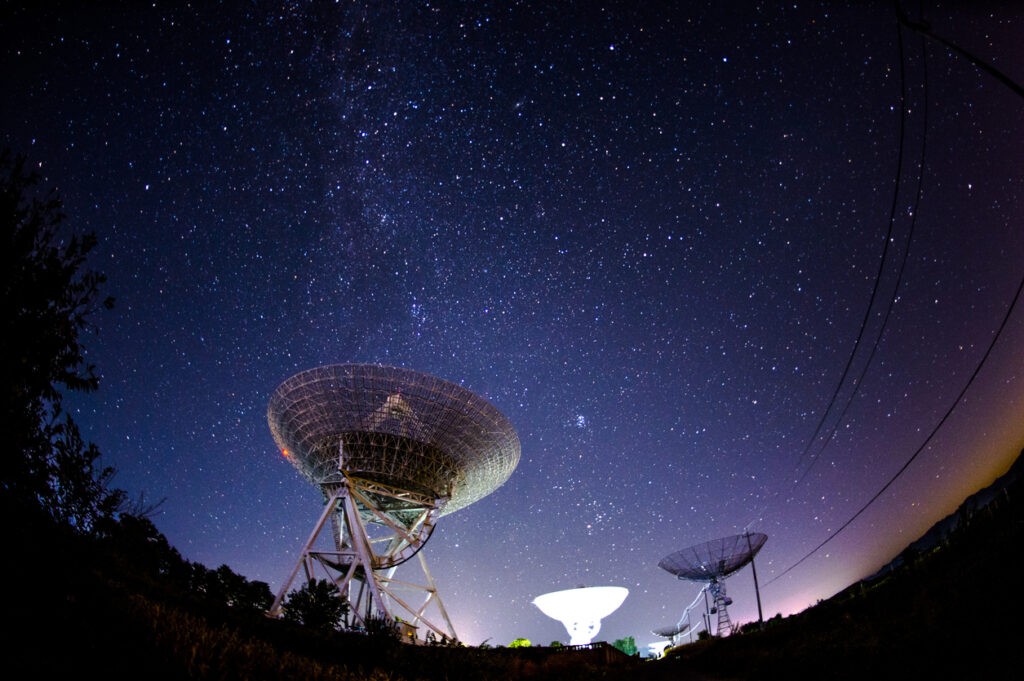
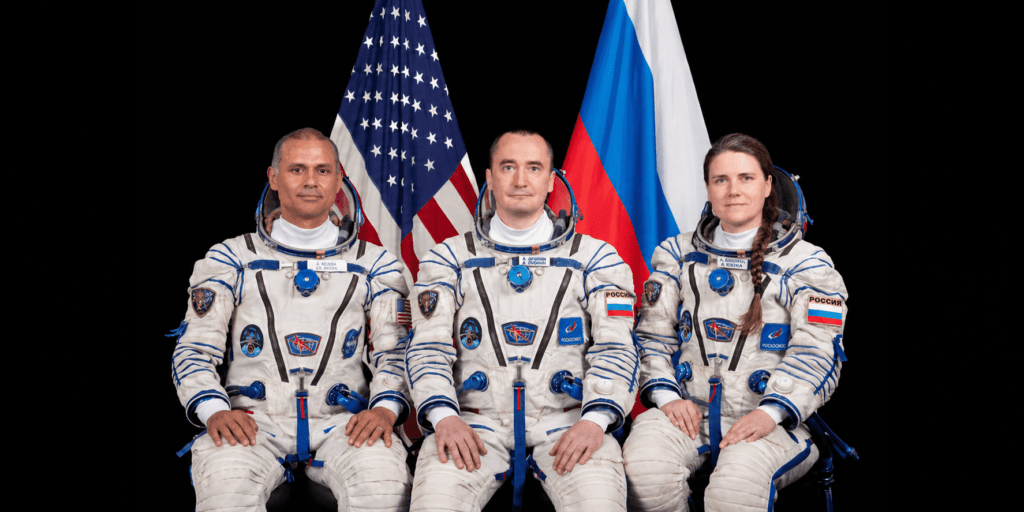
On July 14, 2026, Kazakhstan's Baikonur Cosmodrome will once again serve as the launchpad for discovery and diplomacy. As the site where Soyuz missions carry international crews into orbit, Baikonur continues to show how nations can cooperate in space even when relations are strained. According to NASA, astronaut Dr. Anil Menon and Roscosmos cosmonauts Pyotr Dubrov and Anna Kikina will travel aboard the Soyuz MS-29 spacecraft to the International Space Station (ISS), where they will spend eight months as members of Expeditions 74 and 75. They are scheduled to launch at 10:47 a.m. EDT (7:47 p.m. Baikonur time). The launch will be broadcast live on NASA+, Amazon Prime, and NASA's YouTube channel. According to Ambassador Erzhan Kazykhan, Permanent Representative of Kazakhstan in Geneva, who spoke with The Times of Central Asia, “Kazakhstan supports practical cooperation between the United States and the Russian Federation in space research and remains committed to facilitating such collaboration where appropriate. The Baikonur Cosmodrome will continue to support international space missions and scientific research. The city of Baikonur remains an important center for space science, engineering, and launch operations.” Since its establishment in 1955, the Baikonur Cosmodrome has played a historic role in space exploration, hosting the launch of Sputnik 1 and Yuri Gagarin’s first human spaceflight. Today, Kazakhstan and Russia continue to cooperate on the use of the facility, which remains an important launch site for missions to the International Space Station and other space programs. Baikonur contributes to Kazakhstan’s economic development through lease revenues, employment, infrastructure growth, and international partnerships. It also supports the development of the country’s space capabilities. For more than 25 years, astronauts and cosmonauts have lived and worked continuously aboard the International Space Station, demonstrating the durability of U.S.-Russian space cooperation even during periods of significant political tension. The ISS operates as an integrated platform, with the U.S. and Russian sections providing complementary capabilities, including propulsion, power, life support, and research support. Crew-exchange agreements have helped maintain continuous staffing, reflecting both nations’ commitment to operational safety, scientific cooperation, and mission continuity. [caption id="attachment_52042" align="aligncenter" width="2048"] Baikonur Cosmodrome in Kazakhstan. Credit: NASA/Joel Kowsky[/caption] The Soyuz MS-29 launch from Baikonur on July 14 symbolizes U.S.-Russian teamwork in space and suggests that scientific cooperation can provide a model for diplomacy beyond the launchpad. Ambassador Kazykhan added, “Kazakhstan believes that the path forward lies in advancing initiatives that produce tangible results, bridge differences, and rebuild confidence among nations. The cooperation enabled through the Baikonur Cosmodrome, as well as joint efforts in support of the International Space Station, demonstrate that space can remain a powerful platform for dialogue, partnership, and collective responsibility.” Toktar Aubakirov, Talgat Musabayev, and Aidyn Aimbetov are the three cosmonauts from Kazakhstan to have traveled into space. Musabayev traveled to the International Space Station in 2001, followed by Aimbetov in 2015.
NASA’s Oldest Active Astronaut, Two Russian Cosmonauts, Land in Kazakhstan

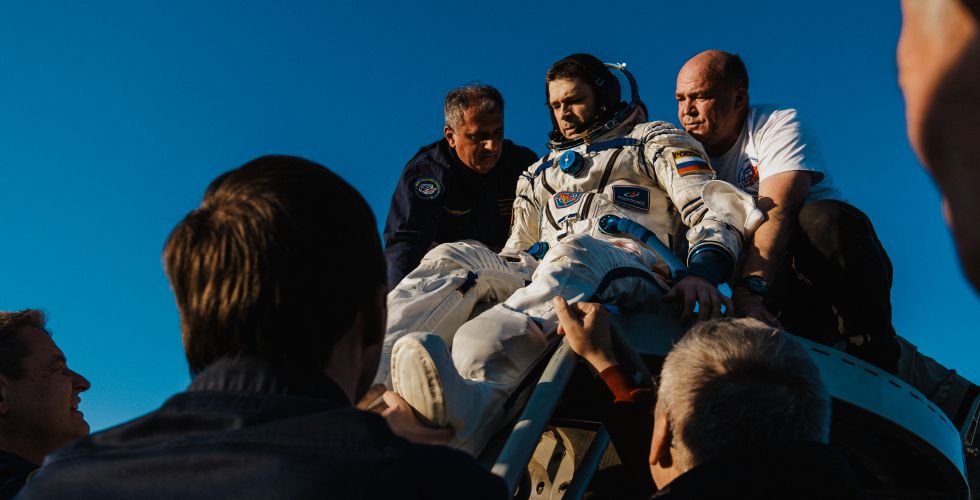
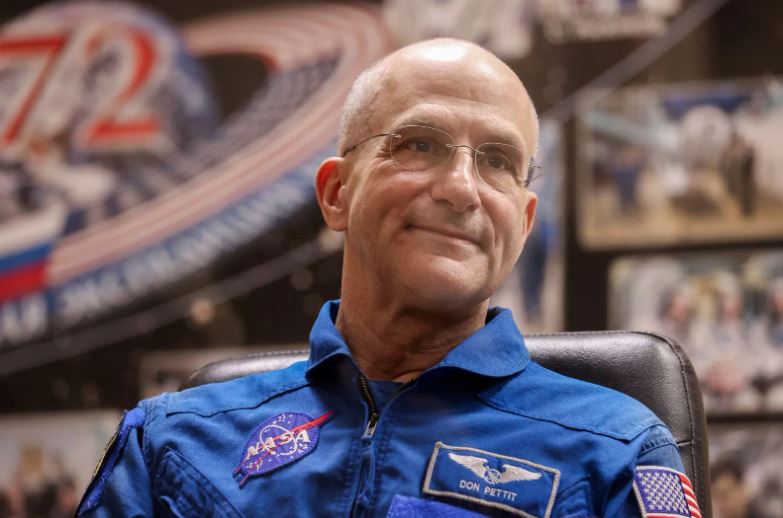
Accompanied by two Russian cosmonauts, NASA astronaut Donald Pettit marked his 70th birthday on Sunday with a parachute-supported landing on the steppes of Kazakhstan after a journey back to Earth from the International Space Station. A Soyuz MS-26 spacecraft carrying Pettit, as well as cosmonauts Alexey Ovchinin and Ivan Vagner, touched down at 6:20 a.m. local time southeast of Zhezkazgan, a city in Kazakhstan’s central Ulytau region. The three men had launched from the Russia-operated Baikonur Cosmodrome in Kazakhstan and docked at the station on Sept. 11 last year, spending a total of 220 days in space. “Rehabilitation and a meeting with loved ones lie ahead!” Roscosmos, the Russian space agency, said on Telegram. Photographs and video of the landing showed Pettit giving a thumbs-up as support team members carried him away from the spacecraft. Ovchinin and Vagner were shown wrapped in blankets and smiling broadly. Pettit, Ovchinin and Vagner orbited the Earth 3,520 times and traveled 93.3 million miles during their mission, according to NASA. It was Pettit’s fourth spaceflight and he has spent a total of 590 days in orbit. Ovchinin, also a four-time spaceflight traveler, has spent just five days longer than Pettit in space. Vagner has logged 416 days in space on his two trips. While American John Glenn became the oldest person to go to space in 1998 at age 77, Pettit is NASA’s oldest active astronaut. During his time on the space station, Pettit researched how to enhance in-orbit metal 3D printing capabilities, advance water sanitization technologies, explore plant growth under varying water conditions, and investigate fire behavior in microgravity, NASA said. His photography also attracted followers back on Earth. “Mother Earth, I am coming home,” Pettit posted on X on Saturday.

NASA Discovers ‘Ghost’ Island in the Caspian Sea

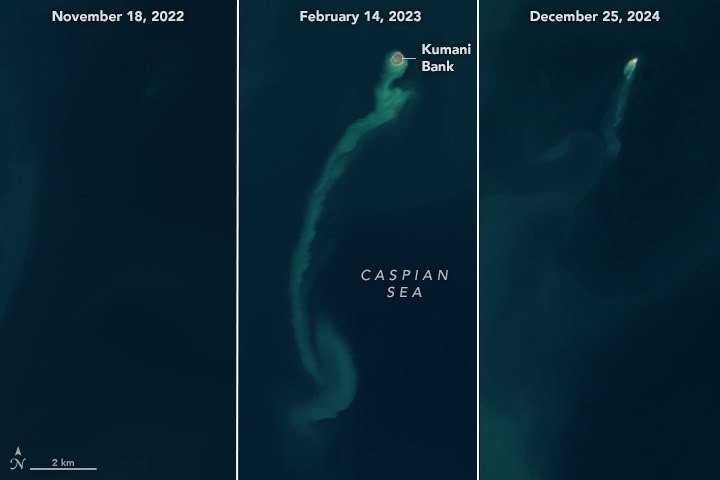
NASA satellites have detected a fascinating phenomenon in the Caspian Sea: the temporary formation of an island following the eruption of the Kumani mud volcano. According to data from NASA's Earth Observatory, the island emerged in early 2023 but had almost completely disappeared by the end of 2024, earning it the nickname “ghost island.” The island was first observed using Landsat 8 and 9 satellite imagery in January 2023, shortly after the volcano erupted. It measured up to 400 meters wide and was accompanied by a visible sedimentary plume extending from its surface. However, by late 2024, the island had diminished significantly, leaving only faint traces of its existence. The Kumani mud volcano, located 25 kilometers off the eastern coast of Azerbaijan, is no stranger to such occurrences. Since its first recorded eruption in 1861, the volcano has periodically created temporary islands, which vanish after short periods. Mud volcanoes like Kumani are common in regions with active tectonic activity. They eject high-pressure mixtures of water, gas, and sediment, forming landmasses that are often unstable and short-lived. The Caspian region is notable for its high concentration of mud volcanoes, with more than 300 such formations in Azerbaijan and on the Caspian Sea shelf. Many of these volcanoes emit combustible gases, particularly methane, which has drawn the interest of scientists and geologists. The connection between these mud volcanoes and the hydrocarbon systems of the South Caspian Basin makes them critical subjects for research. The emergence and disappearance of this “ghost” island in the Caspian Sea highlight how much remains to be understood about mud volcanoes. These transient landforms demonstrate the dynamic forces of nature and underscore the need for further exploration of geological processes occurring on the seafloor.

Uzbekkosmos and NASA Unite for World Space Week Celebrations in Uzbekistan

The Uzbekkosmos agency has announced a series of events in celebration of World Space Week, which will take place in Uzbekistan from October 4 to 10. This global event, commemorated in nearly 100 countries, was established by a UN General Assembly resolution in 1999, recognizing the importance of space exploration. As part of the World Space Week festivities, Uzbekkosmos is launching several major initiatives. A key highlight is a special exhibition on space history at the Tashkent City Mall Trade and Entertainment Center, which will open its doors on October 4. In addition, on October 5 and 6, Uzbekkosmos, in collaboration with NASA, will host the NASA Space Apps Challenge 2024 hackathon. This event will take place at the Turin Polytechnic University in Tashkent, where over 200 young innovators, organized into approximately 40 teams, will showcase their creative projects.

Crew of Record-Breaking Cosmonauts Land in Kazakh Steppe

The descent vehicle of the Soyuz MS-25 spacecraft has successfully landed in the steppe of Kazakhstan, near the town of Zhezkazgan. Russian cosmonauts Oleg Kononenko, Nikolai Chub, and NASA astronaut Tracy Dyson were on board. Cosmonauts Kononenko and Chub spent 374 days in space, making their mission one of the longest in International Space Station (ISS) history. This is second only to the flights of Valery Polyakov and Sergey Avdeev, who spent 438 and 380 days in space, respectively, on the Mir station. Tracy Dyson stayed in orbit for 184 days. During their mission, Kononenko and Chub participated in several scientific experiments, took four Progress MS cargo ships, and conducted two spacewalks. The flight was an important contribution to the development of applied and fundamental research on the ISS. The spacecraft landed yesterday at 14:59, Moscow time. Kononenko and Chub's flight was a significant event for the space programs of Roscosmos and NASA. Despite completing their mission, the crew of the 72nd long-duration expedition, including Russian and American cosmonauts and astronauts, continues to work on the ISS. The station crew includes Roscosmos cosmonauts Alexei Ovchinin, Ivan Wagner, and Alexander Grebenkin, and NASA astronauts Donald Pettit, Matthew Dominick, Michael Barratt, Jeanette Epps, Barry Wilmore, and Sunita Williams. The International Space Station (ISS) is one of mankind's most impressive engineering projects. It was launched in 1998, and is the product of 16 countries. The station revolves around the Earth every 90 minutes, allowing the crew to observe 16 sunrises and sunsets daily. In addition, the ISS is the largest object ever built in space, measuring about 109 meters long. The ISS is also considered the most expensive object built by humans, costing an estimated $120 billion by 2014, alone. According to NASA, the ISS "costs about $3 billion a year, roughly a third of NASA’s annual human space flight budget."