• KGS/USD = 0.01144 0%
  • KZT/USD = 0.00205 0%
  • TJS/USD = 0.10722 0%
  • UZS/USD = 0.00008 0%
  • TMT/USD = 0.28490 0%
  • KGS/USD = 0.01144 0%
  • KZT/USD = 0.00205 0%
  • TJS/USD = 0.10722 0%
  • UZS/USD = 0.00008 0%
  • TMT/USD = 0.28490 0%
  • KGS/USD = 0.01144 0%
  • KZT/USD = 0.00205 0%
  • TJS/USD = 0.10722 0%
  • UZS/USD = 0.00008 0%
  • TMT/USD = 0.28490 0%
  • KGS/USD = 0.01144 0%
  • KZT/USD = 0.00205 0%
  • TJS/USD = 0.10722 0%
  • UZS/USD = 0.00008 0%
  • TMT/USD = 0.28490 0%
  • KGS/USD = 0.01144 0%
  • KZT/USD = 0.00205 0%
  • TJS/USD = 0.10722 0%
  • UZS/USD = 0.00008 0%
  • TMT/USD = 0.28490 0%
  • KGS/USD = 0.01144 0%
  • KZT/USD = 0.00205 0%
  • TJS/USD = 0.10722 0%
  • UZS/USD = 0.00008 0%
  • TMT/USD = 0.28490 0%
  • KGS/USD = 0.01144 0%
  • KZT/USD = 0.00205 0%
  • TJS/USD = 0.10722 0%
  • UZS/USD = 0.00008 0%
  • TMT/USD = 0.28490 0%
  • KGS/USD = 0.01144 0%
  • KZT/USD = 0.00205 0%
  • TJS/USD = 0.10722 0%
  • UZS/USD = 0.00008 0%
  • TMT/USD = 0.28490 0%

Viewing results 1 - 6 of 10

Kazakhstan to Launch Direct Flights to Tokyo and New York Within Next 12 Months

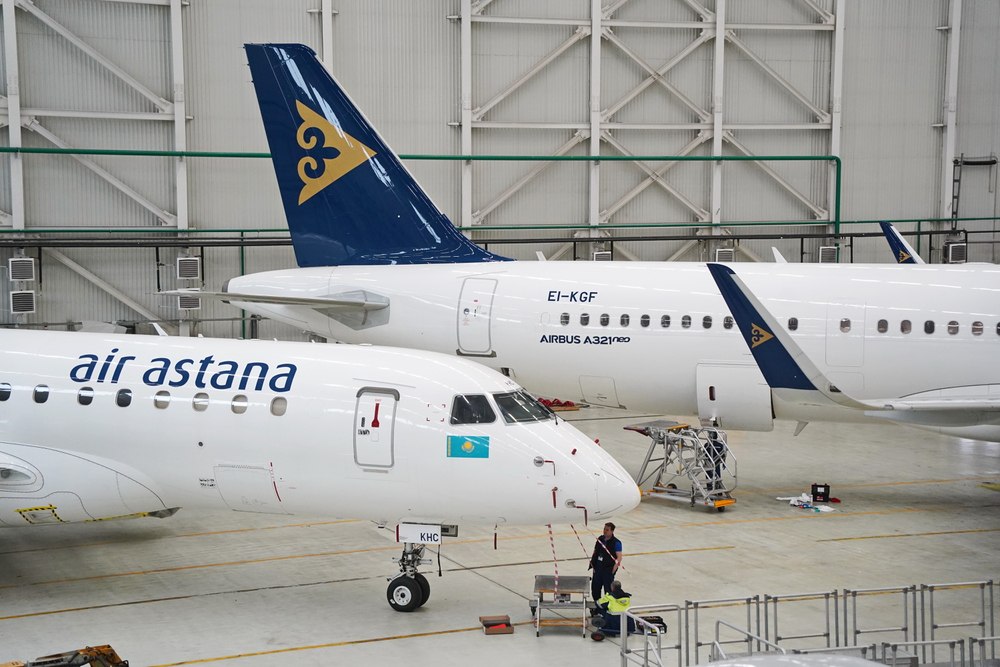
Kazakhstan plans to launch direct flights from Astana to Tokyo and New York within the next 12 months, Transport Minister Nurlan Sauranbayev said during a government meeting on Tuesday. Prime Minister Olzhas Bektenov reminded officials that the Ministry of Transport had previously pledged to open direct air links to Tokyo and New York but had yet to announce concrete results. “In the case of Tokyo, flights will begin in the fourth quarter of 2026, and flights to the United States will begin in the second quarter of 2027,” Sauranbayev said. He added that Astana currently operates 34 international routes. According to the minister, Kazakhstan has already opened four new international routes since the beginning of the year: Almaty-Shanghai, Astana-Yerevan, Atyrau-Tashkent, and Aktau-Yerevan. By the end of 2026, Kazakhstan's aviation authorities plan to open or resume 11 additional international routes, including Astana-Ulaanbaatar, Astana-Guangzhou, Astana-Issyk-Kul, Astana-Larnaca, Astana-Kashgar, Almaty-Tokyo, Almaty-Larnaca, Hanoi-Almaty-Prague, Almaty-Izmir, Almaty-Warsaw, and Kostanay-Tashkent. Meanwhile, Michael Daniel, CEO of the Aviation Administration of Kazakhstan (AAK), said work is ongoing to secure Category 1 status from the U.S. Federal Aviation Administration (FAA) under the International Aviation Safety Assessment (IASA) program, a prerequisite for launching direct flights to the U.S. Daniel said Kazakhstan has been addressing shortcomings identified during an FAA technical assessment conducted in August 2024. “We plan to invite the FAA IASA team to conduct an evaluation in September 2026. The FAA will assess Kazakhstan’s political commitment to complying with international aviation safety standards, including legislation, regulatory oversight, and practical implementation,” he said. “Our primary goal is to obtain FAA Category 1 status in November 2026,” Daniel added. Kazakhstan’s airline fleet is also expected to expand, with six additional aircraft scheduled to enter service by the end of this year. As previously reported by The Times of Central Asia, Kazakhstan’s civil aviation fleet consisted of 104 aircraft last year, with authorities aiming to increase that number to 216 by 2030. The government is also planning a major modernization of airport infrastructure over the next three years. “In accordance with the president’s instructions, work is underway on the construction of airports in the tourist zones of Katon-Karagay, Zaysan, and Kenderli, as well as the restoration of Arkalyk Airport,” Sauranbayev said. He added that aviation hub development is continuing at six major airports: Almaty, Astana, Aktau, Aktobe, Karaganda, and Shymkent. According to the minister, most airport modernization projects are being financed through private investment. As previously reported by The Times of Central Asia, Kazakhstan’s SCAT Airlines, in partnership with Boeing, has begun construction of a major aircraft maintenance, repair, and overhaul center in Shymkent.

Pakistan Sends First Transit Shipment to Uzbekistan via Iran Corridor

Pakistan has launched trade operations under the Pakistan-Iran transit corridor, dispatching its first export consignment to Tashkent in Uzbekistan via Iran, Pakistan Today reported, citing customs officials. According to the report, the inaugural shipment consisted of frozen meat transported in refrigerated trucks. The cargo departed from Pakistan and is being routed through Gwadar and Iranian territory before reaching Central Asia. Officials say the corridor is intended to facilitate overland trade and provide an alternative to maritime routes. Sanaullah Abro, Director General of Transit Trade Customs, said the corridor has been operationalized under the TIR (Transports Internationaux Routiers) system, which enables goods to move across multiple countries with minimal customs checks. He added that key border crossing points including Taftan, Rimdan, Sost, and Gwadar, have been activated for TIR transit, with procedures streamlined to support faster cargo movement. At a launch ceremony, Abro and Director of Transit Muhammad Rashid formally flagged off the first consignment. Officials described the initiative as part of broader efforts to strengthen Pakistan’s trade connectivity with Central Asia and reduce logistics costs. Sources cited by Pakistan Today said the new route offers a more economical option for exporters and is expected to shorten transit times while easing pressure on maritime trade routes. The corridor may also increase traffic through Pakistan’s ports and support export growth. The development comes as Pakistan seeks to expand its economic engagement with Central Asia, including Uzbekistan. As previously reported by The Times of Central Asia, bilateral trade between the two countries reached nearly $500 million last year, with around 230 companies with Pakistani capital currently operating in Uzbekistan. Cooperation spans sectors such as textiles, pharmaceuticals, agriculture, and chemicals. Both sides have agreed to work toward increasing trade turnover to $2 billion in the near term. Measures under discussion include expanding the list of goods covered by the Preferential Trade Agreement, easing phytosanitary requirements, and strengthening trade infrastructure, including Uzbekistan’s trade houses in Lahore and Karachi.

Can the New Multimodal Route Become a Sustainable Corridor for Central Asia?

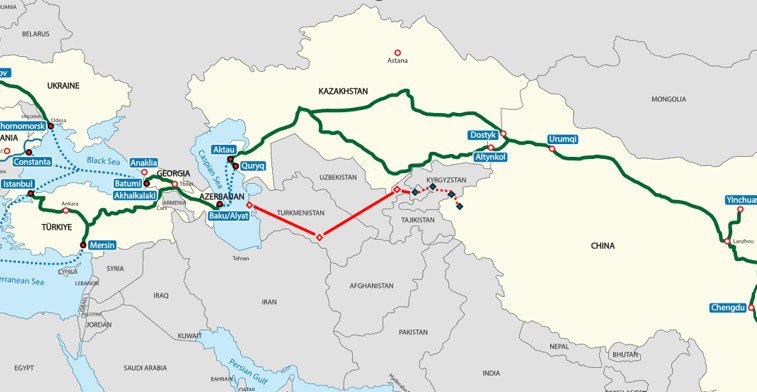
The launch of the China-Kyrgyzstan-Uzbekistan-Turkmenistan-Caspian multimodal corridor has generated significant interest as another attempt to expand Eurasian transport connectivity. A pilot shipment in the fall of 2025 demonstrated the technical feasibility of the new route: cargo transported from Kashgar, China, passed through Kyrgyzstan and Uzbekistan, reached Turkmenistan, and was then delivered to Azerbaijan via the Caspian Sea, continuing along the Baku-Tbilisi-Kars railway toward Europe. Despite its evident geopolitical appeal, questions remain over the route’s long-term sustainability and commercial viability. The central question is whether this demonstration project can evolve into a regularly functioning transport corridor. A Third Alternative Between the Northern and Middle Corridors This multimodal route can be seen as a potential alternative to the two existing pathways: the northern route, China-Kazakhstan-Russia-Europe; and the Trans-Caspian International Transport Route (TITR), or Middle Corridor, which passes through Kazakhstan, the Caspian Sea, the South Caucasus, and Turkey. The growing geopolitical risks along the northern route since 2022, combined with capacity limitations on the Caspian segment of the TITR, have spurred interest in a third option, a so-called “southern belt” traversing Kyrgyzstan, Uzbekistan, and Turkmenistan. Each country along this route has its own strategic calculus. Uzbekistan is seeking to overcome its “double continental isolation” and elevate its role as Central Asia’s transit hub. Kyrgyzstan is aiming to monetize its geographic position between China and the Ferghana Valley. Turkmenistan is developing the port of Turkmenbashi as an alternative to the increasingly congested hubs of Aktau and Alat. China, meanwhile, continues to diversify its westward overland trade routes. The Uzbek Factor: Geoeconomics vs. Logistics From Tashkent's perspective, this corridor aligns with its long-term transport strategy. Analysts frequently cite Uzbekistan’s ambition to transition from a landlocked to a “land-linked” state with direct access to China, the Caspian Sea, and southern routes to the Indian Ocean. The new route offers Uzbekistan three strategic advantages: alternative access to China via Kyrgyzstan, enhanced status as a regional transit hub, and deeper transport cooperation with Turkmenistan, including potential joint development of the Turkmenbashi port. However, when shifting from geopolitical ambition to logistical execution, serious limitations emerge, many outside Uzbekistan’s control. Kyrgyzstan: A Bottleneck in the Chain Documents from the Central Asia Regional Economic Cooperation (CAREC) program highlight the continued challenges facing multimodal transport in the region, namely slow transit, poor modal integration, border delays, and outdated logistics technologies. Within this corridor, Kyrgyzstan remains the primary bottleneck. Approximately 82% of its foreign trade by weight is transported by road, making the route through this mountainous country highly seasonal, expensive, and unpredictable. According to the International Road Transport Union, Kyrgyzstan’s transport system faces severe constraints from alpine terrain, avalanches, and impassable mountain passes that render winter transport nearly impossible in many areas. It is therefore unsurprising that, following the pilot shipment, no major logistics operators committed to shifting regular cargo to this route. The Caspian Sea: Structural Constraints The Caspian Sea leg, anchored by Turkmenbashi port, presents another critical challenge. The limitations here are systemic rather than national. Key issues include insufficient...

Four New Foreign Low-Cost Carriers to Launch Flights from Kazakhstan

Four new low-cost airlines are set to enter Kazakhstan’s aviation market, further expanding the country’s international air connectivity, according to Vice Minister of Transport Talgat Lastayev. Lastayev highlighted that the number of international flights to and from Kazakhstan has been increasing annually. The country currently has air links with 31 countries and 58 cities, operating 119 international routes. In 2024, 12 new flights were introduced across 22 routes, including major cities such as Mumbai (India), Jeddah (Saudi Arabia), and Prague (Czech Republic). Additionally, flights on 10 previously suspended routes were resumed. In 2025, Kazakhstan plans to launch flights to 16 new destinations, including Rome, Munich, Budapest, Shanghai, Guangzhou, and Busan. The country’s low-cost flight options will also expand with the arrival of four new budget airlines: SpiceJet (India) Eastar Jet (South Korea) T’way Air (South Korea) Thai AirAsia (Thailand) The entry of these carriers is expected to make international travel more affordable for passengers. Lastayev also noted that Kazakhstan’s “open skies” policy, aimed at liberalizing the aviation sector, was expanded in 2024 to include airports in Kyzylorda, Kostanay, and Atyrau. The policy is now in effect at all of Kazakhstan’s international airports.