• KGS/USD = 0.01144 0%
  • KZT/USD = 0.00193 -0%
  • TJS/USD = 0.10811 -0.28%
  • UZS/USD = 0.00008 0%
  • TMT/USD = 0.28490 0%
  • KGS/USD = 0.01144 0%
  • KZT/USD = 0.00193 -0%
  • TJS/USD = 0.10811 -0.28%
  • UZS/USD = 0.00008 0%
  • TMT/USD = 0.28490 0%
  • KGS/USD = 0.01144 0%
  • KZT/USD = 0.00193 -0%
  • TJS/USD = 0.10811 -0.28%
  • UZS/USD = 0.00008 0%
  • TMT/USD = 0.28490 0%
  • KGS/USD = 0.01144 0%
  • KZT/USD = 0.00193 -0%
  • TJS/USD = 0.10811 -0.28%
  • UZS/USD = 0.00008 0%
  • TMT/USD = 0.28490 0%
  • KGS/USD = 0.01144 0%
  • KZT/USD = 0.00193 -0%
  • TJS/USD = 0.10811 -0.28%
  • UZS/USD = 0.00008 0%
  • TMT/USD = 0.28490 0%
  • KGS/USD = 0.01144 0%
  • KZT/USD = 0.00193 -0%
  • TJS/USD = 0.10811 -0.28%
  • UZS/USD = 0.00008 0%
  • TMT/USD = 0.28490 0%
  • KGS/USD = 0.01144 0%
  • KZT/USD = 0.00193 -0%
  • TJS/USD = 0.10811 -0.28%
  • UZS/USD = 0.00008 0%
  • TMT/USD = 0.28490 0%
  • KGS/USD = 0.01144 0%
  • KZT/USD = 0.00193 -0%
  • TJS/USD = 0.10811 -0.28%
  • UZS/USD = 0.00008 0%
  • TMT/USD = 0.28490 0%
10 December 2025

Viewing results 1 - 6 of 15

Kazakhstan Plans to Accelerate Construction of First Nuclear Power Plant

Kazakhstan’s Energy Minister, Almasadam Satkaliyev, has announced that the selection of a contractor for the country’s first nuclear power plant (NPP) will be finalized in the first half of 2025. The government is awaiting proposals from bidders that focus on shortening construction timelines and reducing project costs. This follows President Kassym-Jomart Tokayev's directive to expedite the implementation of the nuclear power plant project. “The commission will do everything possible to advance this process and make a decision on the contractor in the first half of 2025,” Satkaliyev told reporters. The shortlist for the potential builders includes four companies: China’s CNNC, Russia’s Rosatom, South Korea’s KHNP, and France’s EDF. Kazakh authorities have also indicated that a consortium involving multiple countries might be formed to leverage diverse technological solutions. Deputy Prime Minister Roman Sklyar highlighted the benefits of such collaboration, where different countries could contribute specific components, such as nuclear islands, turbines, or distribution systems. Satkaliyev emphasized the need for faster construction solutions, citing a precedent where China’s national nuclear company built a power unit in Pakistan in six years. “In today’s world, there are possibilities for expedited solutions,” he stated. Kazakhstan previously projected a 10-year timeline for constructing the NPP. However, the country is expected to face a 2.4 gigawatt energy deficit by 2035, underscoring the urgency of completing the project. The energy minister noted that the process from construction to the launch of the first unit could take up to 14 years, making accelerated timelines crucial. The Times of Central Asia previously reported on the results of a referendum held on October 6, which showed that 71.12% of voters approved the construction of a nuclear power plant in the Almaty region. The accelerated development of the NPP reflects Kazakhstan’s commitment to addressing its future energy needs while integrating advanced international technologies and solutions.

Uzbekistan and China Strengthen Partnership in Nuclear Energy Development

On November 4 during Uzbekistan’s participation in EXPO 2024 in Shanghai, Uzbekistan’s Atomic Energy Agency officials met with Wei Fuqi, General Director of the China National Nuclear Corporation Overseas Ltd (CNOS). They discussed opportunities for collaboration in nuclear energy and other potential joint projects. The Uzbek officials and CNOS reached agreements on cooperation in the peaceful use of nuclear energy, a detailed review of the possibilities of adopting China’s advanced experience in nuclear power plant construction, and studying the possibilities of using China’s small modular reactors. The parties also talked about cooperating to expand uranium ore mining capacity, processing, production and export of finished products with high added value, and subsequent fuel use in nuclear power plants. Uzbekistan is consistently reforming its nuclear program. China has confirmed that it is interested in strengthening bilateral relations in all areas of nuclear technology.

Kazakhstan To Establish Special Commission on NPP Construction

A special government commission will be formed in Kazakhstan to manage the nuclear power plant construction project, according to Energy Minister, Almasadam Satkaliyev. As stated by the minister, the commission will engage in an open, competitive dialog with potential bidders. Preliminary consultations have already been held, including visits to China and South Korea, where critical requirements for future contractors were discussed. Among the main selection criteria are power cost, budget and construction time-frame, mandatory safety guarantees, social commitments, financing, and localization of fuel production. As part of this process, the commission will formulate proposals for further consideration at a meeting of the Energy Council under the President of Kazakhstan. In addition, consultants will analyze the project's financial, economic, legal, and technical aspects. As The Times of Central Asia previously reported, a referendum on nuclear power in Kazakhstan was held on October 6. More than 70% of Kazakhstanis voted in favor of the construction of a nuclear power plant. Potential participants in the project are now being discussed. Among the countries being considered as partners are Russia, China, France, and South Korea. These states have set out their proposals, and the authorities in Kazakhstan are considering them. In addition, the United States has expressed its willingness to participate. President Tokayev has expressed his preference for an international consortium to realize the project. The final decision will be made based on technical and financial conditions, with the preliminary cost estimated at $5 billion.

Kazakhstan’s Energy Ministry Discusses Nuclear Plant Construction With South Korea

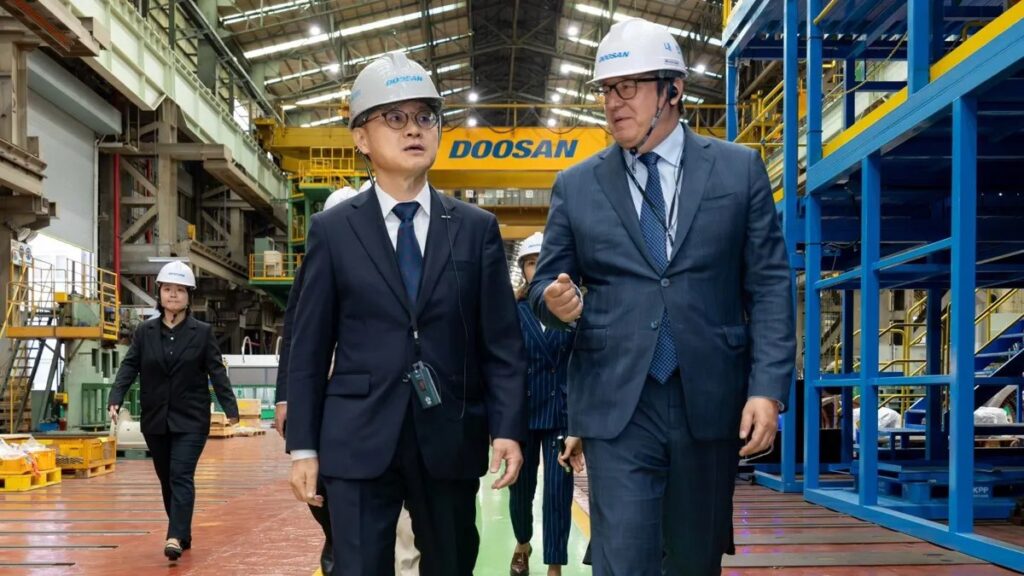
From October 22 to 25, a delegation from Kazakhstan led by Energy Minister Almasadam Satkaliev visited South Korea. As part of the visit, meetings were held with representatives of leading Korean energy companies and government agencies. The key topics of the talks were cooperation issues in the nuclear power industry. In addition, at the meeting with the South Korean Minister of Trade, Industry, and Energy, they discussed opportunities to expand cooperation in the oil and gas sector and renewable energy. Satkaliev also met with the management of major Korean companies, including Doosan Enerbility, Korea Hydro & Nuclear Power (KHNP), Korea Electric Power Corporation (KEPCO), Korea National Oil Corporation (KNOC), and Samsung C&T. During the talks, the parties considered the prospects of Korean companies participating in an international consortium, which Kazakhstan is studying as a model for implementing the project to build a nuclear power plant. As the minister specified, the final decision on this issue is expected in 2025. Negotiations with Doosan Enerbility concluded with the signing of a memorandum of understanding. This document provides for studying opportunities to localize the Korean company's operation in Kazakhstan and establish a representative office of the plant in Astana. Now, Doosan Enerbility cooperates with Kazakhstan to construct a gas turbine power plant with a capacity of 1000 MW in the Turkestan region. In addition, the company, together with KEPCO KPS, is conducting a technical audit of Kazakhstan's energy infrastructure to reduce emissions and extend the life of the equipment. After the October 6 referendum, in which Kazakhstanis supported the construction of the first nuclear power plant, President Kasym-Jomart Tokayev proposed the creation of an international consortium to implement the project. He emphasized that this project requires the participation of the world's leading companies with modern technology and experience to ensure the safety and efficiency of construction. Russia's Rosatom, South Korea's KHNP, France's EDF, and China's CNNC are considered potential participants. These companies are expected to work together to transfer technology and attract investment, which is particularly important for Kazakhstan as it seeks to reduce energy dependence and strengthen the country's energy security. Construction of the plant is planned to begin on the shores of Lake Balkhash and be completed by 2035. A final decision on the structure of the consortium is expected by 2025.

Kazakhstan Enters Era of Peaceful Nuclear Energy

Kazakh President Kassym-Jomart Tokayev's bet on a referendum to secure citizens' consent to construct a nuclear power plant has worked. The Central Election Commission of Kazakhstan announced the final results of the referendum held last Sunday, in which 63,66% of citizens eligible to vote showed up at the polling stations. 71.12 % answered “Yes” to the question on the ballot paper about consent to constructing the nuclear power plant. Organizations engaged in sociological surveys of voters at the exit polls announced similar results on Sunday night and Monday. “The exit poll of the Institute of Complex Social Studies - Astana (SOCIS-A) called the referendum participants' decision to favor the construction of nuclear power plants in Kazakhstan. 'For' voted 69.8%, ‘Against’ - 30.2%. Similar figures were shown by the Institute of Eurasian Integration exit poll ('For' - 71.8%, 'Against' - 28.2%). According to the Institute of Public Policy of the Amanat party, 72.3% of referendum participants voted in favor of the NPP construction. In comparison, 27.7% voted against,” Kazakhstani political analyst Eduard Poletayev said on his Facebook account. His colleague Daniyar Ashimbayev, commenting on the exit poll data, emphasized that Kazakhstanis have managed to overcome old phobias related to Chernobyl and tests at the Semipalatinsk nuclear test site, as well as “enemy propaganda.” By 'propaganda', he means the agitation work of opponents to NPP construction. [caption id="attachment_24131" align="alignnone" width="300"] @ТСА/Kubaizhanov[/caption] “For many years, projects to return to nuclear energy were discussed, but there was always a lack of political will, and powerful foreign pressure prevented the decision necessary for the country. And even now, during the campaign period, we have seen the active work of propagandists paid from abroad to not only disrupt the plans for the construction of nuclear power plants but also to try to destabilize the situation in the country,” said Ashimbayev. Ashimbayev implies that the United States is putting sticks in the wheels of the development of Kazakhstan's nuclear industry. And the point here is not that American nuclear corporations were left off the shortlist, which Kazakhstan is considering, but in the usual policy of containment. Not Kazakhstan, of course, but Russia and China - Washington's main geopolitical rivals and competitors. Realizing this, Tokayev, after voting in the referendum and answering journalists' questions afterward, said that he would like the NPP to be built by an international consortium, presumably from the companies of those countries that were on the shortlist: Russia, China, South Korea, and France. “This is not an easy question. The government should engage in analysis and conduct appropriate negotiations. My vision for this issue is for an international consortium to work in Kazakhstan, consisting of global companies with the most advanced technologies. Further, as they say, life will show,” Tokayev said. Kazakhstan has turned another significant page in its history. In 400 days of discussing nuclear power plants - how long it took from when Tokayev first mentioned atomic power to the end of the campaign period - the president's team has managed the...

Kazakhstan Awaits Results of Nuclear Referendum; Exit Polls Indicate a “Yes” Vote

Kazakhstan is awaiting the official results of a referendum on whether to build its first nuclear power plant, though exit polls showed “yes” voters were in the majority, according to state-run media reports. The project could ease chronic energy shortages and reduce reliance on coal-fired facilities but is fraught with concerns about costs, transparency, and the legacy of the human and environmental cost of Soviet nuclear weapons testing decades ago. Led by President Kassym-Jomart Tokayev, Kazakhstan’s political establishment has backed the idea of peaceful nuclear power as a way to move the country forward and the referendum appears aimed partly at giving people a sense of agency after the trauma of Soviet testing at Semipalatinsk. But some opponents allege that authorities restricted their efforts to organize a “no” campaign with detentions and other pressure designed to lock in an expected vote in favor. Officials results had not been announced as of early Monday morning. Voting at polling stations in Kazakhstan ended at 8 p.m. on Sunday and turnout among eligible voters was 63.87%, according to the Central Election Commission. The highest turnout was in the Kyzylorda region (82.48%) and the lowest turnout was in the city of Almaty (25.39%). Turnout in Astana, Kazakhstan’s capital, was 50.81%. “The precinct referendum commissions have begun counting the votes. The counting process at each polling station must not exceed twelve hours from the start of the count,” the commission said. Additionally, more than 7,358 Kazakh citizens voted at polling stations abroad, including in Asia, South America, Europe, and the United States, according to Roman Vassilenko, Kazakhstan’s Deputy Minister of Foreign Affairs. He noted at a briefing on Sunday night that the referendum had been monitored by observers from regional organizations, including the Shanghai Cooperation Organization, the Organization of Turkic States, and the Astana-based Conference on Interaction and Confidence-Building Measures in Asia. The heads of the observer missions said the referendum was “open, free, and legitimate, with no violations detected at any polling stations,” Vassilenko said. Kazakhstan also invited observers from the Organization for Security and Cooperation in Europe, but the OSCE declined to send a delegation “due to heavy workload,” reported the state-run Kazinform news agency. The OSCE sent a mission to observe a 2022 referendum on constitutional changes in Kazakhstan and concluded that it took place “in an environment short of genuine political pluralism.” One critic of the rules surrounding the nuclear referendum is Tamara Yeslyamova, editor-in-chief of the Uralskaya Nedelya, a newspaper that has sparred with the government over the years. A judge issued her with a fine for 110,760 tenge ($230) after she conducted video interviews about the referendum on nuclear power with half a dozen people on the street, the newspaper reported. It said the judge concluded that the interviews amounted to a public opinion survey; the law says such a poll can only be done by a state-sanctioned entity.