• KGS/USD = 0.01144 0%
  • KZT/USD = 0.00208 0%
  • TJS/USD = 0.10440 -0.19%
  • UZS/USD = 0.00008 0%
  • TMT/USD = 0.28571 0.28%
  • KGS/USD = 0.01144 0%
  • KZT/USD = 0.00208 0%
  • TJS/USD = 0.10440 -0.19%
  • UZS/USD = 0.00008 0%
  • TMT/USD = 0.28571 0.28%
  • KGS/USD = 0.01144 0%
  • KZT/USD = 0.00208 0%
  • TJS/USD = 0.10440 -0.19%
  • UZS/USD = 0.00008 0%
  • TMT/USD = 0.28571 0.28%
  • KGS/USD = 0.01144 0%
  • KZT/USD = 0.00208 0%
  • TJS/USD = 0.10440 -0.19%
  • UZS/USD = 0.00008 0%
  • TMT/USD = 0.28571 0.28%
  • KGS/USD = 0.01144 0%
  • KZT/USD = 0.00208 0%
  • TJS/USD = 0.10440 -0.19%
  • UZS/USD = 0.00008 0%
  • TMT/USD = 0.28571 0.28%
  • KGS/USD = 0.01144 0%
  • KZT/USD = 0.00208 0%
  • TJS/USD = 0.10440 -0.19%
  • UZS/USD = 0.00008 0%
  • TMT/USD = 0.28571 0.28%
  • KGS/USD = 0.01144 0%
  • KZT/USD = 0.00208 0%
  • TJS/USD = 0.10440 -0.19%
  • UZS/USD = 0.00008 0%
  • TMT/USD = 0.28571 0.28%
  • KGS/USD = 0.01144 0%
  • KZT/USD = 0.00208 0%
  • TJS/USD = 0.10440 -0.19%
  • UZS/USD = 0.00008 0%
  • TMT/USD = 0.28571 0.28%

Viewing results 1 - 6 of 20

Tokayev in Bishkek: Deals, Diplomacy, and a Golden Bridge

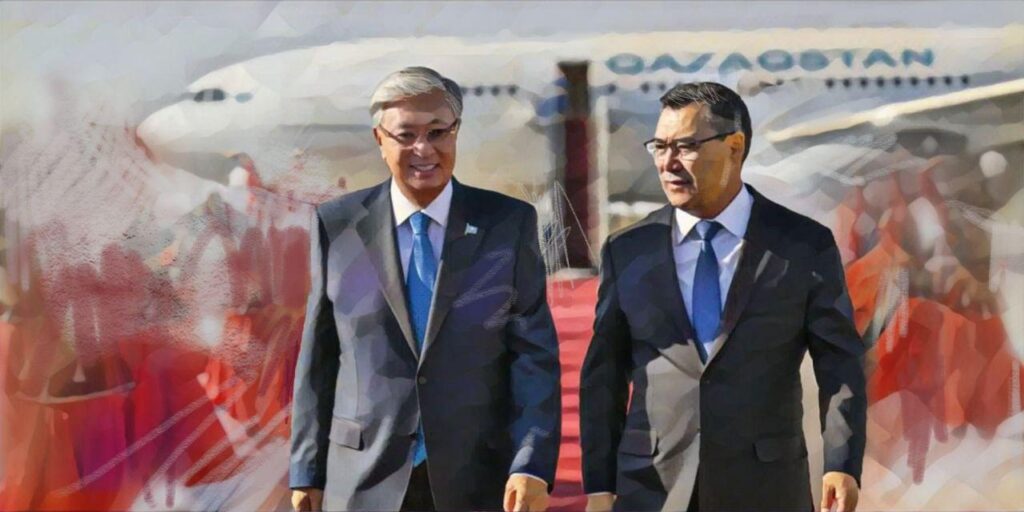
Kazakh President Kassym-Jomart Tokayev arrived in Kyrgyzstan on 21 August for an official visit that rolls into a full day of talks in Bishkek on 22 August, including a session of the Supreme Interstate Council. The Kyrgyz capital implemented rolling traffic restrictions around motorcade routes, a sign of how tightly choreographed the program is. The visit’s centerpiece is a Tokayev–Japarov meeting in both narrow and expanded formats, alongside a packed slate of bilateral events that underscore deepening political, economic, and cultural ties between the neighbors. Tokayev’s schedule blends state protocol with public-facing diplomacy. Alongside presiding over the seventh meeting of the Supreme Interstate Council, the two leaders are set to unveil the “Golden Bridge of Friendship” monument in Bishkek’s Yntymak Park - an attempt to give symbolic form to a relationship both sides have labored to institutionalize over the past two years. The program is also set to include the inauguration of the Consulate General of Kazakhstan in Osh, the launch of a branch of L.N. Gumilyov Eurasian National University in Kyrgyzstan’s south, the third Kyrgyz-Kazakh Youth Forum, and Days of Kazakhstan Cinema - events designed to anchor cooperation beyond chancelleries and boardrooms. This public show of diplomacy is being matched by concrete steps. The new Consulate General in Osh is intended to smooth consular services, support cross-border business, and expand cultural ties in a region where Kazakh–Kyrgyz trade and travel flows are accelerating. Central government, city, and regional officials joined Kazakh diplomats at the ribbon-cutting, underscoring the practical, day-to-day value for citizens who live and work across the southern corridor. Optics aside, the substance is in the talks. Astana and Bishkek have spent the last 18 months upgrading their legal architecture. In April 2024, the presidents signed a Treaty on Deepening and Expanding Allied Relations, moving the relationship beyond the basic language of partnership and into a framework that touches upon security, transport, energy, agriculture, and cultural cooperation. Kazakhstan’s Parliament later approved, and the president signed implementing legislation, putting the allied-relations commitments on a firmer legal footing domestically. This trip is widely viewed in both capitals as a chance to translate that framework into specific projects - some of which are already in motion. Trade and connectivity top the economic agenda. Bilateral trade hit roughly $1.7 billion in 2024, and both governments have repeatedly floated a target of $3 billion within the decade. The composition of flows is familiar: Kazakhstan ships metals, grain, fuels, and construction materials, while Kyrgyzstan supplies gold, coal, light-industry goods, and services. Reaching the next rung, however, will require more predictable border procedures, harmonized standards, and dedicated logistics capacity - areas where ministerial roadmaps are already in circulation. Energy and water cooperation is the other pillar. Kyrgyzstan’s Kambarata-1 hydropower project - envisioned as a 1,860 MW plant on the Naryn River - has become a regional test case for practical integration. Since mid-2024, Kyrgyzstan, Kazakhstan, and Uzbekistan have built a joint track with the World Bank and other partners to complete feasibility work, structure financing,...

Tokayev to Visit Kyrgyzstan for High-Level Talks on Aug. 21–22

Kazakhstan’s President Kassym-Jomart Tokayev is due in Kyrgyzstan for an official visit at the invitation of President Sadyr Japarov, with the main program set in Bishkek. An announcement, carried by state media, confirmed the trip and outlined that talks would take place on deepening political and economic ties. Local authorities have introduced traffic restrictions for Aug. 21–22, indicating a two-day schedule including protocol events and bilateral meetings. The leaders are expected to review cooperation across trade, transit, and energy, and to convene the Supreme Interstate Council, the highest bilateral forum, to sign documents prepared by their foreign ministries in recent weeks. Diplomatic sources say deliverables could include measures to ease border procedures and timelines for joint infrastructure projects. A Busier, More Formalized Partnership Kazakhstan and Kyrgyzstan have intensified engagement through 2024–2025 with frequent ministerial contacts, new investment pledges, and coordination on water-energy policy. In early August, the countries’ foreign ministers initiated a 2025–2027 cooperation plan for presidential approval at the upcoming summit. Energy is central: the governments, together with Uzbekistan and international partners, have advanced groundwork on the Kambarata-1 hydropower plant, a flagship project intended to expand clean generation and regulate seasonal flows in the Syr Darya basin. Economically, both states are members of the Eurasian Economic Union, giving their businesses a shared customs space and labor mobility framework — a recurring theme when leaders meet to resolve practical bottlenecks in border trade and logistics. Business groups on both sides are also pushing for upgrades to road and rail crossings and for the expanded use of digital customs tools. Tokayev’s program is expected to include a formal meeting with President Japarov, a session of the Supreme Interstate Council, and a signing ceremony. While detailed communiqués typically follow the talks, officials in Bishkek and Astana have signaled that this visit aims to translate recent preparatory work into specific targets on trade, transport, and energy, setting the tone for the next phase of Kazakh–Kyrgyz relations.

Uzbekistan and Mongolia Sign Joint Declaration to Deepen Bilateral Ties

President of Uzbekistan Shavkat Mirziyoyev arrived in Mongolia on June 24 for a historic state visit at the invitation of President Ukhnaagiin Khurelsukh. This marks the first official visit by a Uzbek head of state to Mongolia, signaling a significant step forward in bilateral relations. The official welcoming ceremony took place at Sukhbaatar Square in central Ulaanbaatar, where the two leaders reviewed an honor guard and greeted members of their respective delegations as national anthems were performed. In formal talks, both presidents reaffirmed their countries’ commitment to deepening cooperation. President Mirziyoyev expressed gratitude for Mongolia’s warm reception, and extended congratulations in advance of the country’s upcoming People’s Revolution Day celebrations. Expanding Economic Cooperation Discussions focused on strengthening economic ties, including cooperation in healthcare, education, e-commerce, agriculture, and construction materials. A recent Uzbek-Mongolian business forum held in Ulaanbaatar highlighted growing commercial engagement, while the opening of a Trade House for Uzbek goods in the Mongolian capital further cemented trade ties. The two presidents emphasized the importance of expanding trade in high value-added products, and expressed readiness to finalize agreements on preferential trade and investment protection. Areas such as mining, technology transfer, and vocational training were also on the agenda. To support these initiatives, Uzbekistan’s Ministry of Geology has opened a representative office in Ulaanbaatar. Agro-Industrial Development and Connectivity Agro-industrial collaboration will be advanced through the creation of joint clusters in meat, dairy, wool, and leather processing. Both sides are also exploring the possibility of launching direct flights between Tashkent and Ulaanbaatar by the end of 2025 to facilitate business and tourism. Humanitarian and Educational Exchange Humanitarian cooperation featured prominently in the dialogue. The leaders agreed to resume educational exchange programs, enabling Mongolian students to study at universities in Uzbekistan, thereby strengthening cultural and academic ties. Formalizing a Comprehensive Partnership The visit concluded with the signing of a joint declaration establishing a comprehensive partnership, outlining key areas for long-term cooperation and reaffirming mutual commitment to deeper ties. President Mirziyoyev also invited President Khurelsukh for a reciprocal visit to Uzbekistan.

Lavrov in Uzbekistan: Criticism, Controversy, and Clashing Narratives

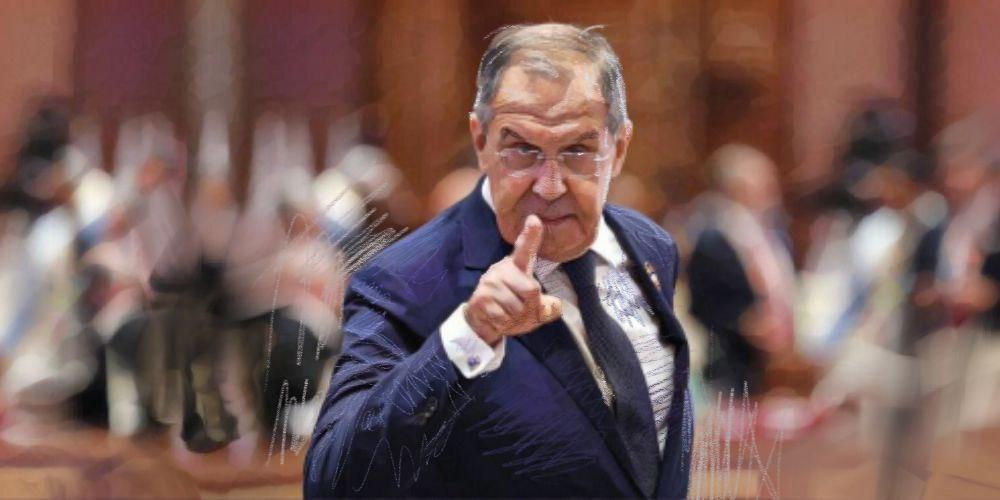
Russian Foreign Minister Sergey Lavrov’s official visit to Uzbekistan this week has triggered significant public and political responses, particularly after remarks he made during a visit to the Motamsaro Ona (Grieving Mother) memorial in Samarkand. While at the memorial, which honors Uzbek soldiers who died during World War II and features inscriptions in Uzbek and English, Lavrov pointed out the absence of a Russian-language text. “There is an inscription in English, but I didn’t see one in Russian. A mother is the most sacred figure,” Lavrov reportedly told his tour guide, according to TASS. Uzbekistan’s Foreign Minister Bakhtiyor Saidov was present during the exchange. Photographs released by the Russian Foreign Ministry show Lavrov laying flowers at the site, accompanied by an honor guard. Lavrov was in Uzbekistan for a two-day official visit. On April 23, he met with President Shavkat Mirziyoyev to discuss bilateral ties and regional cooperation, including trade, energy, and security issues. [caption id="attachment_31165" align="aligncenter" width="1280"] Sergey Lavrov lays flowers at the Grieving Mother memorial in Samarkand; image: MFA Russia[/caption] Domestic Responses to Lavrov’s Remarks Lavrov’s observation about the memorial sparked criticism from several Uzbek public figures. Alisher Qodirov, a member of parliament and leader of the Milliy Tiklanish (National Revival) party, stated that “Russian politicians seem to be trying every possible way to portray Uzbekistan as disrespectful to Russian language and culture... Lavrov surely understands that forced respect and invented needs only create the opposite effect.” Sherzodkhon Qudratkhodja, rector of the University of Journalism and Mass Communications of Uzbekistan, was similarly outspoken. “It is inappropriate for a Foreign Minister from another country to come here and criticize us,” he said. “After all, we are not their colony.” Qudratkhodja further criticized Russia’s treatment of Uzbek labor migrants. “Why are our migrants in Russia discriminated against? Why do Russian officials remain silent when local authorities, migration services, or police violate their basic human rights?” he asked. “If Mr. Lavrov wants to speak about sacred symbols like mothers, Uzbekistan can remind him that human rights are sacred, too.” Mutual Recriminations and Educational Policy Lavrov also addressed Uzbekistan’s engagement with the EU, prompting a further response from Qudratkhodja. “No one has the right to interfere in Uzbekistan’s internal affairs,” he said. “This includes independently determining our level of relations with the European Union. It demonstrates our state’s multi-vector foreign policy.” Coinciding with Lavrov’s visit, Uzbekistan’s Ministry of Preschool and School Education introduced a new requirement: all graduating students, including those from non-Uzbek-language schools, must now pass an exam in the Uzbek state language, a move widely viewed as part of broader efforts to reinforce national identity. At a joint press conference, Lavrov emphasized the closeness of Uzbekistan-Russia relations. “You feel this closeness when you are here, not only at the official level but also at the human level,” he said. Foreign Minister, Saidov responded by underscoring Uzbekistan’s balanced diplomacy: “Our country does not compare friends. We are close to all our strategic partners and friendly countries.” Labor Migration and Energy Cooperation...