• KGS/USD = 0.01144 0%
  • KZT/USD = 0.00206 0%
  • TJS/USD = 0.10789 -0.09%
  • UZS/USD = 0.00008 0%
  • TMT/USD = 0.28571 0%
  • KGS/USD = 0.01144 0%
  • KZT/USD = 0.00206 0%
  • TJS/USD = 0.10789 -0.09%
  • UZS/USD = 0.00008 0%
  • TMT/USD = 0.28571 0%
  • KGS/USD = 0.01144 0%
  • KZT/USD = 0.00206 0%
  • TJS/USD = 0.10789 -0.09%
  • UZS/USD = 0.00008 0%
  • TMT/USD = 0.28571 0%
  • KGS/USD = 0.01144 0%
  • KZT/USD = 0.00206 0%
  • TJS/USD = 0.10789 -0.09%
  • UZS/USD = 0.00008 0%
  • TMT/USD = 0.28571 0%
  • KGS/USD = 0.01144 0%
  • KZT/USD = 0.00206 0%
  • TJS/USD = 0.10789 -0.09%
  • UZS/USD = 0.00008 0%
  • TMT/USD = 0.28571 0%
  • KGS/USD = 0.01144 0%
  • KZT/USD = 0.00206 0%
  • TJS/USD = 0.10789 -0.09%
  • UZS/USD = 0.00008 0%
  • TMT/USD = 0.28571 0%
  • KGS/USD = 0.01144 0%
  • KZT/USD = 0.00206 0%
  • TJS/USD = 0.10789 -0.09%
  • UZS/USD = 0.00008 0%
  • TMT/USD = 0.28571 0%
  • KGS/USD = 0.01144 0%
  • KZT/USD = 0.00206 0%
  • TJS/USD = 0.10789 -0.09%
  • UZS/USD = 0.00008 0%
  • TMT/USD = 0.28571 0%

Viewing results 1 - 6 of 3

Kazakhstan Registers Five New Gold Deposits as Jewelers Seek Raw Materials

Citing World Gold Council data, Azamat Panbayev, chairman of the Industrial Committee at Kazakhstan’s Ministry of Industry and Construction, said Kazakhstan ranked 14th globally in gold production last year. He was speaking at the VII Forum of Gold Producers of Kazakhstan  held as part of the international Astana Mining & Metallurgy Congress 2026. “The gold mining industry remains one of the strategically important sectors of industry and makes a significant contribution to the country’s economic development,” Panbayev said. “Kazakhstan has a substantial mineral resource base: 374 gold deposits with total reserves of 2,369 tons are currently listed on the state balance sheet. Last year alone, five new deposits with reserves of around 98 tons of gold were added to the state register.” According to the Ministry of Industry and Construction, Kazakhstan produced 71.2 tons of refined gold in 2025, while investment in precious metals production reached $202.6 million, up 38% from the previous year. Gold refining in Kazakhstan is carried out by Tau-Ken Altyn LLP, the country’s only specialized state refinery and a subsidiary of National Mining Company Tau-Ken Samruk JSC. The Astana-based plant purchases doré, a semi-refined alloy containing gold and silver, from gold mining companies and sells gold refined to 99.99% purity. However, only 5% of the raw materials purchased by jewelers in Kazakhstan come from the Astana refinery, said Kanat Baitov, executive director of the Dragnet Association. He estimated that more than 50% of the industry’s raw materials market remains in the shadow economy. “We mine 70 tons of gold every year. If even 20 tons, or at least 5 tons, of that were used for jewelry production, the industry would have real potential,” Baitov said. Kazakhstan has introduced a VAT exemption for jewelers purchasing granulated gold from the state refinery, according to Baitov. “They are ready to supply not only granulated gold but, over time, if volumes increase, they are also prepared to supply alloys to the domestic market and could produce ready-made assay standards for jewelers,” he said, referring to Tau-Ken Altyn. He noted that jewelers would only be able to benefit from the new tax incentives for purchasing raw materials from the state plant if they increased procurement volumes. Currently, by his estimate, purchases do not exceed 30 kilograms per year. He added that such practices could eventually raise questions from the state regarding the origin of the raw materials used by jewelers in Kazakhstan. Zhaniya Dabyr, co-owner of the jewelry company Kazakhyuvelir, said the industry faces several challenges. These include high raw material costs, limited access to financing, the shadow market, insufficient government support, weak promotion in foreign markets, and limited tax incentives. “We propose expanding the mechanism for selling gold to domestic manufacturers and introducing a more flexible system of installment payments, fixing the gold price on the purchase date, as well as considering discounts for domestic producers and additional preferences for export-oriented companies,” Dabyr said. Kazakhyuvelir also proposed creating a digital accounting system for the jewelry market that would cover manufacturers...

Digital Gold Trading Launches on Kyrgyz Stock Exchange

On April 3, the Kyrgyz Stock Exchange, Kyrgyzaltyn, and Central Depository CJSC signed an agreement enabling the purchase and sale of precious metals, particularly gold. The initiative aims to provide equal access to exchange-based gold trading for all categories of investors. The exchange will ensure automated and transparent transactions, with prices formed in real time based on supply and demand. Participants in the trading include commercial banks, jewelry and brokerage firms, and other entities registered with the Department of Precious Metals under the Ministry of Finance. “Using exchange infrastructure automates processes and guarantees equal access to the asset for all categories of investors,” said Aida Chodulova, CEO of the Kyrgyz Stock Exchange. She added that gold will function as both a digital and physical asset, with transactions recorded in the exchange’s automated system. Officials say the platform will allow investors to trade gold without the need for physical transportation, while also offering a tool for long-term capital preservation. Gold remains Kyrgyzstan’s main export commodity. In 2025, the country exported 6.2 tons of gold worth $682.8 million, according to preliminary data cited by local media. According to the Ministry of Economy, gold accounted for nearly 24% of total exports. The country’s largest deposit, Kumtor, is located in the Issyk-Kul Region at an altitude of about 4,000 meters. It is one of the world’s largest gold deposits and was nationalized in 2021 after previously being owned by Centerra Gold. The mine is operated by Kumtor Gold Company, which is fully owned by Kyrgyzaltyn. In 2025, the company produced 12,081 kg of gold, generated $1.434 billion in revenue, and reported net profit of more than $706 million, while paying $246.5 million in taxes and other payments.

Vending Machines Selling Gold Bars to Appear in Tajikistan

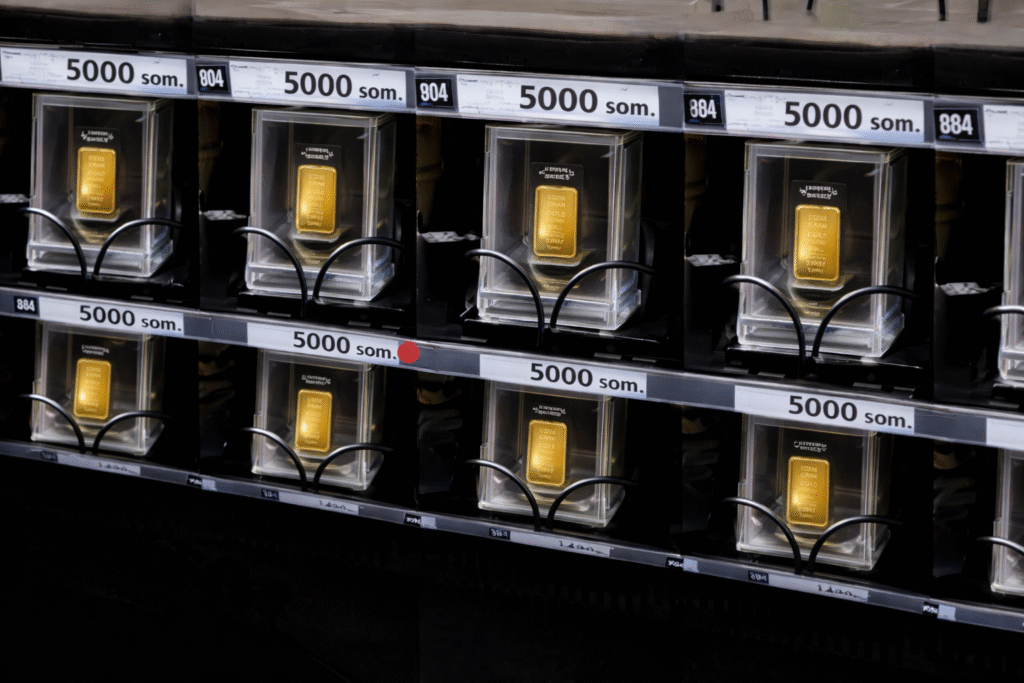
The National Bank of Tajikistan plans to expand public access to investments in precious metals by installing specialized vending machines in the capital Dushanbe, allowing customers to buy and sell gold bars. The initiative was announced by the bank’s chairman, Firdavs Tolibzoda. According to the regulator, the equipment will be installed in Dushanbe and will enable residents to conduct transactions with gold bars automatically. The machines will operate similarly to conventional ATMs. Customers will be able to select a gold bar, pay by bank card, and receive the product. Some machines are also expected to allow customers to sell gold back to the bank. Such devices are typically located in shopping centers, airports, and other high-traffic areas. As Tolibzoda emphasized, the decision is aimed at “expanding public access to the purchase of gold bars.” Gold bars have been in free circulation in Tajikistan since June 2017. They are currently sold at the central office of the National Bank in Dushanbe and through several commercial banks. According to the regulator, 200 kilograms of gold were sold in the country in 2025 for a total of $24.64 million. Individuals accounted for the majority of purchases. The price of bullion is set daily. It is calculated based on the price of a troy ounce (31.1034768 grams) at the morning interbank fixing in London. Additional costs, including production, transportation, insurance, and customs duties, are also taken into account. The bars are produced from gold mined in Tajikistan. According to the National Bank, 2025 marked a turning point for the domestic gold market. The price of its standardized gold bars rose by an average of 39.03% during the year, the highest increase in recent years. The growth was attributed to rising global gold prices amid geopolitical tensions, a weakening U.S. dollar, and increased demand for safe-haven assets. Bars weighing 10, 20, and 50 grams are available for purchase. As is customary in the bullion market, the larger the bar, the lower the price per gram.