• KGS/USD = 0.01144 0%
  • KZT/USD = 0.00216 0%
  • TJS/USD = 0.10698 0%
  • UZS/USD = 0.00008 0%
  • TMT/USD = 0.28530 0%
  • KGS/USD = 0.01144 0%
  • KZT/USD = 0.00216 0%
  • TJS/USD = 0.10698 0%
  • UZS/USD = 0.00008 0%
  • TMT/USD = 0.28530 0%
  • KGS/USD = 0.01144 0%
  • KZT/USD = 0.00216 0%
  • TJS/USD = 0.10698 0%
  • UZS/USD = 0.00008 0%
  • TMT/USD = 0.28530 0%
  • KGS/USD = 0.01144 0%
  • KZT/USD = 0.00216 0%
  • TJS/USD = 0.10698 0%
  • UZS/USD = 0.00008 0%
  • TMT/USD = 0.28530 0%
  • KGS/USD = 0.01144 0%
  • KZT/USD = 0.00216 0%
  • TJS/USD = 0.10698 0%
  • UZS/USD = 0.00008 0%
  • TMT/USD = 0.28530 0%
  • KGS/USD = 0.01144 0%
  • KZT/USD = 0.00216 0%
  • TJS/USD = 0.10698 0%
  • UZS/USD = 0.00008 0%
  • TMT/USD = 0.28530 0%
  • KGS/USD = 0.01144 0%
  • KZT/USD = 0.00216 0%
  • TJS/USD = 0.10698 0%
  • UZS/USD = 0.00008 0%
  • TMT/USD = 0.28530 0%
  • KGS/USD = 0.01144 0%
  • KZT/USD = 0.00216 0%
  • TJS/USD = 0.10698 0%
  • UZS/USD = 0.00008 0%
  • TMT/USD = 0.28530 0%

Viewing results 1 - 6 of 34

Rosatom to Neutralize Hazardous Chemical Waste at Plant in Kyrgyzstan

Rosatom is set to begin work to eliminate hazardous chemicals stockpiled at the Kristall plant in Tash-Kumyr, in Kyrgyzstan’s Jalal-Abad region. The Kristall plant, built in 1989 as a key facility of the Soviet electronics industry to produce polycrystalline silicon, has since become a high-risk environmental site. Hazardous chemical waste accumulated on its premises poses a threat to both the environment and public health. The plant has been bankrupt since 2010. The site contains 49 tanks holding a total of 155 tons of hazardous chemical residues, including trichlorosilane and silicon tetrachloride. In October 2024, Rosatom conducted a technical audit of the facility, revealing the deteriorated condition of the storage tanks. Prolonged inactivity has left the aging infrastructure in poor shape, increasing the risk of structural failure and depressurization. On April 14, in Bishkek, Rosatom and the Kyrgyz Ministry of Emergency Situations discussed technological solutions for neutralizing the chemicals. According to Rosatom, the first phase of the cleanup is scheduled for completion by the end of 2026. This stage will focus on bringing the chemical storage tanks to a safe condition. It also involves the installation of a dual emergency protection system and the introduction of independent environmental monitoring. The proposed neutralization methods have been approved by the Kyrgyz Ministry of Natural Resources, Ecology, and Technical Supervision. By the end of 2026, Rosatom aims to eliminate the risk of leaks and uncontrolled emissions by stabilizing the tanks and ensuring safe conditions for further handling of the hazardous substances. In 2027, the project will enter its second phase, focusing on the on-site neutralization of the chemicals as the preferred solution. Kyrgyz Emergency Situations Minister Kanatbek Chynybayev said the situation at the Kristall plant remains environmentally challenging and requires a comprehensive response. “Our primary objective is to eliminate potential health risks to residents of Tash-Kumyr and lift the state of emergency in the area. Rosatom’s expertise has been engaged to address this issue. As part of this collaboration, a technological strategy has been developed that will allow the threats to be neutralized within the specified timeframe and return the site to a safe condition,” he said.

Kyrgyzstan Weighs Nuclear Power as Rosatom Talks Advance

Kyrgyzstan is still in talks with Russia’s state-owned nuclear power company Rosatom about building a nuclear power plant (NPP) in Kyrgyzstan. But on March 3, Kyrgyz Deputy Chairman of the Cabinet of Ministers, Daniyar Amangeldiyev, was already speaking about conducting a national referendum on the construction of a nuclear power plant. It is clear why Rosatom is anxious to build the NPP, but it is less clear why Kyrgyzstan needs it. Kyrgyzstan’s Road to Nuclear Power Rosatom is active in Central Asia, receiving the contract to build Kazakhstan’s first NPP in June 2025. Uzbekistan had already signed a contract with Rosatom in May 2024, and in late March 2026, the first concrete was poured for the NPP that Rosatom is constructing in Uzbekistan. At first glance, Central Asia might not seem like an ideal market for nuclear power. But after Russia’s full-scale invasion of Ukraine in February 2022, Finland canceled its contract for Rosatom to build the Hanhikivi-1 NPP, and while several  European countries are building or considering building NPPs, Hungary is the only country committed to partnering with Rosatom. With limited prospects for new contracts in Europe, Rosatom is likely to focus on securing additional deals in non-European markets to expand its already extensive portfolio. Kyrgyzstan’s Energy Ministry and Rosatom signed a Memorandum of Understanding for a small NPP in January 2022. The initial plan for Kyrgyzstan’s NPP was to build a small RITM-200N with a 55-megawatt (MW) capacity. In May 2025, Director General of Rosatom, Alexey Likhachev, said his company was offering Kyrgyzstan a modular NPP project that could generate anywhere from 110 MW to 440 MW using RITM-200N reactors, equivalent to two to eight units. In late March 2026, Likhachev said current talks with Kyrgyzstan were not only focused on the construction of a small NPP but also a medium-sized NPP. Kyrgyz Deputy Chairman of the Cabinet of Ministers Amangeldiyev said in June 2025 that Kyrgyz officials and Rosatom representatives were already looking at potential sites for the NPP. Reports about the planned NPP in Kyrgyzstan don’t mention the cost of construction, and it remains unclear how many and what size reactors will be installed. According to Uzbek officials, the six 55-MW units that Rosatom was initially contracted to build (the project has since changed) would have cost “less than $2 billion.” An Agreement or Not In March 2024, Kyrgyzstan’s Deputy Energy Minister Taalaybek Baygaziyev signed an agreement with Rosatom on the development and implementation of the NPP investment project. In September 2025, Altynbek Rysbekov was appointed Kyrgyzstan’s Deputy Energy Minister, and he said, “There is a possibility of building a (nuclear power) station, but no fundamental decision has been made yet.” However, Rysbekov’s further comments indicated he supported the idea of building an NPP in Kyrgyzstan, and he reconfirmed that the search for an appropriate site for the NPP continued. On April 3, 2026, Amangeldiyev said negotiations with Rosatom are continuing. “We are collaborating with Rosatom on infrastructure development and personnel training,” Amangeldiyev stated. “Only after...

Uzbekistan Nuclear Project Could Bring Russia Orders Worth $22 Billion

Uzbekistan’s first nuclear power plant, based on small modular reactor (SMR) technology, has entered a new phase, with initial construction, including concrete works, beginning at the site in the Farish district of the Jizzakh region on March 24. The project is part of Uzbekistan’s long-running plan to diversify its energy mix and reduce reliance on gas-fired power generation. The milestone was marked by parallel ceremonies held in Tashkent and at the construction site. During the events, Uzbekistan’s nuclear energy agency Uzatom and Russia’s state nuclear corporation Rosatom signed several key documents, formally advancing the project to the implementation stage. These included a cooperation roadmap covering nuclear and related sectors, as well as an addendum to the contract for building an integrated nuclear power facility in Uzbekistan. The documents were signed by Uzatom Director Azim Akhmedkhadjaev and Rosatom Director General Alexey Likhachev. Speaking to reporters, Likhachev said the project could also have significant economic benefits for Russia. According to the Russian news agency TASS, he stated that construction of even a small reactor unit at the Uzbek site could generate orders worth up to $22 billion for Russian companies. He added that the project could create around 1,000 jobs in Russia. Likhachev also outlined broader potential economic returns, saying that for every ruble invested during construction, up to 1.5 rubles could be returned to the Russian economy, rising to as much as two rubles during the plant’s operational phase.

Uzbekistan Launches First Concrete Works at Planned Nuclear Power Plant

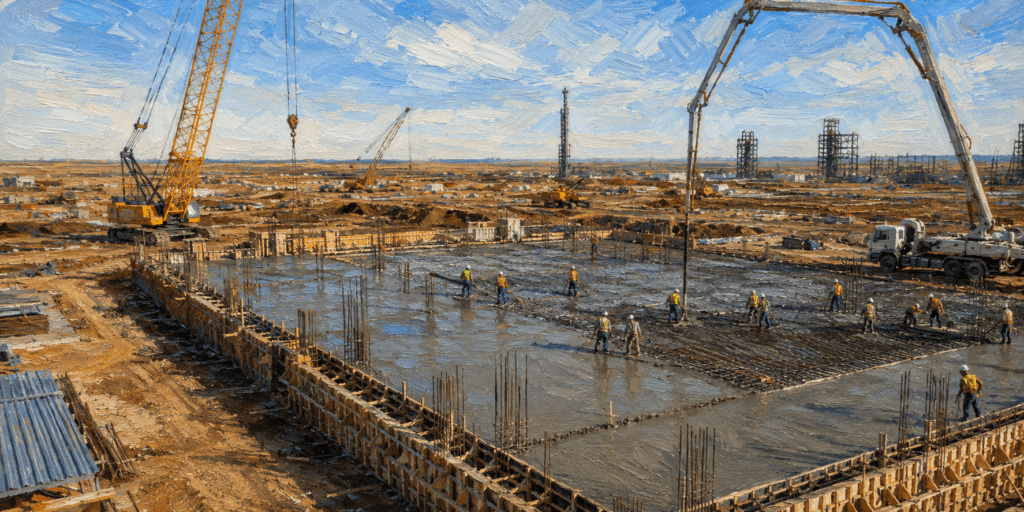
Construction of Uzbekistan’s first nuclear power plant has entered a new phase, with initial concrete works officially launched at the project site in the Farish district of the Jizzakh Region, according to the country’s Atomic Energy Agency, Uzatom. The milestone was marked on March 24 during simultaneous ceremonies held in Tashkent and at the construction site. During the events, Uzatom and Russia’s state nuclear corporation Rosatom signed a number of strategic documents, formally advancing the project to the stage of practical implementation. Among the agreements were a cooperation roadmap covering nuclear and related sectors, as well as an addendum to the contract for the construction of an integrated nuclear power facility in Uzbekistan. The documents were signed by Uzatom Director Azim Akhmedkhadjaev and Rosatom Director General Alexey Likhachev. According to Uzatom, the roadmap outlines cooperation in areas such as project implementation phases, workforce training, public engagement on nuclear energy, and the development of infrastructure for a future town for plant personnel. Uzbek officials said the agreement establishes a comprehensive partnership expected to contribute to both economic and social development. At the construction site, work has begun on laying the concrete foundation beneath the reactor building for a small modular unit using the RITM-200N design. Approximately 900 cubic meters of concrete are scheduled to be poured, with this stage expected to be completed by April 2026. The foundation will incorporate the waterproofing and grounding systems required for the reactor structure. The updated configuration of the plant involves two large power units equipped with Generation III+ VVER-1000 reactors, as well as two smaller units using RITM-200N reactors, each with a capacity of 55 MW. Once fully operational, the facility is expected to generate around 15.4 billion kilowatt-hours of electricity annually, more than 15% of Uzbekistan’s current power consumption. Uzatom stated that regulatory approval for use of the site has already been granted following safety assessments that identified no significant risks related to seismic activity, tectonic faults, or karst formations. The agency said the location meets nuclear, environmental, and technical safety requirements. “The start of concrete works marks an important step in implementing Uzbekistan’s national nuclear energy program,” Akhmedkhadjaev said, adding that the project is proceeding in line with established timelines and safety standards. Separately, Uzatom confirmed that a mission from the International Atomic Energy Agency is expected to visit Uzbekistan in the second half of 2026 to assess progress on the project.

Kazakhstan Has Selected a Site for Its Second Nuclear Power Plant

The Kazakh government has approved the location for its second nuclear power plant. According to an official decree, the facility will be constructed in the Zhambyl district of the Almaty region, adjacent to the site selected for the country's first nuclear plant. The Ministry of Justice published Government Resolution No. 40, dated January 26, 2026, titled On the Construction and Construction Site of the Nuclear Facility “Second Nuclear Power Plant”, in the Adilet system of regulatory legal acts. The resolution came into effect on the day of its signing. Nuclear projects typically proceed through feasibility studies, environmental review, and financing arrangements, and timelines can shift as plans move from preliminary approval to full construction. Earlier reports indicated that contracts for the construction of Kazakhstan’s second and third nuclear plants were awarded to China’s CNNC, with the first plant being developed by the Russian state corporation Rosatom. Its site is located in the village of Ulken, also in Zhambyl district, on the shore of Lake Balkhash, approximately 400 km northwest of Almaty. Thus, Kazakhstan’s first two nuclear power facilities will be concentrated in the country’s southern region. The design capacity of the first plant is 2.4 GW, comprising two VVER-1200 reactors, each with a capacity of 1.2 GW. Rosatom has already begun preparatory work on the site. The foundation is scheduled to be poured in 2029, with commissioning planned for 2035. Previously, Kurchatov in the Abai region, near the former Semipalatinsk nuclear test site, was considered as a possible location for one of the three planned plants. This site was reviewed with International Atomic Energy Agency participation. However, the current government decision confirms a focus on the Almaty region. The Kazakh authorities view nuclear energy as a strategic solution to the country’s growing electricity shortage. At the same time, in January, Energy Minister Yerlan Akkenzhenov stated that Kazakhstan would be able to fully meet domestic energy demand by the end of the first quarter of 2027, without nuclear power, and by 2029, the country is expected to reach a surplus and begin electricity exports.

Uzbekistan Clarifies Nuclear Plant Timeline After Reports of Delay

Uzbekistan’s plans to begin construction of its first nuclear power plant have come under renewed scrutiny following the publication of a draft state program suggesting the start of work could be postponed until December 2026. The draft made public on the regulation.adliya.uz portal prompted widespread media speculation. According to the document, Uzbekistan intends to spend 2026 negotiating, signing, and registering an additional agreement with Russia’s state nuclear corporation, Rosatom. The proposed agreement would revise the configuration of the integrated nuclear power plant project, combining a large-capacity VVER-1000 reactor with small modular RITM-200N reactors. Some outlets interpreted this language as a sign that the pouring of the first concrete might not occur until the end of 2026. In response, the Uzatom nuclear energy agency issued an official clarification, stating that previously announced timelines remain unchanged. In a statement released after the draft’s publication, Uzatom stressed that the document does not stipulate any postponement of construction. The agency noted that the December 2026 date reflects a conservative planning scenario in which all preparatory and licensing procedures are finalized by that time. Uzatom emphasized its adherence to national legislation and international standards on nuclear and radiation safety. It added that the first concrete pouring, considered a key milestone, will only proceed after receiving all necessary permits and approvals from relevant authorities. “We clearly understand the level of responsibility involved in this stage,” the agency said, adding that work on the project is advancing across all areas. The clarification comes amid sustained public interest in Uzbekistan’s nuclear energy plans. Speaking at World Atomic Week in Moscow in September last year, Uzatom Director Azim Akhmedkhadjaev stated that Uzbekistan aims to fully commission a high-capacity nuclear power plant by 2035. According to him, the first small modular reactor in the Jizzakh region is expected to begin operations in 2029, with a second unit following six months later. The first reactor of the large-scale facility is scheduled to come online in 2033, with full capacity reached by 2035, though Akhmedkhadjaev noted that final timelines are contingent on the completion of contractual agreements. Uzatom said it will continue to provide timely updates as the project progresses through its key phases.