• KGS/USD = 0.01144 0%
  • KZT/USD = 0.00210 0%
  • TJS/USD = 0.10563 0%
  • UZS/USD = 0.00008 0%
  • TMT/USD = 0.28530 0%
  • KGS/USD = 0.01144 0%
  • KZT/USD = 0.00210 0%
  • TJS/USD = 0.10563 0%
  • UZS/USD = 0.00008 0%
  • TMT/USD = 0.28530 0%
  • KGS/USD = 0.01144 0%
  • KZT/USD = 0.00210 0%
  • TJS/USD = 0.10563 0%
  • UZS/USD = 0.00008 0%
  • TMT/USD = 0.28530 0%
  • KGS/USD = 0.01144 0%
  • KZT/USD = 0.00210 0%
  • TJS/USD = 0.10563 0%
  • UZS/USD = 0.00008 0%
  • TMT/USD = 0.28530 0%
  • KGS/USD = 0.01144 0%
  • KZT/USD = 0.00210 0%
  • TJS/USD = 0.10563 0%
  • UZS/USD = 0.00008 0%
  • TMT/USD = 0.28530 0%
  • KGS/USD = 0.01144 0%
  • KZT/USD = 0.00210 0%
  • TJS/USD = 0.10563 0%
  • UZS/USD = 0.00008 0%
  • TMT/USD = 0.28530 0%
  • KGS/USD = 0.01144 0%
  • KZT/USD = 0.00210 0%
  • TJS/USD = 0.10563 0%
  • UZS/USD = 0.00008 0%
  • TMT/USD = 0.28530 0%
  • KGS/USD = 0.01144 0%
  • KZT/USD = 0.00210 0%
  • TJS/USD = 0.10563 0%
  • UZS/USD = 0.00008 0%
  • TMT/USD = 0.28530 0%

Viewing results 1 - 6 of 31

Uzbekistan Plans Full Launch of Large Nuclear Power Plant by 2035

Uzbekistan plans to fully launch a high-capacity nuclear power plant by 2035, according to Azim Akhmedkhadjaev, director of the “Uzatom” agency. Speaking on September 25 at World Atomic Week in Moscow, Akhmedkhadjaev said the first small modular reactor is expected to begin operations in 2029 in the Jizzakh region, followed by a second unit six months later. The large-scale plant will see its first reactor come online in 2033, with full capacity expected by 2035. He noted, however, that final timelines depend on the conclusion of outstanding contract agreements. Akhmedkhadjaev confirmed that production of reactor equipment is already underway and that the project is proceeding on schedule. Responding to a question from a Spot correspondent, he reiterated the target dates for the larger reactors and emphasized that the timeline will be refined once contracts are finalized. The announcement aligns with Uzbekistan’s broader nuclear energy strategy. As previously reported by The Times of Central Asia, the country plans to build both small modular and larger reactors at a single integrated nuclear facility. Under a revised agreement with Russia, Uzbekistan intends to construct two large VVER-1000 reactors alongside two smaller RITM-200N units. The initial framework for the project was established in 2018 and updated in 2024. Earlier this year, The Times of Central Asia reported that Rosatom had begun manufacturing reactor components for the smaller units, with the first steel castings for the RITM-200N already produced in Saint Petersburg. Uzbekistan’s pivot to nuclear energy is part of its strategy to meet rapidly increasing electricity demand, which is projected to reach 135 billion kWh by 2035, nearly double current consumption levels. To address this, the government is expanding generation capacity and modernizing the national grid. While the plans are ambitious, challenges remain. As Akhmedkhadjaev acknowledged, the full implementation timeline depends heavily on contract finalization. Nevertheless, Uzbekistan’s dual-track approach, combining scalable small reactors with large base-load units, suggests a strategic commitment to energy security and diversification.

Kyrgyzstan Moves to Develop Local Lithium Battery Production

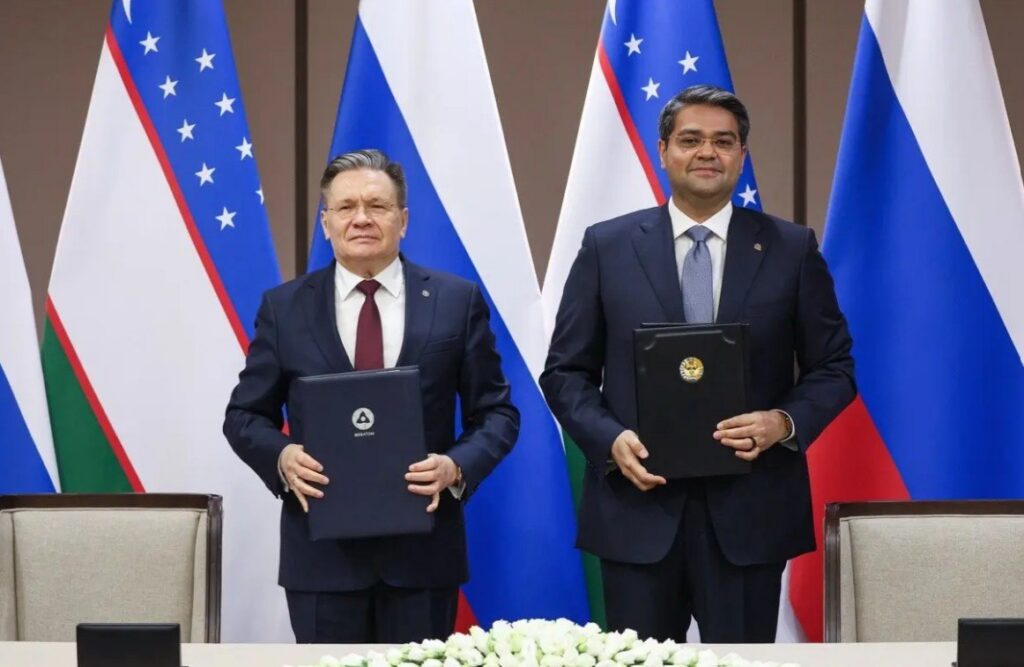
On September 26, the Kyrgyz Ministry of Economy and Commerce signed a memorandum of cooperation with Russian state atomic energy corporation Rosatom, Energy Solutions Kyrgyzstan LLC, and Elbrus Construction Company LLC to explore the development of lithium battery and energy storage system production in Kyrgyzstan. According to the ministry, the agreement outlines joint efforts to analyze the domestic lithium battery market, prepare proposals for localized production, and implement projects focused on energy storage solutions within the country. The initiative is expected to attract high-tech investment, generate new jobs, and contribute to Kyrgyzstan’s energy independence. It also supports the development of clean and sustainable energy technologies. The project is particularly relevant as the number of imported electric vehicles (EVs) in Kyrgyzstan continues to rise, alongside government plans to localize EV assembly. The initiative aligns with the country’s broader strategy to promote eco-friendly transport options and reduce air pollution, especially in urban areas such as Bishkek. In a related development, the Ministry of Economy and Commerce signed a memorandum of understanding in June with South Korean companies EVSIS, NGS, and the Korea Automobile Environment Association. That agreement focuses on expanding EV charging infrastructure in Bishkek. As The Times of Central Asia previously reported, South Korean stakeholders also plan to launch production of EV charging stations in Kyrgyzstan. The project aims to establish a local manufacturing facility and develop a nationwide charging network across major cities and regions.

From Gas to Gigawatts: Uzbekistan Powers Ahead with Dual Nuclear Deal

Uzbekistan has confirmed it will be building a large nuclear power plant (NPP) with two 1000-megawatt (MW) reactors as the country prepares for a sharp increase in electricity consumption in the coming years. Uzbekistan’s state atomic energy company, Uzatom, posted on September 26 that a new agreement calls for both a large and small NPP to be constructed at the same site in Uzbekistan. The revised plan for NPPs in Uzbekistan combines agreements the country signed with the Russian state nuclear company Rosatom in 2018 and 2024. Uzbek Prime Minister Abdullo Aripov and his Russian counterpart at the time, Dmitri Medvedev, signed a deal in September 2018 for a large NPP with two VVER-1200 reactors.  However, in late May 2024, during Russian President Vladimir Putin’s visit to Uzbekistan, a new agreement was signed for six small reactors, each with a capacity of 55 MW. Preparation work for six RITM-200N reactors started shortly after in the Farish district of Jizzakh Province. In June 2025, Russia’s Ministry of Economic Development said the agreement was restructured. The latest official agreement, signed September 26, 2025, commits to building an integrated NPP with two large VVER-1000 reactors and two small modular RITM-200N units. The Farish facility will be the first to house both a large and a small NPP at the same site. Speaking on the sidelines of the World Nuclear Week conference in Moscow on September 25, Uzatom director Azim Akhmedkhadjaev said, “We are the first in Central Asia to create an innovative solution for the future… (a) project combining advanced small modular reactor technology with time-tested solutions from large-scale nuclear energy.” The new agreement calls for the construction of two VVER-1000 units instead of the original VVER-1200 models. There was no explanation for the change in the type of reactors for the Uzbek facility. Uzbek Deputy Prime Minister Jamshid Khodjaev was also at the conference in Moscow. Hojayev noted Uzbekistan is seeking to increase renewable energy sources so that by 2030, these sources will produce more than 40% of Uzbekistan’s energy. Khodjaev pointed to solar and wind projects in explaining why the small NPPs are necessary. “Large blocks (reactors) provide stable baseload generation, while small blocks cover peak loads and balance the erratic operation of solar and wind farms,” according to Khodjaev. Essentially, the smaller reactors will help ensure a constant flow of electricity into the domestic grid when there is insufficient wind or sun to keep wind farms and solar power stations operating at full capacity. As Much as Possible and More Khodjaev has said that when both the large and small NPPs are operational in 2035, it will add some 15-billion-kilowatt hours (kWh) to Uzbekistan’s power grid. Electricity production in Uzbekistan has risen from some 59 billion kWh in 2016 to about 81.5 billion kWh in 2024. A relatively small percentage of that is exported to neighbors. A recent agreement with Kazakhstan calls for sending some 900 million kWh of Uzbek electricity to its northern neighbor between March and December 2026....

Over Sixty Kazakh Firms Compete to Join First Nuclear Power Plant Project

More than 60 Kazakh companies have expressed an interest in supplying goods, services, and undertaking construction work for the country's first nuclear power plant, according to Sergey Agafonov, chairman of the Kazakhstan Association of Energy Repair, Design, Engineering Companies, and Energy Equipment Manufacturers. Construction of the plant began last week near the village of Ulken on the shores of Lake Balkhash, approximately 400 kilometers from Almaty. Under the current plan, Russia’s state nuclear energy corporation Rosatom will commission two reactors with a combined capacity of 2.4 GW by 2035. The facility is expected to meet a substantial share of Kazakhstan’s growing electricity demand. The estimated cost of the project is between $14 billion and $15 billion, with an additional $1 billion allocated for the development of social infrastructure in the region. Rosatom CEO Alexei Likhachev confirmed the company’s readiness to involve Kazakh businesses during a meeting with Prime Minister Olzhas Bektenov. According to the industry association, the preliminary list of potential Kazakh participants includes 66 companies: seven energy equipment manufacturers, 41 building materials producers, and 18 construction firms. Notable names include Tavrida Electric Astana, NERO Group, Kazakhstan Insulator Plant, Sayman Corporation, KARLSKRONA LC AB, Alageum Electric, and Karaganda Turbomachinery Plant. Among building materials suppliers, Qarmet is prominent, while Bazis-A Corp. stands out among construction companies. Agafonov noted that the project could serve as a major driver for local industry, drawing a parallel to Turkey’s Akkuyu nuclear power plant, where local firms played a substantial role. As previously reported by The Times of Central Asia, Kazakhstan plans to construct at least three nuclear power plants. The Chinese National Nuclear Corporation (CNNC) has been granted the rights to develop the second and third sites.

Kazakhstan Breaks Ground on First Nuclear Power Plant

Kazakhstan has officially launched the construction of its first nuclear power plant, marking a significant milestone in the country’s long-term energy strategy. A groundbreaking ceremony was held on Friday in the Almaty region, in the south of the country. The project is being led by a consortium headed by Rosatom, Russia’s state nuclear energy corporation. The facility will be located near the village of Ulken on the shores of Lake Balkhash, approximately 400 kilometers from Almaty, Kazakhstan’s largest city. The plant will feature two reactors with a combined capacity of 2.4 gigawatts by 2035 and is expected to meet a substantial share of the country’s future electricity demand. According to Almasadam Satkaliyev, Chairman of the Atomic Energy Agency of the Republic of Kazakhstan, the total investment in the project is estimated at $14-15 billion. An additional $1 billion has been allocated for the development of social infrastructure in the surrounding region. “Today’s ceremony marks the start of engineering and survey work, a critical preparatory stage that will determine not only the final site and configuration of the plant, but also the safety, reliability, and economic efficiency of the entire project,” Satkaliyev said. Rosatom Director General Alexey Likhachev presented a model of the plant, which will be based on the design of Russia’s Novovoronezh Nuclear Power Plant and utilize Generation III+ reactor technology. This design is recognized for its improved fuel efficiency, advanced safety systems, and standardized construction process, which aims to reduce both construction and operational costs. Satkaliyev stressed that Kazakhstani enterprises and research institutions would play a central role in the project, with the aim of bolstering domestic industry, creating thousands of jobs, and advancing the country's nuclear science capabilities to international standards. According to the Agency’s press service, Satkaliyev recently met with Professor Jozef Konings, Dean of the Nazarbayev University Graduate School of Business, and Professor David Robinson of Duke University (USA) to discuss collaboration on nuclear workforce development. Discussions focused on potential joint academic programs, faculty exchanges, and international research partnerships. “Human capital development is a key pillar of the safe and sustainable introduction of nuclear technologies in Kazakhstan. I am confident that cooperation with leading academic institutions will contribute to forming a new generation of specialists capable of ensuring the safe and efficient operation of future nuclear power plants,” Satkaliyev stated. As previously reported by The Times of Central Asia, Kazakhstan plans to build at least three nuclear power plants. The second and third facilities are slated for development by the China National Nuclear Corporation (CNNC).

Kazakhstan’s Nuclear Diplomacy – With China Set to Build Second, Who Will Construct Third Nuclear Power Plant?

Kazakhstan’s famed hospitality, long enshrined in its national proverbs, has also become a guiding principle in its foreign policy. One recent example is the Kazakh government’s diplomatic maneuvering in the selection of partners for its nuclear power program. Leader of the Race Initially, Kazakhstan planned to build a single nuclear power plant by 2035 to address potential electricity shortages. However, following the October 6, 2024, referendum, where 71.12% of voters approved a plant in the Almaty Region, President Kassym-Jomart Tokayev instructed the government to explore the construction of at least two additional facilities. This directive, as it turns out, was both timely and strategic. In March 2025, the newly formed Atomic Energy Agency, reporting directly to the president, was tasked with overseeing the selection of international consortium leaders. On June 14, the agency announced that Russia’s state-owned Rosatom would lead the consortium to build Kazakhstan’s first nuclear power plant. Rosatom CEO Alexey Likhachev welcomed the decision, stating that the VVER-1200 Generation 3+ reactors, already operating in Russia and Belarus and selected by partners in Hungary, Egypt, Turkey, Bangladesh, and China, would be used. These reactors, he emphasized, meet international safety standards and integrate both active and passive safety systems. Tricks Up Their Sleeves Behind the scenes, the selection process revealed a quiet tug-of-war between Chinese and Russian interests. Ultimately, Rosatom prevailed, thanks, in part, to two strategic moves. First, Rosatom’s supporters enlisted Assystem, an ostensibly independent nuclear engineering consultancy, to assist Kazakhstan Atomic Power Plants LLP in the evaluation process. The firm’s analysis favored Rosatom. Second, to pre-empt concerns about Western sanctions, the Kazakh authorities emphasized that Kazakhstan would be the sole owner and operator of the facility. Atomic Energy Agency head Almasadam Satkaliev stated that Kazakhstan would control the entire production cycle from uranium mining to fuel processing and plant maintenance, thereby limiting direct Russian involvement post-construction. This arrangement may allow the creation of a Kazakh legal entity immune to Western sanctions, as it would be wholly state-owned. Whether this could offer Rosatom a loophole for acquiring restricted components remains an open question but one that few may press given the global interest in nuclear safety. Another Contender Emerges Just hours after Rosatom’s contract was announced, Satkaliev made a second, equally strategic statement: China National Nuclear Corporation (CNNC) would lead the construction of Kazakhstan’s second nuclear power plant. Satkaliev cited CNNC’s “strongest proposals” and revealed plans for a broader agreement on nuclear cooperation with China. “Objectively, few countries can master the entire nuclear cycle. China is one of them,” Satkaliev noted. Back in February, prior to the agency’s creation, Kazakhstan’s Ministry of Energy, then also led by Satkaliev, had identified Kurchatov and Aktau as potential sites for future nuclear facilities. Kurchatov lies near the former Semipalatinsk nuclear test site, while Aktau once hosted the Soviet-era BN-350 fast neutron reactor. The timing of Satkaliev’s announcement is no coincidence. Chinese President Xi Jinping is scheduled to visit Kazakhstan on June 16 for the second China-Central Asia Summit. For a nation that...