• KZT/USD = 0.00213
  • TJS/USD = 0.10810
  • UZS/USD = 0.00008
  • TMT/USD = 0.29850
  • KZT/USD = 0.00213
  • TJS/USD = 0.10810
  • UZS/USD = 0.00008
  • TMT/USD = 0.29850
  • KZT/USD = 0.00213
  • TJS/USD = 0.10810
  • UZS/USD = 0.00008
  • TMT/USD = 0.29850
  • KZT/USD = 0.00213
  • TJS/USD = 0.10810
  • UZS/USD = 0.00008
  • TMT/USD = 0.29850
  • KZT/USD = 0.00213
  • TJS/USD = 0.10810
  • UZS/USD = 0.00008
  • TMT/USD = 0.29850
  • KZT/USD = 0.00213
  • TJS/USD = 0.10810
  • UZS/USD = 0.00008
  • TMT/USD = 0.29850
  • KZT/USD = 0.00213
  • TJS/USD = 0.10810
  • UZS/USD = 0.00008
  • TMT/USD = 0.29850
  • KZT/USD = 0.00213
  • TJS/USD = 0.10810
  • UZS/USD = 0.00008
  • TMT/USD = 0.29850

Viewing results 1 - 6 of 6

Kazakhstan’s Energy Sector Without Local Business: The Anatomy of Major Projects

In late June 2026, construction began on a 1 GW wind power plant in Kazakhstan’s Zhambyl Region. The project is valued at $1.4 billion. Companies based in the United Arab Emirates, Masdar and W Solar, hold 80% of the project, while Kazakhstan’s quasi-state sector holds the remaining 20% through Qazaq Green Power and the Kazakhstan Investment Development Fund. This ownership model has become typical across Kazakhstan’s energy industry. Nearly all major new energy infrastructure projects rely on foreign capital. The country’s largest renewable energy developments involve international investors, including France’s TotalEnergies and Saudi Arabia’s ACWA Power. Even when agreements collapse, the government continues to rely on foreign partners. After financing problems ended cooperation with Russia’s Inter RAO, construction of new thermal power plants in Semey and Ust-Kamenogorsk was quickly reassigned to a Kazakh-Singapore consortium. A similar pattern appears across the sector: foreign investors provide most of the capital and technology, while Kazakhstan’s state-linked companies take minority stakes through Samruk-Kazyna or its subsidiaries This has created an unusual situation. Despite an acute shortage of generating capacity and guaranteed long-term demand, Kazakhstan’s largest private businesses have largely stayed away from electricity generation. Instead, domestic capital continues to favor sectors with greater liquidity and shorter investment horizons, ranging from finance to residential real estate. The reasons lie in straightforward economics, where financing costs and regulatory conditions outweigh the sector’s potential returns. The Financial Equation Power generation is one of the most capital-intensive infrastructure industries, with investment payback periods typically ranging from 10 to 15 years. Such projects require access to long-term financing at low interest rates. For Kazakhstan’s private sector, those financing instruments are largely unavailable. Under the National Bank’s tight monetary policy, with the benchmark interest rate standing at 17%, commercial borrowing costs for businesses routinely exceed 20% annually. Financing the construction of a power plant with local-currency loans at those rates is, mathematically, unviable. Such projects are virtually guaranteed to become unprofitable. Rather than engaging in complex, long-term infrastructure financing, Kazakhstan’s banking sector has increasingly concentrated on faster and more profitable lending. Official statistics from the National Bank of Kazakhstan illustrate this imbalance. As of May 2026, banks’ claims on households had reached approximately $60 billion, while lending to non-financial private enterprises, the real economy,stood at about $29 billion, less than half that amount. In practice, commercial banks have largely withdrawn from financing major industrial investment projects, preferring consumer lending with higher liquidity and quicker returns. Foreign corporations, meanwhile, enter Kazakhstan with access to international capital markets. They secure financing from global development institutions or sovereign wealth funds in their home countries at significantly lower borrowing costs. As a result, domestic private investors often lose the competitive race before projects even reach the investment decision stage. Unequal Conditions for Investors A second obstacle for domestic investors lies in Kazakhstan’s regulatory framework. Electricity tariffs have historically been kept under government control to limit inflationary pressures and avoid sharp increases in household utility bills and production costs. To attract major international energy companies,...
Masdar Launches Construction of $1.4 Billion Wind Farm in Southern Kazakhstan

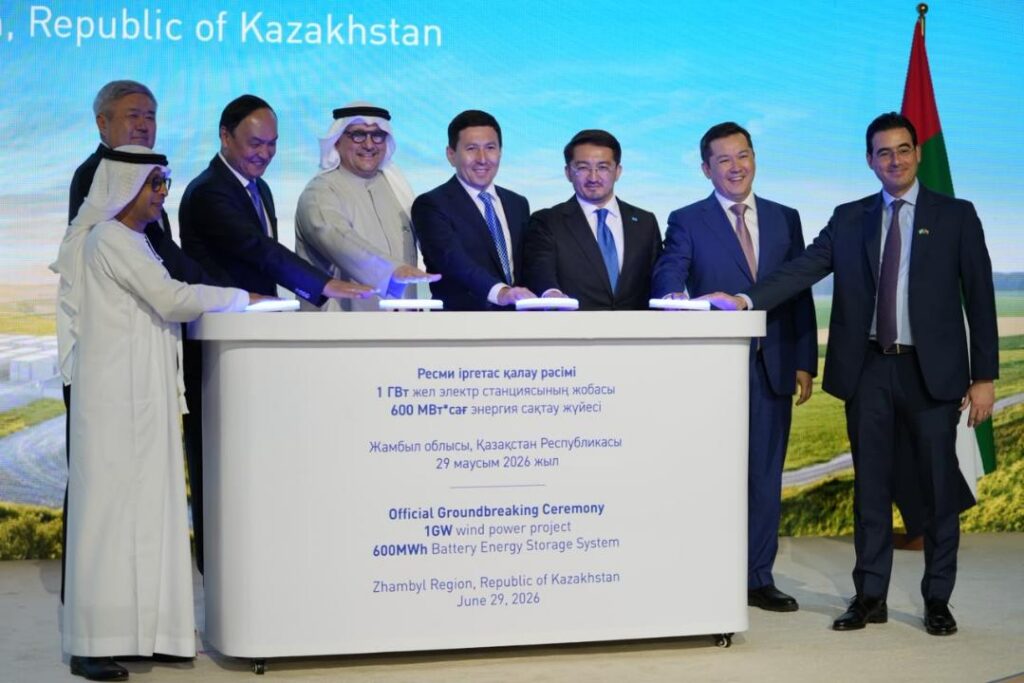
Construction has begun on one of Kazakhstan’s largest renewable energy projects, a 1-gigawatt wind power plant in the southern Zhambyl Region, as the country moves to address energy shortages and expand green generation capacity. The $1.4 billion project is being developed by a consortium of Kazakhstani companies and investors from the United Arab Emirates. The shareholders include Abu Dhabi-based clean energy company Masdar with a 40% stake, W Solar with 40%, Kazakhstan’s Qazaq Green Power, part of the Samruk-Kazyna fund, with 18%, and the Kazakhstan Investment Development Fund with 2%. The official groundbreaking ceremony took place on June 29 in a teleconference format, with the launch signal given from Astana by Kazakhstan’s Vice Minister of Energy Sungat Yessimkhanov, Samruk-Kazyna CEO Nurlan Zhakupov, and Masdar CEO Mohamed Jameel Al Ramahi. Commercial operations are scheduled to begin in the third quarter of 2029. “Partnership with Masdar contributes to the development of renewable energy and Kazakhstan’s progress toward carbon neutrality,” Yessimkhanov said. “This project will strengthen regional energy security and bring advanced technologies into the renewable energy sector.” The project’s key technical feature is its integration of wind generation with battery energy storage. The facility will include an energy storage system with a capacity of 300 MW and storage volume of 600 MWh. Officials say the battery system will help address one of the main challenges of renewable energy by stabilizing electricity supply during fluctuating weather conditions and peak evening demand. The wind farm is expected to reduce carbon dioxide emissions by 2.5 million tons annually, supporting Kazakhstan’s national climate targets. Masdar has been expanding its presence across Central Asia. In 2024, Uzbekistan signed an agreement with the UAE company to build Central Asia’s first solar power plant with battery storage in the Bukhara region. In 2022, Masdar also reached an agreement with Turkmenistan to build the country’s first utility-scale solar plant, with a planned capacity of 100 MW. The company faces growing competition from Chinese firms in the region. In May, China Energy International Group launched construction of a 500-MW wind farm in central Kazakhstan. Kazakhstan aims to generate 15% of its electricity from renewable sources by 2030 as part of its broader strategy to reduce dependence on coal and improve long-term energy security.

Kazakhstan Proposes Kenyan Trade Hub to Access Eurasian Markets

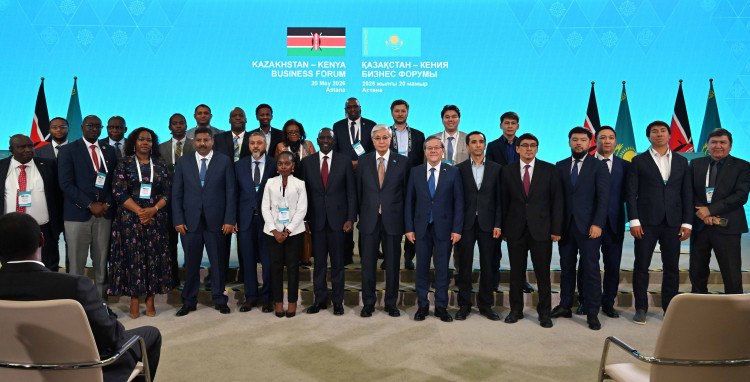
Kazakhstan has proposed establishing a Kenyan trade and logistics hub on its territory to facilitate the export of Kenyan goods to Eurasian markets, as Astana seeks to position itself as a key transit link between Asia, Europe, and Africa. The initiative was announced by President Kassym-Jomart Tokayev of Kazakhstan during the Kazakhstan-Kenya Business Forum, held as part of Kenya’s President William Ruto’s state visit to Astana. “We are committed to opening a Kenyan trade hub in Kazakhstan that will provide your businesses with direct access to the entire Eurasian region,” Tokayev told representatives of the Kenyan business community. Kazakhstan hopes to expand exports of grain and other agricultural products to Africa, while Kenya could increase supplies of tea, coffee, and flowers to Central Asian and broader Eurasian markets. Astana is also promoting itself as an important part of international transport corridors. According to Tokayev, approximately 85% of overland transit traffic between China and Europe passes through Kazakhstan. The country is actively developing the Trans-Caspian International Transport Route, commonly known as the Middle Corridor, which is increasingly viewed as an alternative to traditional transit routes through Russia. Tokayev proposed integrating the Middle Corridor with East African maritime routes by using the potential of China’s Belt and Road Initiative. Kazakhstan specifically expressed interest in cooperation with the ports of Mombasa and Lamu, which are regarded as the region’s largest logistics hubs. “It is necessary to connect the Middle Corridor with Africa’s vital maritime arteries,” Tokayev said. The two sides also discussed the development of direct cargo air links between Kazakhstan and Kenya, as well as the possibility of launching direct passenger flights between Astana and Nairobi in the future. Beyond logistics, Kazakhstan and Kenya plan to expand cooperation in the extraction of rare earth metals and critical minerals, resources in growing global demand amid the energy transition and the expansion of digital technologies. During the forum, Kazakhstan’s sovereign wealth fund, Samruk-Kazyna, and Kenya’s National Mining Corporation signed an agreement on joint geological exploration and subsoil development projects in Kenya. Tokayev also proposed establishing a Kazakhstan-Kenya Business Council and a specialized expert group focused on transport and logistics infrastructure development. According to the president, these steps should accelerate the creation of an intergovernmental commission on trade and economic cooperation. Ruto said Nairobi was interested in creating a “new economic bridge” between Central Asia and Africa. “The logistics ports of Mombasa and Lamu will be available to companies from Kazakhstan interested in entering East African markets,” Ruto said. The visit comes as Kazakhstan seeks to diversify its trade routes and expand economic ties with countries of the Global South. Earlier, authorities in Kazakhstan announced plans to expand the country’s maritime fleet on the Caspian Sea to increase the capacity of the Middle Corridor.

Artificial Intelligence Joins Board of Directors at Samruk-Kazyna

For the first time in Central Asia, a neural network has been appointed to the board of directors of a major state fund. The SKAI system (Samruk-Kazyna Artificial Intelligence), developed around a domestic language model, now holds voting rights on the board of the Samruk-Kazyna National Wealth Fund. A Digital Voice in Governance SKAI was officially introduced in Astana at the Digital Bridge 2025 international forum. The system is described by the fund as the first AI-powered and independent board member in the region with decision-making powers. According to Samruk-Kazyna, SKAI analyzes internal and external regulations, board decisions dating back to 2008, and other corporate documentation. Its deployment is expected to improve “transparency and the quality of corporate governance” by enabling more data-driven decisions. Nurlan Zhakupov, Chairman of the Management Board of Samruk-Kazyna, hailed the development as a “quantum leap.” “Technology and people are beginning to make decisions together. Digitalization is moving beyond processes; it’s becoming part of leadership philosophy,” he said. Security and Supercomputing Cybersecurity was a top priority in SKAI’s development. It operates within a closed network on the Al Farabium supercomputer, owned by Kazakhtelecom, a portfolio company of the fund. Kazakhstan’s most powerful supercomputing resources, built with NVIDIA hardware, are being used to support the system. SKAI runs on Alem LLM, a large language model trained on Kazakh data, allowing it to process sensitive documents domestically without information being transmitted abroad. SKAI is expected to participate in upcoming board meetings as part of Samruk-Kazyna’s broader digital transformation agenda. AI at the Heart of National Strategy The initiative aligns with Kazakhstan’s national digital transformation strategy. Speaking at the Digital Bridge 2025 forum, President Kassym-Jomart Tokayev reiterated the goal of becoming a fully digital nation within three years. “We have set a clear objective: Kazakhstan must become a truly digital nation within three years. This is an ambitious task,” Tokayev said. He also reaffirmed Kazakhstan’s intent to engage in global AI governance efforts under the United Nations and welcomed China’s initiative to establish an international organization for AI cooperation. Institutions and Infrastructure In 2025, Kazakhstan launched the Ministry of Artificial Intelligence and Digital Development, as well as the region’s first AI Council. The government is also preparing legislation, including a dedicated Artificial Intelligence Law and a Digital Code, which will form the foundation for AI governance in education, healthcare, and the economy. Tokayev announced the establishment of Kazakhstan’s first AI-focused university and the Alem.ai International Center for Artificial Intelligence. He described the center as a “historic step” intended to become a platform for ethical AI development and a core institution within Central Asia’s emerging tech ecosystem. “Alem.ai will be a place where artificial intelligence technologies are implemented efficiently and ethically,” the president said. Established in 2008, Samruk-Kazyna manages national assets and spearheads economic modernization. The Government of Kazakhstan remains its sole shareholder. The fund’s Chairman of the Board of Directors is Prime Minister Olzhas Bektenov, and the Chairman of the Management Board is Nurlan Zhakupov. Samruk-Kazyna’s total assets are...

Liberalizing Kazakhstan’s Economy Must Not Become Uncontrolled Privatization, Expert Warns

Last week, President Kassym-Jomart Tokayev signed a decree on reducing the state’s participation in the economy, aiming to help develop competition and private business. This could be a significant boost to the economy, financial analyst Rassul Rysmambetov, an Almaty-based expert in distressed assets and Director of the Financial Freedom Public Foundation, told The Times of Central Asia, though everything will depend on how the decree is implemented. Firstly, the decree envisages creating a National Office for Privatization under the Agency for the Protection and Promotion of Competition. This office is to develop criteria for state assets subject to privatization and create a list of them. In addition, measures are provided to increase the autonomy, quality, and independence of corporate governance at Samruk-Kazyna, the National Welfare Fund, and its subsidiaries. “The government must establish a specific list of large entities that will offer major stakes in the next two years in IPOs,” President Tokayev explained. According to Tokayev, the quasi-public sector – bloated and often ridden with debt – needs serious reform. “We need to put an end to the question of where state participation should continue and where competition can be developed. The largest share of the state in the economy is represented by the group of companies held by the Samruk-Kazyna fund, so that is where this work must start. New, systemic measures are required to fundamentally rehabilitate the fund,” the president stated. A separate section of the decree presents measures aimed at protecting the rights and legitimate interests of business, including decriminalizing offenses related to economic activity and coordinating with prosecutors on prohibitive and restrictive measures initiated by government agencies. This is not the first time Kazakhstan has tried to liberalize its economy – it has even privatized social institutions, such as hospitals, schools, and creative centers for children before – but previous attempts yielded no tangible successes. “We need to continue to work to improve the quality of services, consistently reduce state participation and eliminate excessive regulation and restrictions. This applies to all sectors of the economy,” Tokayev stressed. “Uncontrolled monopolies, unequal access to resources and unfair trade practices must be eliminated at the root. A pillar of economic liberalization will be effective privatization. There have been so many privatization plans, but every time we make the same mistakes.” Rysmambetov believes that professionals should take the lead. “Liberalizing the economy is a process. By no means can it be limited to a single decree – it is a strategic course. I see here dozens, if not hundreds of by-laws, industry reference documents and possibly new laws and codes. I'm afraid that parliament will prove unable to keep up with the pace at which these reforms should be carried out,” he stated. According to Rysmambetov, Samruk-Kazyna could be dissolved tomorrow, but the holding has taken on a lot of debt for its subsidiaries, meaning that in the near term its assets can only be partially privatized. In general, each Samruk-Kazyna company has a related supervising ministry, so, to...

Cleaning up the Samruk-Kazyna National Welfare Fund

In his efforts to transition Kazakhstan from previous president Nazarbayev’s era, President Kassym-Jomart Tokayev has centered his policy agenda on strengthening justice and eradicating kleptocracy in Kazakhstan. His presidential platform, known as “Just and Fair Kazakhstan,” remains a focal point in his addresses, which often emphasize dismantling systems that have facilitated kleptocracy in the country. Tokayev's anti-corruption efforts aim to enhance transparency and combat corruption through retrieving stolen assets, implementing digital monitoring of public expenditures, mandating financial disclosures from officials, and reallocating confiscated funds to infrastructure projects. In its 2023 consultations, the IMF recognized these positive steps. These initiatives, combined with a notable increase in the public’s trust in the anti-corruption agency from 30% in 2022 to 43% in 2023, reflect tangible progress in Kazakhstan's fight against corruption. A 2024 report by Transparency International asserts that “President Tokayev has initiated a series of anti-corruption reforms, and Kazakhstan is currently in the process of implementing recommendations made by the Council of Europe’s Group of States against Corruption (GRECO) in its 2022 evaluation report.” Critics claim, however, that the country’s administration has not gone far enough in combatting corruption and that the government still lacks transparency when it comes to the management of state assets. Recently, Eurasianet commented that “Kazakhstan shows improvement on graft, but [is] still struggling.” Radio Free Europe has further reported that high-profile Kazakhs were escaping prosecution. Tokayev has been visibly distraught with the government’s progress to date on tackling corruption and has even made major leadership changes, including in the office of the General Prosecutor in 2023. Also in 2023, the former Minister of Justice came under investigation for corruption. In February 2024, the Cabinet resigned to make way for a new government under Olzhas Bektenov, a former head of an anti-corruption watchdog. This move was widely recognized as the latest effort to clean out a bureaucracy compromised by its ties to business elites, particularly those linked with the “Old Kazakhstan” under former president Nazarbayev, who have undermined the state’s capacity to ensure a fair business environment, as well as to effectively investigate and prosecute corruption charges.   New steps to combat corruption and kleptocracy In a presidential decree signed last week “On measures to liberalize the economy” that introduced several initiatives aimed at “ensuring freedom of entrepreneurship by developing competition, reducing state participation in the economy, and reducing business costs”, the President took aim at Samruk-Kazyna National Welfare Fund, i.e., the country’s Sovereign Wealth Fund, which has almost $70 billion under its’ management. The fund has been highly scrutinized for being an instrument of kleptocracy. It has provided unreasonable support to banks, written-off major loans, given exorbitantly favorable loan terms, and in one case, caused a bank to fail and be taken over by a rival months later. As in other post-Soviet republics, banks have been vehicles for oligarchs ascendancy by way of using government funds to build massive business empires. Tokayev has publicly stated that the government needed to “immediately stop this orgy of leaking state...