
• KGS/USD = 0.01144 0%
  • KZT/USD = 0.00205 0%
  • TJS/USD = 0.10784 0%
  • UZS/USD = 0.00008 0%
  • TMT/USD = 0.28490 0%
  • KGS/USD = 0.01144 0%
  • KZT/USD = 0.00205 0%
  • TJS/USD = 0.10784 0%
  • UZS/USD = 0.00008 0%
  • TMT/USD = 0.28490 0%
  • KGS/USD = 0.01144 0%
  • KZT/USD = 0.00205 0%
  • TJS/USD = 0.10784 0%
  • UZS/USD = 0.00008 0%
  • TMT/USD = 0.28490 0%
  • KGS/USD = 0.01144 0%
  • KZT/USD = 0.00205 0%
  • TJS/USD = 0.10784 0%
  • UZS/USD = 0.00008 0%
  • TMT/USD = 0.28490 0%
  • KGS/USD = 0.01144 0%
  • KZT/USD = 0.00205 0%
  • TJS/USD = 0.10784 0%
  • UZS/USD = 0.00008 0%
  • TMT/USD = 0.28490 0%
  • KGS/USD = 0.01144 0%
  • KZT/USD = 0.00205 0%
  • TJS/USD = 0.10784 0%
  • UZS/USD = 0.00008 0%
  • TMT/USD = 0.28490 0%
  • KGS/USD = 0.01144 0%
  • KZT/USD = 0.00205 0%
  • TJS/USD = 0.10784 0%
  • UZS/USD = 0.00008 0%
  • TMT/USD = 0.28490 0%
  • KGS/USD = 0.01144 0%
  • KZT/USD = 0.00205 0%
  • TJS/USD = 0.10784 0%
  • UZS/USD = 0.00008 0%
  • TMT/USD = 0.28490 0%

Viewing results 1 - 6 of 9

Kazakhstan to Launch Direct Flights to Tokyo and New York Within Next 12 Months

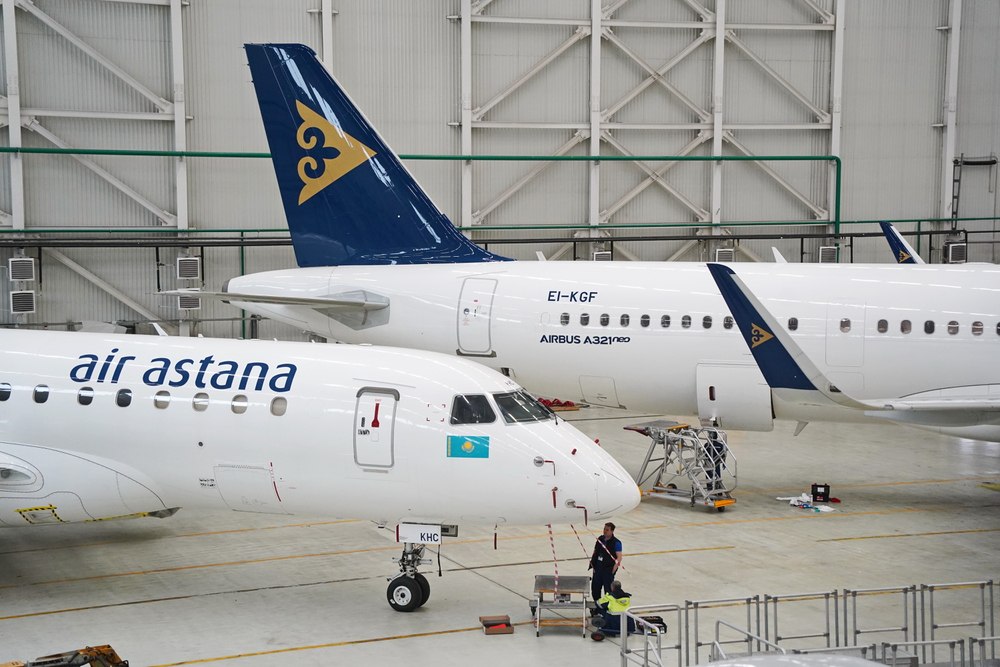
Kazakhstan plans to launch direct flights from Astana to Tokyo and New York within the next 12 months, Transport Minister Nurlan Sauranbayev said during a government meeting on Tuesday. Prime Minister Olzhas Bektenov reminded officials that the Ministry of Transport had previously pledged to open direct air links to Tokyo and New York but had yet to announce concrete results. “In the case of Tokyo, flights will begin in the fourth quarter of 2026, and flights to the United States will begin in the second quarter of 2027,” Sauranbayev said. He added that Astana currently operates 34 international routes. According to the minister, Kazakhstan has already opened four new international routes since the beginning of the year: Almaty-Shanghai, Astana-Yerevan, Atyrau-Tashkent, and Aktau-Yerevan. By the end of 2026, Kazakhstan's aviation authorities plan to open or resume 11 additional international routes, including Astana-Ulaanbaatar, Astana-Guangzhou, Astana-Issyk-Kul, Astana-Larnaca, Astana-Kashgar, Almaty-Tokyo, Almaty-Larnaca, Hanoi-Almaty-Prague, Almaty-Izmir, Almaty-Warsaw, and Kostanay-Tashkent. Meanwhile, Michael Daniel, CEO of the Aviation Administration of Kazakhstan (AAK), said work is ongoing to secure Category 1 status from the U.S. Federal Aviation Administration (FAA) under the International Aviation Safety Assessment (IASA) program, a prerequisite for launching direct flights to the U.S. Daniel said Kazakhstan has been addressing shortcomings identified during an FAA technical assessment conducted in August 2024. “We plan to invite the FAA IASA team to conduct an evaluation in September 2026. The FAA will assess Kazakhstan’s political commitment to complying with international aviation safety standards, including legislation, regulatory oversight, and practical implementation,” he said. “Our primary goal is to obtain FAA Category 1 status in November 2026,” Daniel added. Kazakhstan’s airline fleet is also expected to expand, with six additional aircraft scheduled to enter service by the end of this year. As previously reported by The Times of Central Asia, Kazakhstan’s civil aviation fleet consisted of 104 aircraft last year, with authorities aiming to increase that number to 216 by 2030. The government is also planning a major modernization of airport infrastructure over the next three years. “In accordance with the president’s instructions, work is underway on the construction of airports in the tourist zones of Katon-Karagay, Zaysan, and Kenderli, as well as the restoration of Arkalyk Airport,” Sauranbayev said. He added that aviation hub development is continuing at six major airports: Almaty, Astana, Aktau, Aktobe, Karaganda, and Shymkent. According to the minister, most airport modernization projects are being financed through private investment. As previously reported by The Times of Central Asia, Kazakhstan’s SCAT Airlines, in partnership with Boeing, has begun construction of a major aircraft maintenance, repair, and overhaul center in Shymkent.

Kazakhstan’s SCAT Airlines Adds Two Boeing 737 MAX 8 Aircraft

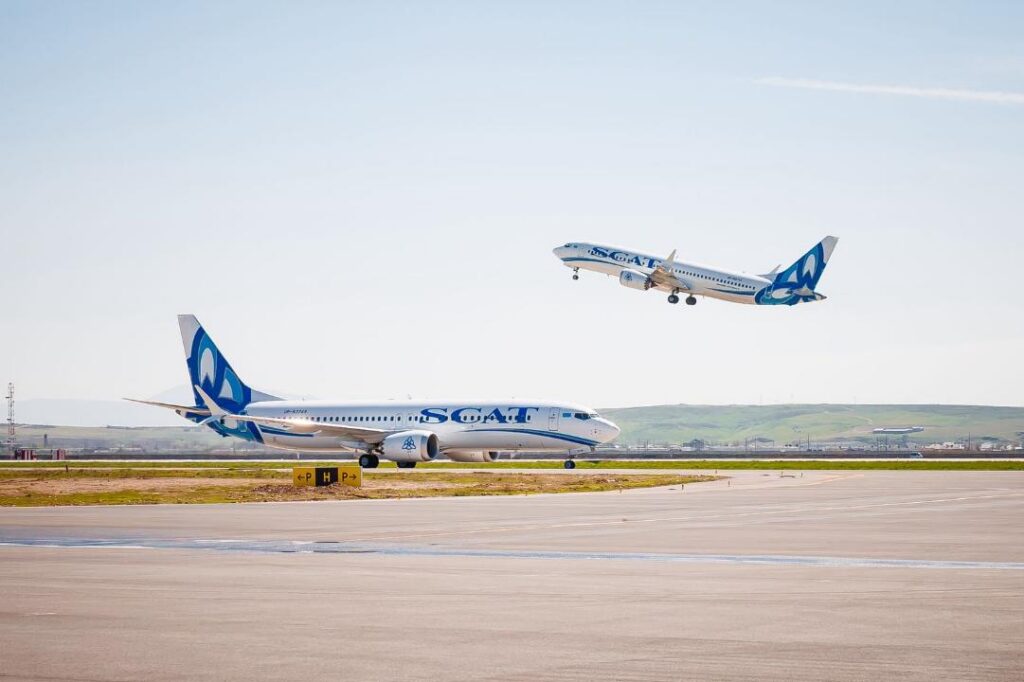
Kazakhstan-based SCAT Airlines has taken delivery of two new Boeing 737 MAX 8 aircraft. The planes were delivered directly from Boeing’s facility in Seattle, marking the first time the carrier has added two aircraft of this type to its fleet simultaneously. The fleet expansion is linked to the growth of the airline’s route network and the strengthening of existing flight programs. In 2026, SCAT launched new routes from Shymkent to Karaganda, Kostanay, Bishkek, Novosibirsk, St. Petersburg, and Tyumen, as well as a direct service from Astana to Ulaanbaatar. The new aircraft will support the development of a hub at Shymkent Airport, which is emerging as a key node in the airline’s network. “It is important for SCAT that the new aircraft will be used to develop the hub in Shymkent and expand the route network,” said company president Vladimir Denisov. The airline’s fleet currently consists of approximately 40 aircraft. In September 2025, the carrier received another Boeing 737 MAX 8, bringing the total number of aircraft of this type in its fleet to eleven. SCAT Airlines was founded in 1997. The company’s structure includes Aulie-Ata International Airport in Taraz, a 70% stake in Yuzhnoye Nebo Airlines, and a 40% stake in the Egyptian carrier Red Sea Airlines. The Times of Central Asia previously reported that SCAT Airlines, in partnership with Boeing, had begun construction of a new maintenance center in Shymkent. The facility will specialize in servicing Boeing aircraft, including the Boeing 737 (Classic, NG, and MAX), Boeing 757 and Boeing 767, as well as the wide-body Boeing 777. During a working visit to the United States, President Kassym-Jomart Tokayev met with Boeing executives. He noted that airlines including Air Astana, SCAT, and Vietjet Qazaqstan are interested in expanding joint projects that are important for the development of Kazakhstan’s aviation industry.

Largest Aircraft Maintenance Center in Central Asia Under Construction in Kazakhstan

Kazakhstan’s SCAT Airlines, in partnership with Boeing, has begun construction of a new maintenance, repair, and overhaul (MRO) center in Shymkent. The facility is expected to become the largest aircraft maintenance complex in Kazakhstan and across Central Asia. The capsule-laying ceremony, held on February 27, was attended by Shymkent Mayor Gabit Syzdykbekov, Deputy Transport Minister Talgat Lastayev, and Boeing Vice President of Sales and Marketing for Eurasia, India, and South Asia Paul Righi. According to the Ministry of Transport, the center will specialize in servicing Boeing aircraft, including the Boeing 737 (Classic, NG, and MAX), Boeing 757 and 767 models, as well as the Boeing 777 widebody aircraft. The facility will occupy 10 hectares, with engineering and technical infrastructure covering 45,000 square meters. The aircraft parking area alone will span more than six hectares. The project is intended to establish a modern, internationally certified repair and maintenance base capable of servicing not only domestic carriers but also foreign airlines, thereby expanding Kazakhstan’s technical expertise and aviation services export potential. Kazakhstan’s civil aviation sector continues to demonstrate steady growth. According to the Ministry of Transport, in 2025 the country’s airports handled 31.8 million passengers, compared to 29.7 million in 2024. Cargo traffic reached 173,300 tons, up from 170,900 tons the previous year. Deputy Minister Talgat Lastayev stated that the growth in traffic has been accompanied by systematic efforts to strengthen safety oversight. Kazakhstan’s compliance with international aviation safety standards reached 95.7%, significantly exceeding global and regional averages and placing the country among the world’s top 20 performers in this category. Lastayev also noted that KazMunayGas-Aero LLP, a jet fuel supply subsidiary of the national oil and gas company KazMunayGas, has been granted direct access to airport infrastructure and has begun providing direct “into-plane” refueling services. This has reduced the average cost of jet fuel at Kazakh airports. According to the ministry, direct refueling without intermediaries has lowered jet fuel prices to below $1,000 per ton, compared to $1,200-$1,300 per ton in other countries. The new refueling mechanism was introduced on the instructions of the President of Kazakhstan to support the development of international air hubs by ensuring stable supplies of competitively priced aviation fuel. Officials say it is expected to improve the reliability of fuel supply for airlines and reinforce the country’s role as a key transit hub.
