• KGS/USD = 0.01144 0%
  • KZT/USD = 0.00202 0%
  • TJS/USD = 0.10486 0.48%
  • UZS/USD = 0.00008 0%
  • TMT/USD = 0.28571 0%
  • KGS/USD = 0.01144 0%
  • KZT/USD = 0.00202 0%
  • TJS/USD = 0.10486 0.48%
  • UZS/USD = 0.00008 0%
  • TMT/USD = 0.28571 0%
  • KGS/USD = 0.01144 0%
  • KZT/USD = 0.00202 0%
  • TJS/USD = 0.10486 0.48%
  • UZS/USD = 0.00008 0%
  • TMT/USD = 0.28571 0%
  • KGS/USD = 0.01144 0%
  • KZT/USD = 0.00202 0%
  • TJS/USD = 0.10486 0.48%
  • UZS/USD = 0.00008 0%
  • TMT/USD = 0.28571 0%
  • KGS/USD = 0.01144 0%
  • KZT/USD = 0.00202 0%
  • TJS/USD = 0.10486 0.48%
  • UZS/USD = 0.00008 0%
  • TMT/USD = 0.28571 0%
  • KGS/USD = 0.01144 0%
  • KZT/USD = 0.00202 0%
  • TJS/USD = 0.10486 0.48%
  • UZS/USD = 0.00008 0%
  • TMT/USD = 0.28571 0%
  • KGS/USD = 0.01144 0%
  • KZT/USD = 0.00202 0%
  • TJS/USD = 0.10486 0.48%
  • UZS/USD = 0.00008 0%
  • TMT/USD = 0.28571 0%
  • KGS/USD = 0.01144 0%
  • KZT/USD = 0.00202 0%
  • TJS/USD = 0.10486 0.48%
  • UZS/USD = 0.00008 0%
  • TMT/USD = 0.28571 0%

Viewing results 1 - 6 of 13

SCO Summit: Eurasian Alliance Signs Security Agreements; Welcomes Belarus

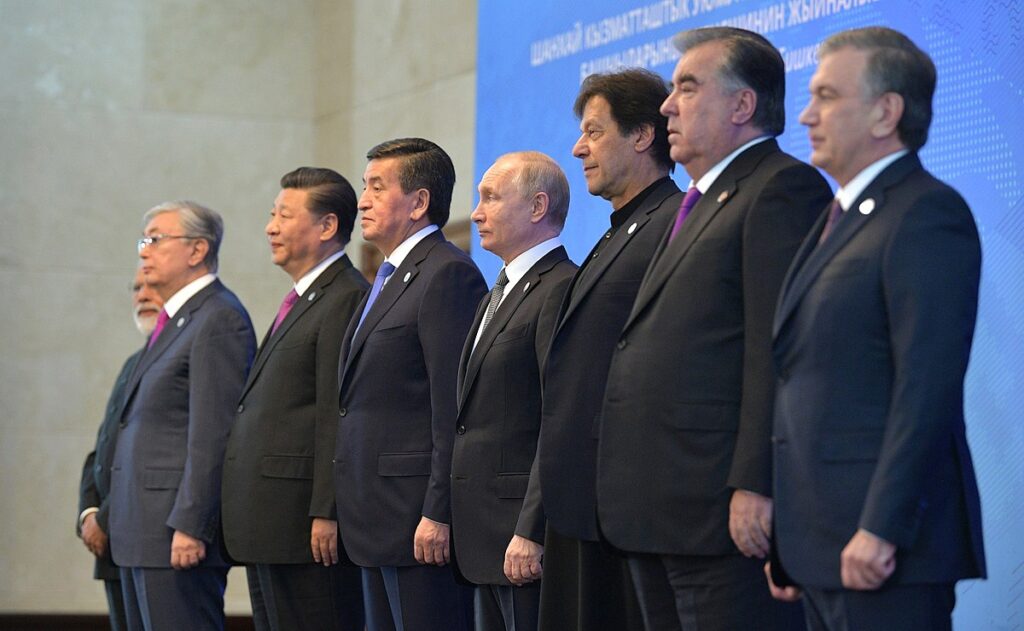
By Jonathan Campion, reporting from the SCO Summit in Astana   At the Shanghai Cooperation Organization (SCO) Summit in Astana this morning, leaders from the bloc’s member states signed a host of agreements intended to promote cohesion in the Eurasia region. The first session, which was held behind closed doors, had begun with the signing of the document that accepted Belarus as the SCO’s 10th full member. The SCO is a political, security and economic alliance, of which Kazakhstan, Kyrgyzstan, Tajikistan and Uzbekistan are founding members. The group also includes China, Russia, Iran, India, Pakistan, and now Belarus. The organization has four observer states and 14 dialogue partners, covering half of the world’s population, and almost a third of global GDP.  The first agreement signed was a document outlining the Shanghai Cooperation Organization’s development strategy for the next 12 months. In 2025 Kazakhstan will pass chairmanship of the alliance to China, and there is speculation that the SCO may grow further next year, to include at least one new member. With security a growing concern for members, particularly in light of the March terrorist attack outside Moscow, for which the terror group Islamic State Khorasan Province (ISIS-K) have claimed responsibility, leaders approved the SCO’s latest three-year Cooperation Program to counter terrorism, separatism and extremism. The parties also signed an agreement on the organization’s regional anti-drug strategy. Another high-profile document is the SCO’s development strategy for cooperation in the energy sphere. Kazakhstan is at the forefront of the region’s transition to green energy, with Chinese leader Xi Jinping mentioning the country’s new Zhanatas wind farm and the Turgusun hydropower station as key joint projects with China in an article published in the Kazakh press this week. The heads of state were welcomed to the Summit by Kazakh President Kassym-Jomart Tokayev, with his Russian counterpart Vladimir Putin, Aleksandr Lukashenko of Belarus and Chinese leader Xi Jinping the last to arrive, ten minutes after the other dignitaries. Some leaders did not arrive at all: India’s Narendra Modi is not attending this year’s SCO Summit, and has sent the country’s external affairs minister Subrahmanyam Jaishankar in his place.  The Summit's afternoon session is styled as "SCO Plus". In attendance are the heads of state of the alliance's dialogue partners, including the presidents of Turkey and Azerbaijan, Recep Tayyip Erdogan and Ilham Aliyev. Turkmenistan – which is not affiliated to the SCO but which is invited as a guest – is led not by its President Serdar Berdimuhamedov, but by his father Gurbanguly Berdimuhamedov, the former leader who is now the chairman of the country’s People’s Council.  
SCO Round-Up

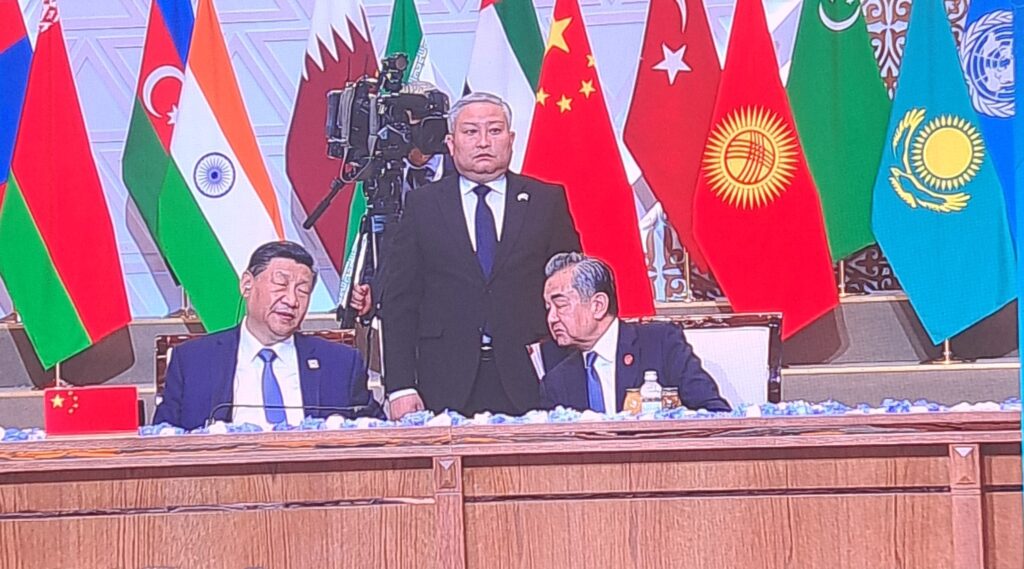
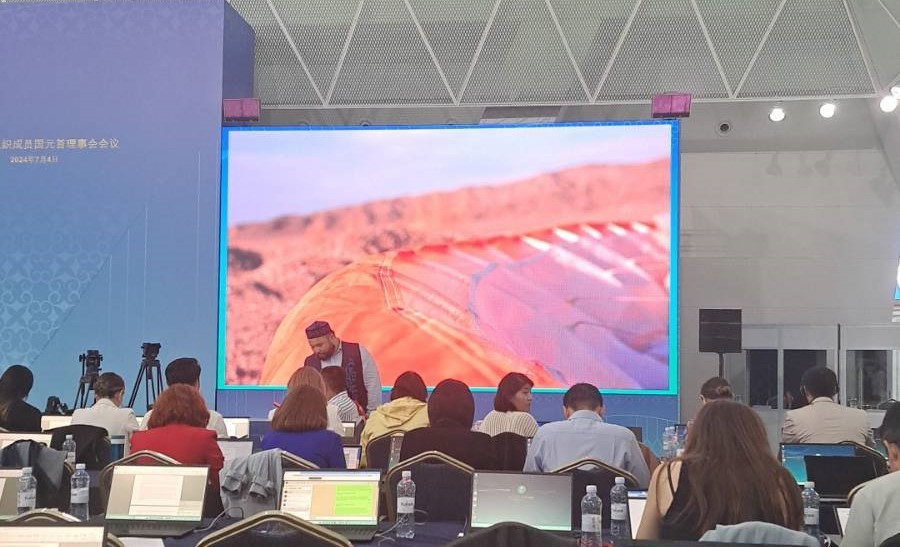
The Times of Central Asia is reporting live from the SCO Summit in Astana. Kazakhstan’s Red Carpet Astana put on a fireworks show on Wednesday night as dignitaries gathered in the Kazakh capital for the Shanghai Cooperation Organization, a regional forum for talks on security, economic and other issues. The event is a chance for landlocked, resource-rich Kazakhstan to showcase its culture, hospitality and rising diplomatic profile at a time when wars in Ukraine and Gaza, along with big power tension and the threat of climate change, tend to dominate headlines. High-stepping honor guards, motorcycle escorts, military marching bands and greeters in glittering traditional costumes welcomed the leaders arriving in Astana, which boasts a collection of shiny, futuristic-looking buildings that were constructed with the help of Kazakhstan’s oil wealth after independence from Soviet rule in 1991. The nine full members of the SCO are India, Iran, Kazakhstan, China, Kyrgyzstan, Russia, Pakistan, Tajikistan and Uzbekistan. Belarus is expected to become a new member at this week’s summit.   Putin to Tokayev: I’ll Be Back Russian President Vladimir Putin, responding to an invitation to visit Kazakhstan again, has suggested that he will return on a state trip in November. Putin spoke about another visit in a conversation on Wednesday with Kazakh President Kassym-Jomart Tokayev on the sidelines of the Shanghai Cooperation Organization meeting in Astana, Russia’s official news agency, TASS has reported. "I believe this is simply necessary to maintain the pace of cooperation between our countries,” Tokayev said. “I hope to see you again, this time on a state visit to our country.” According to Tass, Putin thanked Tokayev and said: “Of course, it is most rational to do it in connection with the summit of the Collective Security Treaty Organization. Thank you for the invitation; I certainly accept it." Kazakhstan has the rotating chairmanship of the Collective Security Treaty Organization, or CSTO. The security alliance includes Russia and the former Soviet republics of Kazakhstan, Tajikistan, Kyrgyzstan, Belarus and Armenia. However, Armenia appears close to pulling out of the alliance because it feels betrayed by Russia its’ inaction when rival Azerbaijan made military gains over Armenia.   Erdogan to Putin: Let’s Trade Türkiye, which holds the status of “dialogue partner” in the SCO and treads a delicate line in the war between Russia and Western-backed Ukraine, wants to boost trade with Moscow. Turkish President Recep Tayyip Erdogan and Russian leader Vladimir Putin met in Astana on Wednesday. “The Turkish president expressed confidence in reaching the ambitious trade volume goal of $100 billion, citing strong potential for growth in bilateral relations,” Türkiye's official Anadolu news agency stated. Reports have indicated trade between the two countries was above $65 billion in the last couple of years. Anadolu quoted Erdogan as saying that “we can take serious steps” on plans for the Sinop Nuclear Power Plant in Türkiye's Black Sea region. Russia is potentially a partner in that electricity-producing project. Rosatom, Russia’s nuclear energy agency, is currently building Türkiye’s first nuclear power plant in...

Two-Dimensional Outlook Characterizes Western Media Response to SCO Summit

The Western media’s binary response to the latest Shanghai Cooperation Organization (SCO) summit in Astana creates an unnecessary – and perhaps unintentional – “us-versus-them” dichotomy. Characterizing the SCO as the “anti-NATO” alliance where China, Russia and Iran come together, this style of coverage makes no mention of the evident efforts of the majority of post-Soviet states to balance Russia’s decades-long influence in the region. It is also notable that the same outlets serving up this black and white coverage are not even in attendance at the summit, preferring to take aim from abroad. Central Asian states cannot escape the realities of their geography and have to largely rely on Russia and China for their economic prosperity. At the same time, their future independence requires that they are a respected part of the international rules-based order as well as on their increased contribution to global supply chains. Kazakhstan’s recent democratic reforms are in direct contrast to the authoritarian image cast on so-called “anti-NATO” countries. Armenia has announced plans to quit Russia’s Collective Security Treaty Organization (CSTO) military alliance. Generally, the countries in the region have – with different degrees of enthusiasm – implemented a multi-vector foreign policy, including following international sanctions against Russia and issuing statements supporting the “territorial integrity of Ukraine.” Uzbekistan’s courts even went so far as to convict a citizen for joining Russian troops fighting in Ukraine. Those looking to force an antiquated one-size-fits-all Cold War paradigm on Central Asia will ultimately be frustrated. The ongoing SCO event in Astana is bringing together a mainly Eastern-centric group of leaders speaking about deeper cooperation among the Organization’s members. While the Western press may simply decry this gathering as anti-Western, the fact that Central Asia stood in support of international sanctions against Russia and stayed neutral in the conflict with Ukraine, much to the chagrin of Vladimir Putin and his retinue, shows the region holds more shades of grey than stark black and white. Central Asia cannot be expected to fall entirely into the orbit of Western or Eastern leaning powers. The region’s republics will, and should, aim to be aligned with both. Arguably, the West, Russia, and China may all be disappointed in the end, but that outcome may well be in the best interests of the Central Asian states.

Astana Hosts SCO Summit: A New Platform for Kazakh Diplomacy

With the first events of the Shanghai Cooperation Organization (SCO) Summit taking place this morning in Kazakhstan’s capital, Astana, conversations are beginning about what the host country will be discussing – and with whom. The SCO is a political, security and economic alliance in the wider Eurasia region, aimed at promoting trade and investments between member states, as well as global security. Its nine full members are Kazakhstan, Kyrgyzstan, Tajikistan, Uzbekistan, China, Russia, Iran, India and Pakistan. The Organization – which includes four observer states and 14 dialogue partners – covers half of the world’s population, and almost a third of global GDP. Kazakhstan’s multi-vector approach to its foreign policy has seen the country combining its role within the SCO with cooperation with Western governments, through dialogue with the European Union and the United States’ C5+1 platform. President Tokayev recently commented that: “Kazakhstan is committed to multilateral cooperation. In our foreign policy we proceed from the national interests, and are in favor of solving all disputable issues on the basis of rational compromise. In addition to the SCO, this year our country is chairing five other international organizations. This is an unprecedented case, one could say an achievement in the history of Kazakh diplomacy.” This multi-vector approach is key to Kazakhstan’s international diplomacy. Indeed, ‘mutually beneficial cooperation’ and ‘mutually beneficial strategic partnership’ have become the watchwords of Tokayev’s presidency. Over the past decade, Kazakhstan has become an increasingly important land-bridge between East and West, both in terms of trade and diplomacy. Due to projects such as the Belt and Road Initiative and the Middle Corridor, Kazakhstan’s location has made it an indispensable ally to China, whilst playing a pivotal role in the expansion of transcontinental trade has led to Central Asia, in the words of Tokayev, “become a global stakeholder.” In the opinion of experts, more of the same can be expected at this week’s SCO Summit. In an interview conducted by the Kazinform news agency, local political analyst Valery Volodin stressed that: “It goes without saying that each government will be defending its own interests [at the Summit]. But Kazakhstan will be placing an emphasis on regional stability, which will allow countries to implement a host of joint projects with China and Russia. Besides this, Kassym-Jomart Tokayev’s gift for diplomacy will push the SCO to become not just a discussion club, but a real mechanism to solve problems in Eurasia using dialogue between governments.” In an article in The Geopolitics, Michael Rossi, a professor of political science at Long Island University, posited that Kazakhstan is not playing the so-called ‘Great Game’ between East and West, but rather pointing out the scope for "Big Opportunities". “Kazakhstan’s positive relations with countries often in conflict, such as Russia and Ukraine, China and the United States, Azerbaijan and Armenia, and Israel and the Palestinian territories, grant Astana legitimacy,” Rossi writes, “to act as a buffer and stabilizing force among major powers. This positioning allows Kazakhstan to reduce tensions and potentially mediate conflicts. Under...

Putin in Full Diplomatic Mode on SCO Sidelines

Russian President Vladimir Putin has faced Western efforts to isolate him because of the war in Ukraine. But he has a full day of diplomacy on the sidelines of the Shanghai Cooperation Organization event in Kazakhstan. Putin has meetings with the leaders of Azerbaijan, Kazakhstan, Mongolia, Turkey, China and Pakistan on Wednesday, one day ahead of the main group events at the summit in Astana, Kazakhstan’s capital, according to Tass, the official Russian news agency. Russia views the summit in Astana as an "opportunity to organize bilateral contacts with the country leaders who will attend it," said Putin aide Yury Ushakov, according to Tass. Ushakov said he expected Putin to hold several more “brief bilateral contacts” on Thursday. Putin’s flurry of diplomacy comes despite Western sanctions that have sought to weaken Russia’s military campaign in Ukraine, now in its third year. Many countries prefer to maintain trade with Russia, a key producer of energy and other natural resources. Central Asia has chosen neutrality in the Russia-Ukraine conflict and with the exception of a handful of private entities has avoided  sanctions. The SCO is a forum for discussion of security, economic and political issues. Its members are China, Russia, Kazakhstan, Kyrgyzstan Tajikistan, Uzbekistan, Iran, India and Pakistan. Belarusian President Alexander Lukashenko, a close ally of Putin, has said he expects Belarus to become a new member of the group at the Astana meeting.

SCO Summit: Tokayev and Xi Laud Kazakhstan-China Ties

On the eve of the 2024 Shanghai Cooperation Organization (SCO) Summit, hosted this year by Kazakhstan in its capital Astana, the leaders of Kazakhstan and China were keen to highlight the strength of their countries’ partnership. The SCO is a political, security and economic alliance in the wider Eurasia region, aimed at promoting trade and investments between member states, as well as global security. The Organization – which includes nine full members, four observer states and 14 dialogue partners – covers half of the world’s population, and almost a third of global GDP.  In comments to China’s Xinhua news agency, Kazakh President Kassym-Jomart Tokayev spoke of a “close political dialogue” between the two countries, supported by the SCO, thanks to which “China is consolidating its position as Kazakhstan’s leading trade and investment partner”.  Mutual trade between the countries reached a historic record of $41 billion in 2023. Tokayev added that “China became one of the top four foreign investors in Kazakhstan in 2023, investing around $2 billion in direct investments, a year-on-year growth of 16.4%. The total volume of Chinese investment in the Kazakh economy is over $25 billion. Around 4,700 Kazakh-Chinese enterprises operate in our country.” In his comments to Xinhua Tokayev also highlighted Kazakhstan’s growing cultural ties with China, mentioning a new agreement on a visa-free regime between the countries, the creation of cultural centers in both nations, and the fact that 2024 has been named the “Year of Kazakhstan tourism in China”. The president himself lived in China for eight years, where he studied Chinese in Beijing before working for the Soviet Union’s embassy to China. In turn, in a letter published by the Kazinform news agency, China’s leader Xi Jinping noted: “China is now Kazakhstan’s largest trading partner and its top export destination. Major strategic projects including the Zhanatas wind farm, Turgusun hydropower station, and the modernization of Shymkent Oil Refinery have been completed and commissioned. China-Kazakhstan crude oil and natural gas pipelines are operating in a safe and stable manner. The ‘green lanes’ for fast customs clearance of agricultural products are available at all border ports between the two countries, which makes green agri-products of high quality from Kazakhstan easily accessible for Chinese consumers. The potential for cooperation in new energy and transportation infrastructure has been unleashed. The transport and logistics terminal in Xi’an, the Western Europe-Western China Highway, and the China-Europe Railway Express all operate smoothly, providing a strong boost to the development of both China and Kazakhstan.” Kazakhstan has a multi-vector approach to its foreign policy; its role within the SCO complements the country's cooperation with the United States through the C5+1 platform, and a constant dialogue with the European Union. In a recent speech about Kazakhstan's chairmanship of the Shanghai Cooperation Organization this year, President Tokayev commented: "Kazakhstan is committed to multilateral cooperation. In our foreign policy we proceed from the national interests, and are in favor of solving all disputable issues on the basis of rational compromise. In addition to the...