• KGS/USD = 0.01144 0%
  • KZT/USD = 0.00216 0%
  • TJS/USD = 0.10659 0%
  • UZS/USD = 0.00008 0%
  • TMT/USD = 0.28530 0%
  • KGS/USD = 0.01144 0%
  • KZT/USD = 0.00216 0%
  • TJS/USD = 0.10659 0%
  • UZS/USD = 0.00008 0%
  • TMT/USD = 0.28530 0%
  • KGS/USD = 0.01144 0%
  • KZT/USD = 0.00216 0%
  • TJS/USD = 0.10659 0%
  • UZS/USD = 0.00008 0%
  • TMT/USD = 0.28530 0%
  • KGS/USD = 0.01144 0%
  • KZT/USD = 0.00216 0%
  • TJS/USD = 0.10659 0%
  • UZS/USD = 0.00008 0%
  • TMT/USD = 0.28530 0%
  • KGS/USD = 0.01144 0%
  • KZT/USD = 0.00216 0%
  • TJS/USD = 0.10659 0%
  • UZS/USD = 0.00008 0%
  • TMT/USD = 0.28530 0%
  • KGS/USD = 0.01144 0%
  • KZT/USD = 0.00216 0%
  • TJS/USD = 0.10659 0%
  • UZS/USD = 0.00008 0%
  • TMT/USD = 0.28530 0%
  • KGS/USD = 0.01144 0%
  • KZT/USD = 0.00216 0%
  • TJS/USD = 0.10659 0%
  • UZS/USD = 0.00008 0%
  • TMT/USD = 0.28530 0%
  • KGS/USD = 0.01144 0%
  • KZT/USD = 0.00216 0%
  • TJS/USD = 0.10659 0%
  • UZS/USD = 0.00008 0%
  • TMT/USD = 0.28530 0%

Viewing results 1 - 6 of 141

Turkmen Border Guards Delay Medical Aid for Seriously Injured Man at Shavat Checkpoint

At the border between Turkmenistan and Uzbekistan, a seriously injured man was forced to wait for hours at the Shavat checkpoint after Turkmen border guards refused to allow immediate medical evacuation while verifying his documents. The incident involved a married couple from Kunya-Urgench, Turkmenistan, who were en route to visit relatives in Uzbekistan’s Andijan region when they were involved in a car accident on October 13. The man, who was sitting in the front seat, sustained multiple injuries, including broken ribs, a fractured shoulder and foot, and numerous bruises and lacerations. His wife, who was in the back seat, suffered only minor bruises. Following the accident, both were taken to the Khorezm Regional Hospital in Urgench, Uzbekistan, where the man underwent treatment for nine days. His injuries required extensive casting. On October 22, an Uzbek medical commission declared him fit for transport and approved his transfer to Turkmenistan for further treatment. An ambulance transported the patient to the Shavat checkpoint, accompanied by a doctor and his wife. At approximately 11:00 a.m., Turkmen border guards carried the man, still on a stretcher, across the border, assuring the family that an ambulance had already been dispatched from Dashoguz. However, no medical team arrived for another five hours. The man remained on a stretcher on the ground beside the border post until 4:00 p.m., while his wife repeatedly pleaded with officers to call the ambulance again. Although the border guards assisted the man twice when he needed to relieve himself, they did not provide medical assistance. It later emerged that officials were conducting background checks, verifying the authenticity of the couple’s visas, and contacting Ashgabat as well as the Uzbek embassy to confirm the couple’s stated purpose of visiting relatives rather than engaging in commercial activity. When the ambulance eventually arrived, yet another obstacle emerged: Dashoguz Regional Hospital refused to admit the patient, citing concerns over the validity of the diagnosis and the origin of the medical documentation. Only after the intervention of higher authorities was the man finally admitted for treatment.

World Happiness Index: Central Asian Countries Stand Out With “Warm Social Climate”

Kazakhstan has been named the happiest country in Central Asia, according to the World Happiness Report 2025 published by the Oxford Wellbeing Centre. Ranking 43rd globally, Kazakhstan outperformed its regional neighbors in metrics such as social support, trust, and freedom of choice.  The report evaluates national well-being based on six key indicators: GDP per capita Social support (help from family, friends, and society) Healthy life expectancy Freedom to make life choices Generosity (willingness to help others) Perceived absence of corruption Kazakhstan scored 6.38 out of 10, demonstrating especially strong performance in trust and honesty. The country ranked 30th globally for the likelihood of returning a wallet to a neighbor and 42nd for returning it to a stranger. Uzbekistan followed at 53rd place with a score of 6.2. The country stood out for its high levels of charitable giving (29th) and public trust in law enforcement (19th). Kyrgyzstan ranked 75th with 5.9 points and was recognized as the regional leader in helping strangers. Tajikistan placed 90th with a score of 5.4 but made the global top four in volunteering, an indicator linked to longstanding traditions of mutual aid. Turkmenistan was excluded from the ranking due to insufficient data. The report highlights that Central Asian countries exhibit some of the world’s highest levels of kindness. The region's mutual aid index ranges from 0.30 to 0.36, compared to the global average of 0.33. “Despite economic differences, the region maintains strong social ties and a culture of collectivism, where helping others and participating in community life remain important values,” the report notes. According to the authors, happiness is influenced less by income than by trust, stability, and personal freedom. Central Asia, they conclude, fosters a “warm social climate,” where interpersonal kindness often offsets institutional shortcomings and economic hardship. Globally, Finland topped the 2025 rankings, followed by Denmark, Iceland, Sweden, and the Netherlands. At the bottom of the list were Sierra Leone (146th) and Afghanistan (147th), where happiness levels remain the lowest worldwide.

Canadian Musician Releases Protest Song About Uzbek Student’s Experience with Wizz Air

Canadian singer-songwriter Dave Carroll, best known for his 2009 viral hit “United Breaks Guitars,” has released a new protest song titled “Don’t Fly Wizness Class,” inspired by the travel ordeal of Uzbek student Suhrob Ubaydullayev. The track and accompanying video, featuring Ubaydullayev himself, highlight his experience with Wizz Air in 2023 and raise broader concerns about discrimination and passenger rights. Carroll first gained international attention after United Airlines damaged his $3,500 Taylor guitar during a 2008 flight and refused to compensate him. In response, he released “United Breaks Guitars,” which amassed over 20 million views on YouTube and reportedly caused a $180 million drop in United’s stock value. The episode sparked industry-wide changes in customer service protocols. More than a decade later, Carroll has turned his attention to another case of alleged mistreatment, this time involving a 24-year-old Uzbek national. His latest song recounts how Ubaydullayev was denied boarding on a Wizz Air flight on August 31, 2023. “I had all my documents in order,” Ubaydullayev previously told The Times of Central Asia. “The staff checked them and returned them to me, but when I reached the gate, they suddenly said I couldn’t fly. No reason. No explanation.” According to Ubaydullayev, one airline employee asked, “Are you from Uzbekistan?” Upon confirming he was, he says he was denied boarding without further justification. What followed, he claims, was a humiliating ordeal: threats to call the police, warnings that the Uzbek embassy could not assist him, and refusal to provide any written explanation. Ubaydullayev had just completed a Work and Travel program in Europe and was returning home. After spending his savings on the now-cancelled flight, he borrowed money to reach Istanbul, where he was robbed and left stranded. “I met some Uzbek guys near the Sultan Ahmed Mosque who offered to help,” he said. “But they ended up taking my money and disappearing.” His journey home eventually took him through Kazan in Russia and Osh in Kyrgyzstan, before he reached the Uzbek city of Namangan, exhausted, indebted, and disillusioned. In May, during a visit to Canada, Ubaydullayev met Carroll in person. “He was kind and respectful,” Ubaydullayev told The Times of Central Asia. “Carroll listened to my story and was deeply moved.” Carroll then turned the young man’s experience into a song, aiming to bring attention to the broader issue of traveler discrimination. “My goal,” Ubaydullayev said, “is to ensure Wizz Air and other airlines stop discriminating against Uzbek citizens and start treating them with respect.”

Kazakh Tulips to Bloom in Paris

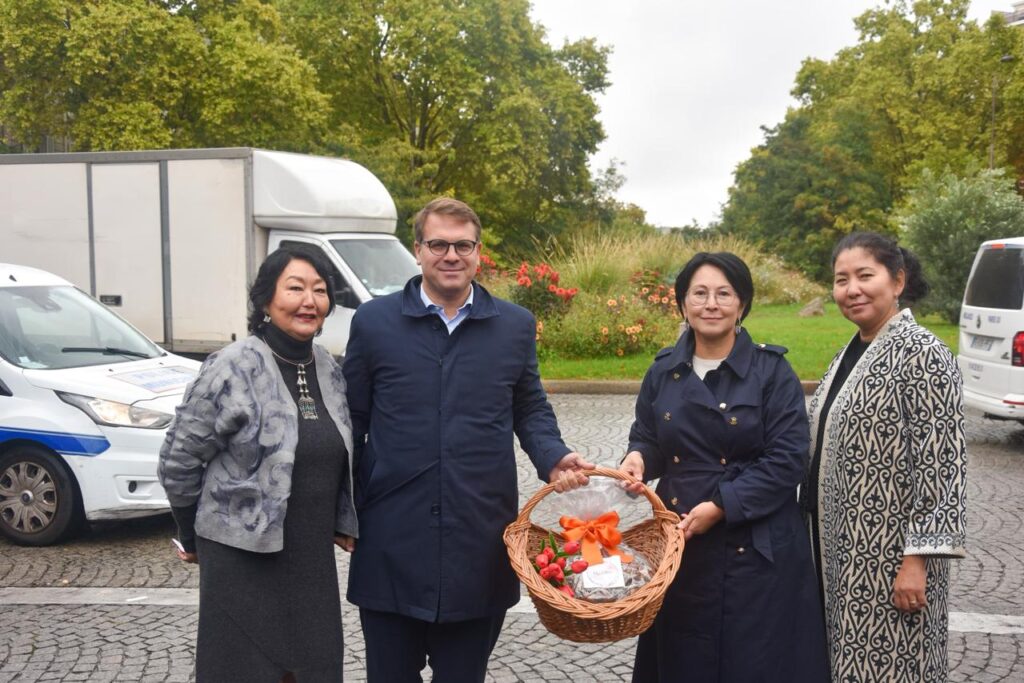
Bulbs of native Kazakh tulips from the steppes near Shymkent have made their way to Paris as part of a broader program of botanical cooperation between Kazakhstan and France. These tulips, originally native to the territory of modern-day Kazakhstan, have long been admired in Europe, especially since the “tulip mania” of the 17th century. Today, Paris officials are eager to add these new specimens from the Kazakh steppe to the city's botanical heritage. The initiative was spearheaded by the Association of Kazakh Women in France, “QazElles,” with support from the Embassy of Kazakhstan in France and in close collaboration with the mayor’s office of Paris’s 17th arrondissement. A flower bed dedicated to Kazakh tulips will be established on Place de Wagram, with Shymkent’s city administration selecting and donating the finest local varieties for the project. [caption id="attachment_36767" align="aligncenter" width="352"] @Aliya Syzdykova[/caption] The symbolic planting ceremony was attended by Kazakhstan’s Ambassador to France, Gulsara Arystankulova; the mayor of the 17th arrondissement, Geoffroy Boulard; and QazElles president Madina Kulmanova. “I have good impressions from participating in the symbolic planting of Kazakh tulips in our district, where 160,000 people live. This is a sign of friendship with Kazakhstan. In addition, tulips are an environmentally sustainable plant, which is important to us. Together with the mayor of Shymkent, we are pleased to participate at our level in strengthening ties between France and Kazakhstan,” said Mayor Boulard. [caption id="attachment_36768" align="aligncenter" width="350"] @Aliya Syzdykova[/caption] The ceremonial handover of the tulip bulbs was conducted in the presence of Paris’s landscaping services, which will be responsible for planting and maintaining the flower bed. A total of 300 tulips are scheduled to bloom on the square by April next year. “And now there will be a little piece of Kazakhstan in this place, and we will admire it every spring. This is a great joy for us Kazakhs living here, but our tulips will also make one of the most beautiful cities in the world, Paris, even more beautiful,” said Meruert Tazhenova, a QazElles member and one of the event’s organizers.

Montenegro Will Not Extradite NeMolchi Founder to Kazakhstan

The authorities in Montenegro have decided that the director of Kazakhstan’s NeMolchi.kz (Don’t be silent) foundation, Dina Smailova (Tansari), will not be deported to Kazakhstan, where she faces charges of knowingly disseminating false information, violation of privacy, and fraud. Smailova’s Legal Battles and Exile Since 2017, Smailova has faced a plethora of criminal cases. In 2021, she left Kazakhstan and relocated to Georgia. After she departed, Almaty police launched new inquiries against her. In June 2022, Smailova said that these investigations were opened “because I criticize the activities of the Almaty police, because I demand the resignation of the leadership, because I do not recognize the police who torture our people in their dungeons!” In early 2024, Smailova left Georgia and requested asylum in the European Union, and in April of that year, she was detained in Montenegro based on an Interpol warrant from Kazakhstan’s Interior Ministry. Kazakhstan and Montenegro do not have an extradition agreement, so Montenegrin officials needed time to consider the Kazakh authorities’ request to repatriate Smailova to Kazakhstan. Smailova was therefore quickly freed from custody but remained in Montenegro, and in July, she and her husband, Almat Mukhamedzhanov, were granted international protection status in the country, signaling that she was unlikely to be extradited. On September 4, Montenegro’s Supreme Court ruled to deny Kazakhstan’s request for her extradition, and on September 12, Smailova wrote on Facebook that the decision had come into force. NeMolchi.kz is an organization that defends the rights of women and children in Kazakhstan and reports on incidents of domestic violence, a problem that has become more visible in the country in recent years. Violence against women has become a priority issue for the Kazakh government, especially since the high-profile murder of a young woman named Saltanat Nukenova in 2023. The Nukenova Case and Public Outcry Saltanat Nukenova was killed in an Astana restaurant by her husband, Kuandyk Bishimbayev, a former Kazakh Minister of National Economy. Bishimbayev was convicted of taking bribes and, in March 2018, was sentenced to ten years in prison. His term was later reduced to four years, and he was eventually released early in December 2020. On November 9, 2023, Bishimbayev and Nukenova went to an Astana restaurant where they had a private room reserved. Bishimbayev and Nukenova quarreled, following which Bishimbayev severely beat his wife, then waited several hours while she lay dying from head injuries he inflicted on her before calling for medical help. Later that same month, it was reported that the police in East Kazakhstan Province had started investigating Smailova for fraud. Police questioned “hundreds” of people who had donated to NeMolchi.kz, on the suspicion that Smailova had used some of the donated money for personal purchases. Before the end of 2023, formal charges were lodged against Smailova, and Kazakhstan put out an international warrant for her arrest. Bishimbayev’s trial was televised and drew a huge audience in Kazakhstan. He was found guilty and sentenced to 24 years in prison. The details of the beating of...

Prestige or Coercion? Turkmen Police Questioned Over Costly Leader Watches

Turkmenistan’s Ministry of Internal Affairs has launched an internal investigation after reports emerged that police officers were purchasing high-priced watches featuring images of President Serdar Berdimuhamedov, his father and former president Gurbanguly Berdimuhamedov, and state symbols. According to an internal directive sent to regional departments, police personnel must submit written explanations detailing whether they bought the watches voluntarily or under pressure from superiors. The ministry also announced inspections of police uniforms to ensure compliance with official standards. The directive reminds officers that wearing rings, medallions, or signet rings, aside from wedding bands, is strictly prohibited while on duty. Internal security units have been tasked with monitoring adherence. Prestige or Coercion? The Times of Central Asia previously reported that such watches have become a status symbol within law enforcement circles. Manufactured by Sagat Turkmenistan, the watches feature silver cases with gold plating, gemstone embellishments, and insignias of state agencies. They retail for between 3,000 and 5,000 TMT ($870-1,450). However, many residents allege the watches are frequently used as informal bribes. “If you are told that a criminal case will be brought against you, it means you need to buy such a watch and go to the investigator. This does not mean that the case will be closed. But it’s the first installment,” said a resident of Bayramali with experience of dealing with the police. Watches with white straps are seen as particularly prestigious. Sources say that investigators often request the strap be replaced, at the giver’s expense, to enhance the watch’s appearance. Mandatory Purchases for Civil Servants This phenomenon extends beyond law enforcement. In May 2024, The Times of Central Asia reported that heads of state institutions in the Balkan region were required to purchase similar watches. Prices ranged from 1,500 to 3,000 TMT ($435-870 at the official rate; $75-150 on the black market). High-end models featured portraits of both Berdimuhamedovs, each in differently colored ties, alongside the Turkmen flag and map. Less expensive variants depicted only the president, or a simplified combination of national symbols. The purchase requirement applied to all budget-funded institutions, including schools, hospitals, and transportation agencies. Different “rates” were imposed based on the official’s seniority: lower-level managers paid 1,500 manats, while higher-level administrators paid up to 3,000. The tradition of producing watches featuring national leaders dates back to the rule of Saparmurat Niyazov, under whom such accessories were distributed to schoolchildren and state employees. Serdar Berdimuhamedov has continued this legacy with his own line of commemorative timepieces.