


How Koreans Were Deported to Central Asia: Myths and Reality
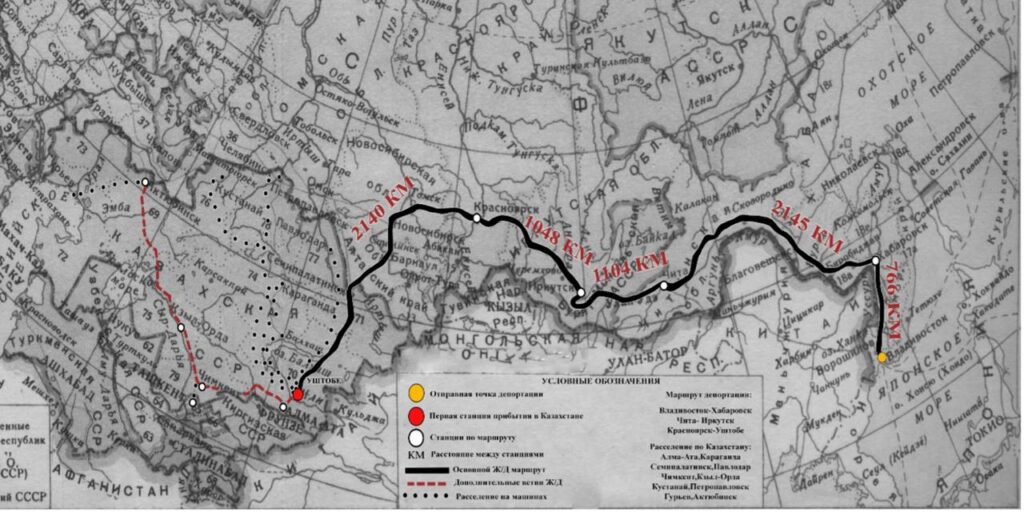
The 1937 deportation from the Soviet Far East was the greatest tragedy in the history of Soviet Koreans, Koryo-saram, the self-designation of ethnic Koreans living across the former Soviet Union. It became the first case in Soviet history in which an entire ethnic group was forcibly relocated solely on the basis of ethnicity. Later, Soviet Germans, Crimean Tatars, Chechens, Ingush, Kalmyks, Poles, Kurds, and many other peoples would endure similar repression. For decades, this history remained largely suppressed, giving rise to numerous myths and misconceptions surrounding the deportation. Yet it is inaccurate to claim that Koreans first appeared in Kazakhstan and Central Asia only in 1937. Historical and archaeological evidence points to earlier Korean ties with the region. The 1897 census of the Russian Empire recorded 42 Koreans living in Turkestan, while in 1929 a Korean agricultural cooperative called “Kazakh Rice” was established in Kazakhstan. Nevertheless, 1937 marked the beginning of the modern history of Koreans in Central Asia. Myth One: The Deportation Was a Sudden Decision One common belief is that Joseph Stalin suddenly decided to deport Koreans from the Soviet Far East as part of a campaign against Japanese espionage. Reality In fact, plans to relocate Koreans had been discussed since the late 1920s. The Politburo of the Soviet Communist Party repeatedly revisited the issue of the Korean population living in border regions. The joint decree issued by the Soviet government and Communist Party on August 21, 1937 (No. 1428-326ss), was the culmination of a long-term state policy. By the mid-1930s, the Soviet Far East was increasingly viewed as a vulnerable frontier zone. Japan had expanded its military presence in the region, and Soviet authorities feared a possible war. Koreans living in compact settlements near the border, while maintaining cultural and family ties with Korea, came to be regarded as politically unreliable. Ironically, many of them had originally fled to Russia precisely to escape Japanese colonial rule in Korea. Myth Two: The Deportation Was Entirely About Japanese Espionage Officially, Soviet authorities justified the deportation as a measure aimed at preventing Japanese espionage. Reality The espionage threat served more as a pretext than the principal cause. During the years of the Great Terror, Stalin’s regime perceived danger not only in individuals, but also in entire social and ethnic groups. Suspicion replaced evidence, and ethnic origin itself could become grounds for repression. Local officials sought to demonstrate political vigilance, while the state simultaneously pursued broader strategic and economic goals: strengthening military control in the Far East and redirecting labor resources to Kazakhstan and Central Asia, regions devastated by collectivization and famine. [caption id="attachment_48623" align="aligncenter" width="854"] Museum of the History of Russian Koreans (Koryo-saram) in Ussuriysk.[/caption] Myth Three: The Operation Was Chaotic For many deported families, the expulsion felt like a sudden catastrophe, creating the impression of disorder and improvisation. Reality At the state level, however, the operation was carefully organized. Before the deportation, party purges and political repression had already targeted the Korean intelligentsia. Soviet authorities fabricated cases involving alleged...
