


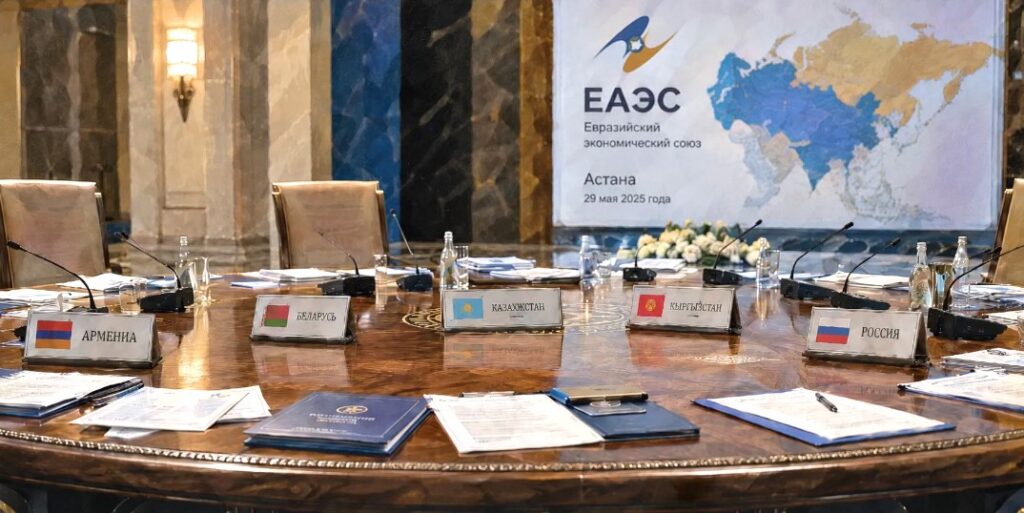
EAEU Leaders Meet in Astana Amid Growing Internal Trade Disputes
Astana is hosting Eurasian Economic Union events on May 28-29, with leaders arriving on Thursday and the main meeting of the Supreme Eurasian Economic Council scheduled for Friday, May 29. The first part of Thursday was dominated by President Kassym-Jomart Tokayev’s meeting with Russian President Vladimir Putin and his delegation during Putin’s state visit to Kazakhstan. At the Palace of Independence, Tokayev and Putin introduced their official delegations to each other during the Russian president’s state visit, while Russian presidential aide Yury Ushakov said the Supreme Eurasian Economic Council meeting would begin on Friday morning in narrow and expanded formats. The Supreme Eurasian Economic Council is the highest body of the Eurasian Economic Union, which came into force on January 1, 2015. Now more than a decade old, the bloc is facing deepening internal contradictions driven largely by external economic pressure on Russia, the Union’s core member. Some of those tensions are linked to the bloc’s expansion beyond its original Russia-Belarus-Kazakhstan core. To understand the current state of Eurasian integration, it is necessary to revisit its origins, particularly the role played by Kazakhstan and its first president, Nursultan Nazarbayev, who had sought to preserve a looser union among the Soviet republics as the USSR collapsed. As prime minister and later president of the Kazakh SSR, Nazarbayev understood the economic consequences that would follow the collapse of the integrated Soviet economic system, and how deeply Kazakhstan remained tied to Soviet-era supply chains, infrastructure, and decision-making structures centered in Moscow. Nazarbayev first publicly proposed the idea of Eurasian integration in 1994 during a lecture at Moscow State University. At the time, however, the administration of Russian President Boris Yeltsin showed little interest in the concept. That changed after Vladimir Putin came to power. In 2001, the Eurasian Economic Community, known as EurAsEC, was established, bringing together Belarus, Kazakhstan, Kyrgyzstan, Russia, and Tajikistan. The founding agreement had been signed in Astana in October 2000. Uzbekistan joined EurAsEC in 2006, but suspended its membership only two years later. Meanwhile, Russia, Belarus, and Kazakhstan launched work in 2007 on creating a Customs Union, which officially came into existence in 2010. In the autumn of 2011, Putin announced plans to establish a Eurasian Economic Union based on a future Single Economic Space. Two years later, Nazarbayev proposed dissolving EurAsEC in connection with the planned creation of the EAEU by Russia, Kazakhstan, and Belarus. Kyrgyzstan, Tajikistan, and Armenia were invited to join the Customs Union. However, by 2014, when the treaty establishing the EAEU and dissolving EurAsEC was signed, neither Armenia nor Kyrgyzstan had initially been central to the Eurasian project. At that stage, much of the discussion revolved around the possible accession of Ukraine. Russian political commentator and current State Duma deputy Anatoly Wasserman devoted several books to the idea of integrating Ukraine into the Russia-Belarus-Kazakhstan project, including Ukraine and the Rest of Russia. Wasserman argued that Russia, Belarus, Kazakhstan, and Ukraine needed to move away from a raw-materials-based economic model by creating a unified market...
