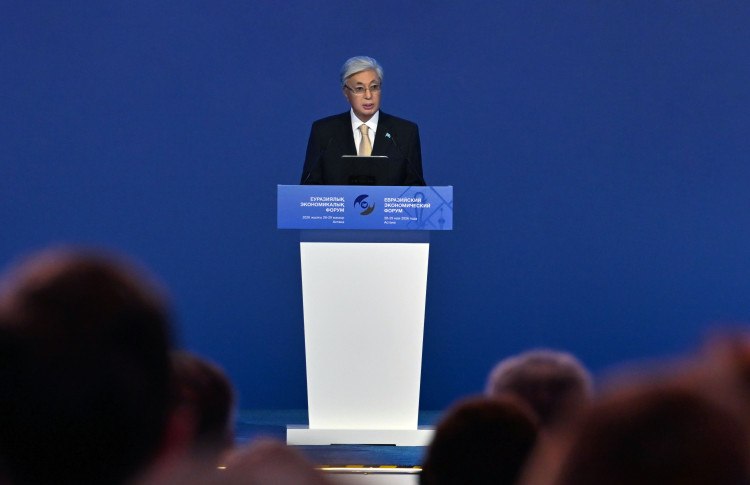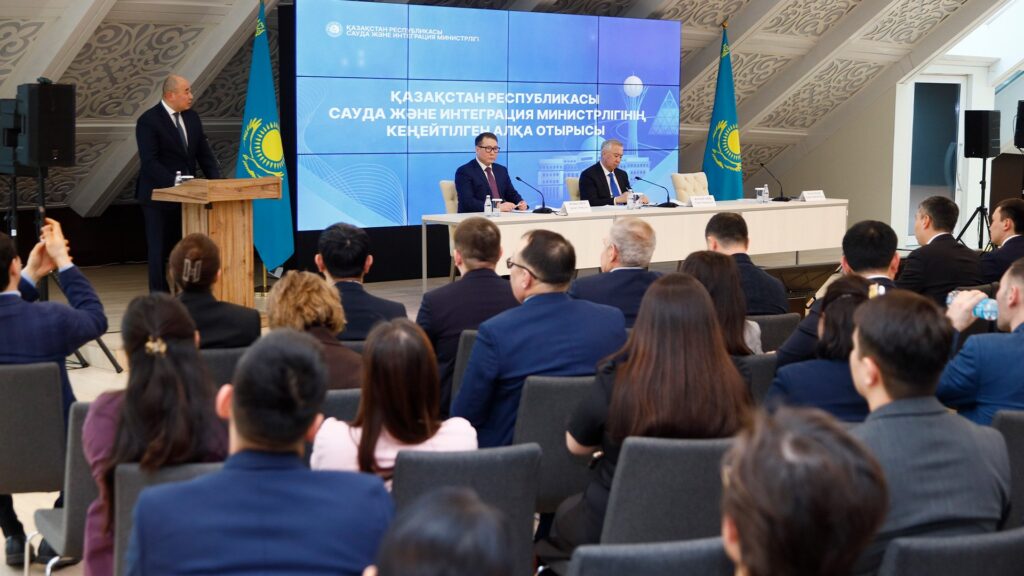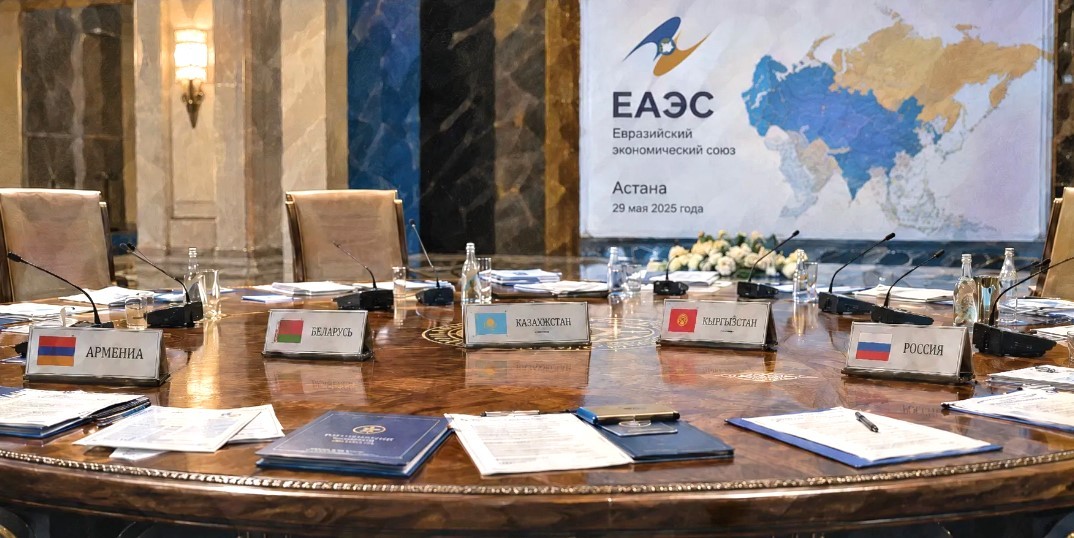
Astana is hosting Eurasian Economic Union events on May 28-29, with leaders arriving on Thursday and the main meeting of the Supreme Eurasian Economic Council scheduled for Friday, May 29.
The first part of Thursday was dominated by President Kassym-Jomart Tokayev’s meeting with Russian President Vladimir Putin and his delegation during Putin’s state visit to Kazakhstan. At the Palace of Independence, Tokayev and Putin introduced their official delegations to each other during the Russian president’s state visit, while Russian presidential aide Yury Ushakov said the Supreme Eurasian Economic Council meeting would begin on Friday morning in narrow and expanded formats.
The Supreme Eurasian Economic Council is the highest body of the Eurasian Economic Union, which came into force on January 1, 2015. Now more than a decade old, the bloc is facing deepening internal contradictions driven largely by external economic pressure on Russia, the Union’s core member. Some of those tensions are linked to the bloc’s expansion beyond its original Russia-Belarus-Kazakhstan core.
To understand the current state of Eurasian integration, it is necessary to revisit its origins, particularly the role played by Kazakhstan and its first president, Nursultan Nazarbayev, who had sought to preserve a looser union among the Soviet republics as the USSR collapsed. As prime minister and later president of the Kazakh SSR, Nazarbayev understood the economic consequences that would follow the collapse of the integrated Soviet economic system, and how deeply Kazakhstan remained tied to Soviet-era supply chains, infrastructure, and decision-making structures centered in Moscow.
Nazarbayev first publicly proposed the idea of Eurasian integration in 1994 during a lecture at Moscow State University. At the time, however, the administration of Russian President Boris Yeltsin showed little interest in the concept. That changed after Vladimir Putin came to power.
In 2001, the Eurasian Economic Community, known as EurAsEC, was established, bringing together Belarus, Kazakhstan, Kyrgyzstan, Russia, and Tajikistan. The founding agreement had been signed in Astana in October 2000.
Uzbekistan joined EurAsEC in 2006, but suspended its membership only two years later. Meanwhile, Russia, Belarus, and Kazakhstan launched work in 2007 on creating a Customs Union, which officially came into existence in 2010.
In the autumn of 2011, Putin announced plans to establish a Eurasian Economic Union based on a future Single Economic Space. Two years later, Nazarbayev proposed dissolving EurAsEC in connection with the planned creation of the EAEU by Russia, Kazakhstan, and Belarus. Kyrgyzstan, Tajikistan, and Armenia were invited to join the Customs Union.
However, by 2014, when the treaty establishing the EAEU and dissolving EurAsEC was signed, neither Armenia nor Kyrgyzstan had initially been central to the Eurasian project. At that stage, much of the discussion revolved around the possible accession of Ukraine.
Russian political commentator and current State Duma deputy Anatoly Wasserman devoted several books to the idea of integrating Ukraine into the Russia-Belarus-Kazakhstan project, including Ukraine and the Rest of Russia.
Wasserman argued that Russia, Belarus, Kazakhstan, and Ukraine needed to move away from a raw-materials-based economic model by creating a unified market for industrial production. At the time, Ukraine’s population of around 40 million would have expanded the EAEU’s consumer market to more than 200 million people, making large-scale industrial production economically viable. Today, the combined population of EAEU member states is usually estimated at more than 185 million.
“Raw material exports have exhausted their potential,” Wasserman said in an interview during that period. “I also believe that an economy focused on foreign investment is a flawed model. The new economic system should be oriented not toward foreign capital, but toward development within the Eurasian Economic Union, toward the creation of a single interconnected economic complex in which all participants are equally interested in the development of the common economy.”
Around the same time, the project was drawing sharper scrutiny from Washington. In 2012, then-U.S. Secretary of State Hillary Clinton described Russian-led Eurasian integration efforts as an attempt to “re-Sovietize the region.”
By early 2014, hopes of bringing Ukraine into the EAEU had collapsed. In one interpretation, Armenia and Kyrgyzstan became the next additions to a project whose earlier economic logic had assumed a larger Ukrainian market. Some studies of Kazakhstan’s role in the EAEU have noted that Astana opposed the accession of Armenia and Kyrgyzstan, reflecting concern that the bloc was moving beyond its original core.
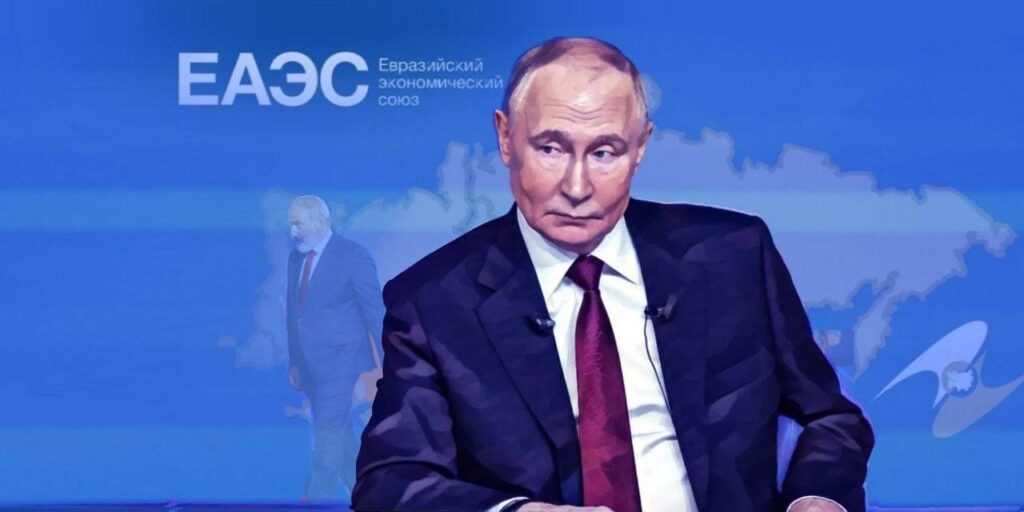
In recent years, Moscow’s relations with Armenia have deteriorated. The rupture with Yerevan deepened after Azerbaijan’s 2023 takeover of Nagorno-Karabakh, when Armenian officials increasingly blamed Russia and the Russian-led security framework for failing to protect Armenian interests. Russia has since imposed restrictions on several Armenian products amid the diplomatic fallout from Yerevan’s tilt toward the West.
Tensions rose further after Ukrainian President Volodymyr Zelenskyy visited Armenia in May, prompting Moscow to summon the Armenian ambassador and accuse Yerevan of giving Kyiv a platform for anti-Russian statements.
Kyrgyzstan, meanwhile, remains heavily exposed to Russia through labor migration and remittances, making any dispute with Moscow politically and economically sensitive. Even so, Bishkek has taken Russia to the EAEU Court over health insurance rights for migrant workers’ families, underscoring how practical disputes inside the bloc can spill into formal legal channels.
For the EAEU, these disputes expose a structural tension. The Union formally provides for the free movement of goods, services, capital, and labor. In practice, its members increasingly face different sanctions risks, foreign-policy pressures, and trade priorities. Russia remains the bloc’s central economy, but it is also the main source of external pressure on the Union.
Because these issues are politically sensitive, most discussions are likely to take place behind closed doors, while only positive messaging will be presented publicly. The Astana meeting is therefore likely to present unity in public while testing how much friction the Union can absorb behind closed doors.