
• KGS/USD = 0.01144 0%
  • KZT/USD = 0.00212 0%
  • TJS/USD = 0.10768 0%
  • UZS/USD = 0.00008 0%
  • TMT/USD = 0.28571 0%
  • KGS/USD = 0.01144 0%
  • KZT/USD = 0.00212 0%
  • TJS/USD = 0.10768 0%
  • UZS/USD = 0.00008 0%
  • TMT/USD = 0.28571 0%
  • KGS/USD = 0.01144 0%
  • KZT/USD = 0.00212 0%
  • TJS/USD = 0.10768 0%
  • UZS/USD = 0.00008 0%
  • TMT/USD = 0.28571 0%
  • KGS/USD = 0.01144 0%
  • KZT/USD = 0.00212 0%
  • TJS/USD = 0.10768 0%
  • UZS/USD = 0.00008 0%
  • TMT/USD = 0.28571 0%
  • KGS/USD = 0.01144 0%
  • KZT/USD = 0.00212 0%
  • TJS/USD = 0.10768 0%
  • UZS/USD = 0.00008 0%
  • TMT/USD = 0.28571 0%
  • KGS/USD = 0.01144 0%
  • KZT/USD = 0.00212 0%
  • TJS/USD = 0.10768 0%
  • UZS/USD = 0.00008 0%
  • TMT/USD = 0.28571 0%
  • KGS/USD = 0.01144 0%
  • KZT/USD = 0.00212 0%
  • TJS/USD = 0.10768 0%
  • UZS/USD = 0.00008 0%
  • TMT/USD = 0.28571 0%
  • KGS/USD = 0.01144 0%
  • KZT/USD = 0.00212 0%
  • TJS/USD = 0.10768 0%
  • UZS/USD = 0.00008 0%
  • TMT/USD = 0.28571 0%

Viewing results 1 - 6 of 4

Central Asia Steps Out of the Post-Soviet Shadow

Central Asia is rarely presented on its own terms. It is more often viewed through exterior lenses like Russian imperial memory, Chinese reach, Silk Road romance, or great-power rivalry. The result is a region made to look secondary to the forces around it, even as its five countries carry deep histories, distinct languages, and identities that cannot be reduced to a backdrop. That old frame is starting to crack. Central Asia is finding new ways to tell its own story. The shift goes beyond tourism or national branding. It is about who gets to define the region, which is still too often seen through the things done to it or extracted from it. Culture depicts the other side of that narrative, a place that has shaped history, not merely endured it, with traditions and ideas that have long carried influence far beyond its borders. [caption id="attachment_49147" align="aligncenter" width="2048"] Sky above Almaty: Qandy Qantar; image courtesy of Saule Suleimenova[/caption] Kazakhstan offers one visible example. The Almaty Museum of Arts opened on September 12, 2025, adding a major institution for modern and contemporary art. Its arrival builds on a broader shift in which private galleries, international platforms, and artists such as Aigerim Karibayeva and Saule Suleimenova are moving Kazakh art beyond folkloric shorthand toward identity, postcolonial memory, and urban life. The reopening of the Tselinny Center of Contemporary Culture, in a former Soviet-era cinema, adds a sharper symbolic layer. A building once tied to Soviet public culture has become a platform for modern Central Asian voices, reflecting a scene increasingly rethinking nomadism rather than simply reproducing it. [caption id="attachment_49148" align="aligncenter" width="1024"] Image: The Tselinny Center of Contemporary Culture[/caption] Uzbekistan has made culture central to its international reemergence. The inaugural Bukhara Biennial brought contemporary art into a city more often seen through its monuments, turning madrasas and caravanserais into exhibition spaces for Uzbek and world artists. The same push is visible in the Tashkent Centre for Contemporary Art, Uzbekistan’s presence at the Venice Architecture Biennale, and design projects such as When Apricots Blossom, which link heritage, craft, and the environmental disaster of the Aral Sea. Artists such as Oyjon Khayrullaeva show a younger generation reworking Islamic ornament, textiles, and public space into new visual languages. At the same time, the State Museum of Karakalpakstan in Nukus, with its Soviet-era censored works, gives the country’s art history deeper heft. In Tashkent, the Islamic Civilization Center is working on a different scale. Recognized by Guinness World Records in 2026 as the largest museum of Islamic civilization, it gives Uzbekistan a stronger role in shaping how that legacy is understood today. [caption id="attachment_49146" align="aligncenter" width="2048"] Image courtesy of Oyjon Khayrullaeva[/caption] Kyrgyzstan’s confidence rests on different ground. The sixth World Nomad Games are scheduled for August 31 to September 6, 2026, with events in Bishkek and around Issyk-Kul. That gives Kyrgyzstan a stage for living nomadic traditions, not a static museum display of them. Its contemporary art scene adds a more intimate layer, with artists such as...

Central Asian Perspectives Take Center Stage in Milan

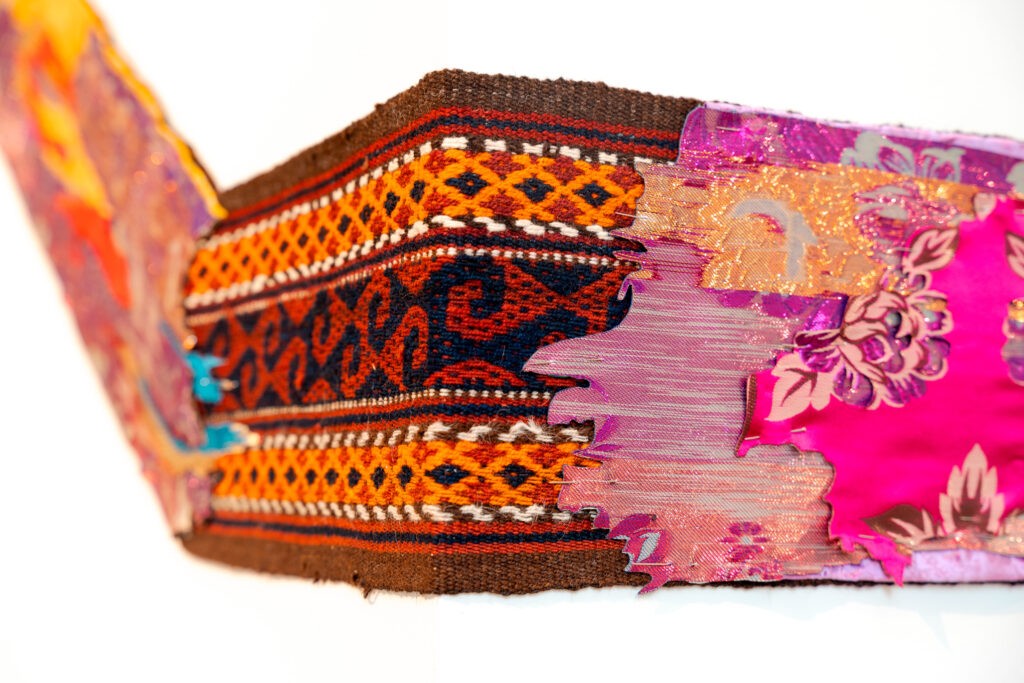
A pale Milanese dawn draped the city in shifting greys, as visitors crossed the threshold into the space of Fondazione Elpis, a foundation created to promote dialogue with emerging geographies and young artists. This time, it was Central Asian artists who were in the spotlight, claiming a shared history fractured by Soviet rule and global currents. The show YOU ARE HERE: Central Asia redraws a regional map, allowing artists to redraw the borders of their belonging beyond nation-states. At the same time, it invites each visitor to relate to the works by locating its place within these stitched, erased, and reconfigured narratives. Curators Dilda Ramazan and Aida Sulova orchestrated twenty-seven artists into a living constellation: from Munara Abdukakharova’s rolled patchwork, its golden hammer-and-sickle motifs softened by the hand-stitched curves of Kyrgyz kurak korpe, to Vyacheslav Akhunov’s furious erasures of scraped notes, the show reassembled in unexpected patterns stories of resilience, resistance, and reimagined belonging. YOU ARE HERE not only reframed Central Asia for a European audience but asserted that the region’s histories are neither static nor singular, they are stitched, erased, reconfigured, and claimed anew by the very people who live them. The Times of Central Asia spoke with Kazakh curator, Dilda Ramazan. [caption id="attachment_31541" align="aligncenter" width="2560"] "YOU ARE HERE. Central Asia", installation view, primo piano, Fondazione Elpis, Milano © Fabrizio Vatieri Studio[/caption] TCA: Can you tell us about the genesis of the show? The show emerged after the invitation of the Fondazione Elpis, whose founder, Marina Nissim, became interested in the region and its artists after seeing one of the Central Asian pavilions at the Venice Biennale. By presenting the complex Central Asian landscape to a European public who might not know it very well, we wanted to give artists the platform for free expression without framing the region from the stereotypical perspective, as is often the case in the Western context. We wanted the artists to reflect on the idea of space and belonging through the idea of locating oneself. TCA: Do you feel there is a growing awareness of Central Asia in Europe? Yes, I can feel and see it, but it is a natural process one should expect within the logic of globalization. The exhibition addressed the impact of Soviet and post-Soviet transitions on the cultural identities of Central Asian nations by showcasing artists of several generations. Some of them had a direct experience of living under the Soviet regime, so again the artists spoke for themselves and the region’s past through their works. [caption id="attachment_31542" align="aligncenter" width="2560"] Emil Tilekov, Traces and Shadows, 2024 © Fabrizio Vatieri Studio[/caption] TCA: How is the theme of migration explored in the exhibition, particularly concerning its economic and emotional implications for Central Asian communities? Migration was one of the key aspects evoked in the show because it is still an experience lived by the artists and/or their relatives and families. Two Kyrgyz artists, for example, raised this issue in their projects. This was the case in the video by Chingiz...