• KGS/USD = 0.01144 0%
  • KZT/USD = 0.00207 0%
  • TJS/USD = 0.10415 -0.19%
  • UZS/USD = 0.00008 0%
  • TMT/USD = 0.28571 0%
  • KGS/USD = 0.01144 0%
  • KZT/USD = 0.00207 0%
  • TJS/USD = 0.10415 -0.19%
  • UZS/USD = 0.00008 0%
  • TMT/USD = 0.28571 0%
  • KGS/USD = 0.01144 0%
  • KZT/USD = 0.00207 0%
  • TJS/USD = 0.10415 -0.19%
  • UZS/USD = 0.00008 0%
  • TMT/USD = 0.28571 0%
  • KGS/USD = 0.01144 0%
  • KZT/USD = 0.00207 0%
  • TJS/USD = 0.10415 -0.19%
  • UZS/USD = 0.00008 0%
  • TMT/USD = 0.28571 0%
  • KGS/USD = 0.01144 0%
  • KZT/USD = 0.00207 0%
  • TJS/USD = 0.10415 -0.19%
  • UZS/USD = 0.00008 0%
  • TMT/USD = 0.28571 0%
  • KGS/USD = 0.01144 0%
  • KZT/USD = 0.00207 0%
  • TJS/USD = 0.10415 -0.19%
  • UZS/USD = 0.00008 0%
  • TMT/USD = 0.28571 0%
  • KGS/USD = 0.01144 0%
  • KZT/USD = 0.00207 0%
  • TJS/USD = 0.10415 -0.19%
  • UZS/USD = 0.00008 0%
  • TMT/USD = 0.28571 0%
  • KGS/USD = 0.01144 0%
  • KZT/USD = 0.00207 0%
  • TJS/USD = 0.10415 -0.19%
  • UZS/USD = 0.00008 0%
  • TMT/USD = 0.28571 0%

Viewing results 1 - 6 of 1027

Kazakhstan-Uzbekistan Jibek Joly Train Tour Extended to Tajikistan

Kazakhstan’s national railway company, Kazakhstan Temir Zholy (KTZ), has announced the expansion of its popular Jibek Joly (Silk Road) tourist train route to include Tajikistan, adding a new stop to one of Central Asia’s flagship railway tourism initiatives. The updated route will now reach the Tajik capital, Dushanbe, extending the tour beyond Kazakhstan and Uzbekistan for the first time. The inaugural journey on the extended route is scheduled to depart from Almaty on March 20, 2026, and return on March 25, passing through a series of historic Silk Road cities: Turkestan (Kazakhstan), Samarkand (Uzbekistan), Dushanbe (Tajikistan) and Tashkent (Uzbekistan). The tour package includes rail travel, guided sightseeing, entrance to cultural and historical sites, and organized transfers. Its launch coincides with Nauryz, the region’s traditional spring holiday, allowing travelers to experience vibrant local celebrations along the way. First introduced in November 2024, the Jibek Joly train originally ran between Almaty, Turkestan, and Tashkent, and has since become a highly visible symbol of the region’s growing tourism sector. The project reflects broader efforts to promote Central Asia as a unified tourist destination. Regional leaders have advocated for a shared visa-free regime for foreign visitors, similar to Europe’s Schengen Zone, to encourage cross-border travel and boost international tourism. Officials say that initiatives like Jibek Joly can help strengthen cultural ties, foster regional integration, and raise Central Asia’s profile on the global tourism map.

Uzbekistan Signals Possible Retaliation Over Increased Trade Costs in Tajikistan

Uzbekistan may introduce reciprocal measures in response to trade barriers impacting its exports to Tajikistan, Deputy Prime Minister Jamshid Khodjaev announced on January 17 during a meeting of entrepreneurs, ambassadors, and government officials in Tashkent. Khodjaev highlighted challenges faced by Uzbek exporters, particularly in the construction materials sector, despite full compliance with required documentation. “We have problems related to Tajikistan. We export products to this market, but even when all documents are complete, our goods are cleared under a so-called ‘reserve’ procedure,” he said. “As a result, the price of our products in that market rises by about 15%.” Meeting participants reported that additional charges imposed at Tajik customs are inflating the cost of Uzbek construction materials and reducing competitiveness. Khodjaev warned that if such restrictions are not lifted, Uzbekistan may respond with similar trade measures. The issue was also raised by representatives of German construction materials giant Knauf. The company’s commercial director noted that exporters face similar obstacles not only in Tajikistan but also in Turkmenistan and parts of the Caucasus region. In Tajikistan’s case, the “reserve” customs clearance procedure was cited as a key driver of increased costs. “This is pushing the price of our products in the Tajik market up by as much as 15%,” the representative said. Entrepreneurs stated that combined logistics and customs costs for shipments to Tajikistan have surged from approximately $2,000 to $12,000. Despite multiple appeals to Tajik authorities, they said no resolution has been achieved, and the elevated costs are undermining export volumes. “If they impose duties, we can do the same,” Khodjaev stated. “Our customs officials will talk to their counterparts. If this practice continues, we will take response measures. Our ambassador should clearly convey this signal.” Despite the ongoing friction, trade between Uzbekistan and Tajikistan surpassed $700 million in 2024, nearly three times higher than in previous years. Both governments have indicated they are exploring new logistics corridors and simplified customs procedures to deepen bilateral economic ties.

UN Adopts AI Resolution for Central Asia at Tajikistan’s Initiative

On July 25, 2025, the United Nations General Assembly unanimously adopted a resolution titled “The Role of Artificial Intelligence in Creating New Opportunities for Sustainable Development in Central Asia.” The resolution was spearheaded by Tajikistan. A Historic Decision by the General Assembly According to Tajikistan’s Ministry of Foreign Affairs, the resolution sets a “historic precedent” in shaping a global framework for the ethical and secure use of artificial intelligence. It also emphasizes the importance of responsible governance, including mechanisms for national and regional self-regulation and oversight of AI technologies. Regional AI Center to Be Established in Dushanbe A central component of the resolution is the proposal to establish a Regional Artificial Intelligence Center in Dushanbe. The center will coordinate AI-related efforts across Central Asian countries, facilitating joint research, startup development, specialist training, and regulatory alignment. The center’s key objectives include: Launching joint educational initiatives and supporting AI start-ups via regional technology parks; Promoting scientific and applied research at universities, laboratories, and research institutes throughout Central Asia; Creating a unified data center network to improve access to computational resources; Harmonizing national monitoring and self-regulation systems in AI; Advancing international cooperation with global partners and specialized organizations. Tajikistan Steps onto the Global AI Stage The resolution stresses the need to develop “safe, trustworthy, and transparent AI systems,” promoting a balance between innovation and regulatory oversight. This, it states, will support sustainable development and digital transformation across the region. Tajikistan’s initiative, culminating in this UN resolution, marks a significant step in the country’s aspirations to position itself as a regional hub for artificial intelligence.

Tajikistan Seeks to Join China-Kyrgyzstan-Uzbekistan Railway Project

Tajikistan has officially expressed interest in joining the China-Kyrgyzstan-Uzbekistan (CKU) railway construction project, an ambitious regional transport initiative designed to enhance connectivity across Central and South Asia. The proposal was raised during a meeting between Tajik Minister of Transport Azim Ibrahim and Chinese Minister of Transport Liu Wei on July 2 in Tianjin, on the sidelines of the 12th Meeting of Transport Ministers of the Shanghai Cooperation Organization (SCO) Member States. According to the Tajik Ministry of Transport, the two sides discussed potential Chinese support for Tajikistan’s accession to the CKU railway project, as well as participation in the development of a broader multimodal corridor linking China, Tajikistan, Uzbekistan, Turkmenistan, Iran, Turkey, and Europe. The CKU railway, a strategically vital infrastructure project, spans 523 kilometers. Construction officially began on December 27, 2024, in Jalal-Abad, Kyrgyzstan. Once completed, the route will connect Kashgar in China with Torugart, Makmal, and Jalal-Abad in Kyrgyzstan, and Andijan in Uzbekistan. The railway is projected to handle up to 15 million tons of cargo annually. Currently, neither Kyrgyzstan nor Uzbekistan has a direct rail link with China, the only such connection in Central Asia runs through Kazakhstan. At the SCO ministerial meeting, Minister Ibrahim noted that the SCO region already functions as a strategic bridge between East and West, North and South. He also outlined key emerging challenges, including the need to strengthen transport chain resilience, accelerate digitalization, reduce carbon emissions, and promote green logistics solutions. To that end, Ibrahim proposed the establishment of a Unified SCO Digital Platform for managing multimodal transportation. This platform would harmonize customs, border, and transport procedures, enable real-time cargo tracking, streamline documentation, and enhance operational transparency. The minister further emphasized the need to advance and integrate several major international corridors: China - Kyrgyzstan - Tajikistan - Afghanistan - Pakistan - Indian Ocean China - Tajikistan - Uzbekistan - Turkmenistan - Iran - Turkey - Europe Trans-Caspian International Transport Route (TITR) He also underscored the importance of attracting international partners to help restore and expand transport infrastructure through Afghanistan, describing it as key to unlocking new regional trade routes.

Tajikistan Predicts Economic Slowdown Amid Declining Remittances

Tajikistan's economic growth is projected to decelerate to 7.5% in 2025, largely due to weakening domestic demand, according to the latest regional economic review by the Eurasian Fund for Stabilization and Development (EFSD). Migrant Remittances: A Key Factor The anticipated slowdown is primarily attributed to a decline in remittances from labor migrants, which have historically formed a substantial share of Tajikistan’s GDP. EFSD analysts forecast that from 2025 to 2027, the volume of transfers will gradually normalize after peaking between 2022 and 2024. Despite this decline, the EFSD maintains that Tajikistan’s balance of payments will remain stable, helped in part by reduced capital outflows, including foreign currency purchases. Previously, the World Bank reported that migrant remittances accounted for 45% of the country’s GDP in 2024, the highest proportion globally. By comparison, remittances made up 24% of GDP in Kyrgyzstan and 14% in Uzbekistan. The Asian Development Bank (ADB) expects this share to fall to 37% in 2025. Inflation Pressures Rise EFSD economists also warn of mounting inflationary pressures. Inflation is projected to approach the upper limit of the National Bank of Tajikistan’s target corridor, 5% with an acceptable deviation of ±2 percentage points. Over the medium term, inflation is expected to stabilize within the target range. Food prices remain the primary risk to price stability, the EFSD cautioned. Exports, External Risks, and Trade Barriers The ADB has also published a forecast supporting a more restrained outlook, highlighting falling global prices for Tajikistan’s key exports, metals and agricultural goods, including aluminum, as an added drag on growth. Additionally, regional trade barriers are posing challenges. Uzbekistan recently raised import duties on Tajik cement, a move seen by analysts as part of a broader trend of protectionist policies in neighboring countries. External conditions are also exerting pressure. Economic slowdowns in Russia and China, Tajikistan’s primary trading partners, could suppress both export revenue and remittances, the majority of which come from migrant workers in Russia. GDP Projections and Sector Breakdown According to the ADB’s baseline scenario, Tajikistan’s GDP growth is expected to slow to 7.4% in 2025 and 6.8% in 2026. In contrast, Tajik authorities aim to maintain growth at no less than 8%. In 2024, the economy grew by 8.4%, a 0.1 percentage point increase over the previous year. GDP totaled 153.4 billion somoni (approximately $14 billion). The sectoral composition of GDP included agriculture (22.8%), industry (16.9%), trade (15.2%), transportation (9.3%), construction (8.1%), taxes (9.4%), and other services (18.3%). Despite the projected slowdown, ADB experts remain cautiously optimistic. They cite sustained investment in energy and industrial sectors, expanded agricultural and service output, and continued, albeit diminished, remittance inflows as key factors that will support Tajikistan’s economic momentum.

Jewelry Factory Opens in Tajikistan with Chinese Investment

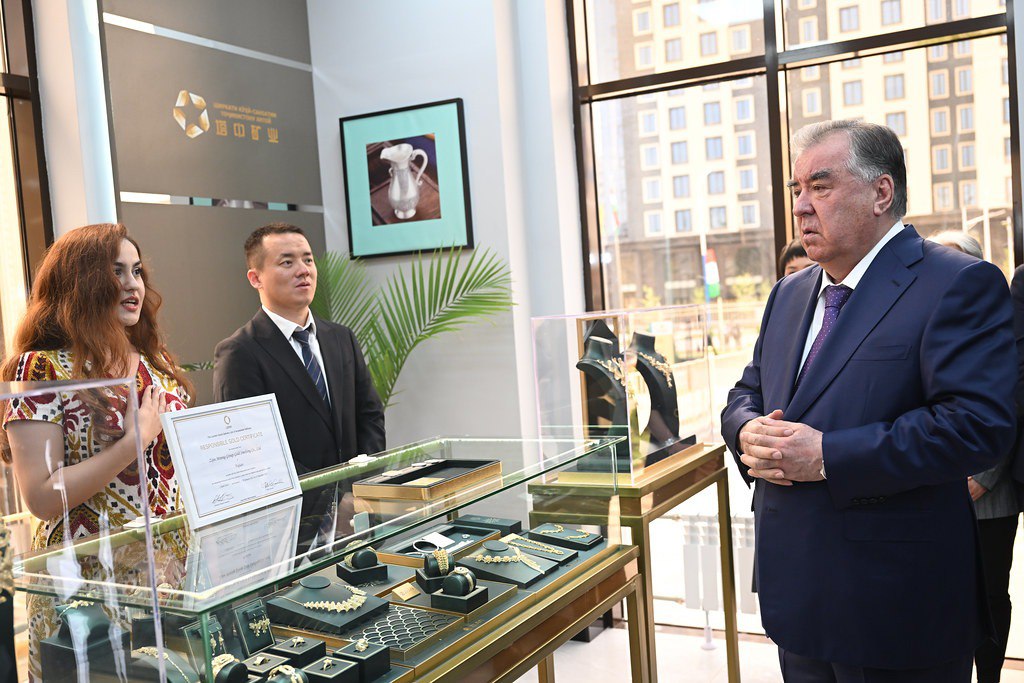
A new jewelry factory operated by China-Tajikistan Mining Industry Company LLC officially opened in Dushanbe on April 10. The inauguration ceremony was attended by President Emomali Rahmon of Tajikistan. Construction of the facility began in 2023. The complex now includes modern production facilities and a two-story gold sales center. Utilizing the latest Chinese technology, the factory is capable of processing up to one ton of gold and 30 tons of silver annually. It will also produce a variety of goods, including jewelry, home decorations, and household items. On the same day, President Rahmon laid the foundation stones for two additional jewelry factories, also backed by Chinese investment. One will be operated by TBEA Dushanbe Mining Industry Company LLC, and the other by Pakrut Company LLC. Both are slated for completion within a year and will be located in Dushanbe. China currently controls over 75% of Tajikistan’s gold production. While Chinese investment has helped develop Tajikistan’s mining infrastructure, it has also raised concerns. Critics point to potential environmental risks and labor rights issues associated with the expanding influence of Chinese firms in the sector.