• KGS/USD = 0.01143 0%
  • KZT/USD = 0.00200 0%
  • TJS/USD = 0.10593 -0.19%
  • UZS/USD = 0.00008 0%
  • TMT/USD = 0.28575 0%
  • KGS/USD = 0.01143 0%
  • KZT/USD = 0.00200 0%
  • TJS/USD = 0.10593 -0.19%
  • UZS/USD = 0.00008 0%
  • TMT/USD = 0.28575 0%
  • KGS/USD = 0.01143 0%
  • KZT/USD = 0.00200 0%
  • TJS/USD = 0.10593 -0.19%
  • UZS/USD = 0.00008 0%
  • TMT/USD = 0.28575 0%
  • KGS/USD = 0.01143 0%
  • KZT/USD = 0.00200 0%
  • TJS/USD = 0.10593 -0.19%
  • UZS/USD = 0.00008 0%
  • TMT/USD = 0.28575 0%
  • KGS/USD = 0.01143 0%
  • KZT/USD = 0.00200 0%
  • TJS/USD = 0.10593 -0.19%
  • UZS/USD = 0.00008 0%
  • TMT/USD = 0.28575 0%
  • KGS/USD = 0.01143 0%
  • KZT/USD = 0.00200 0%
  • TJS/USD = 0.10593 -0.19%
  • UZS/USD = 0.00008 0%
  • TMT/USD = 0.28575 0%
  • KGS/USD = 0.01143 0%
  • KZT/USD = 0.00200 0%
  • TJS/USD = 0.10593 -0.19%
  • UZS/USD = 0.00008 0%
  • TMT/USD = 0.28575 0%
  • KGS/USD = 0.01143 0%
  • KZT/USD = 0.00200 0%
  • TJS/USD = 0.10593 -0.19%
  • UZS/USD = 0.00008 0%
  • TMT/USD = 0.28575 0%
22 February 2026

Viewing results 1 - 6 of 27

Tourism in Tajikistan: Five Years of Progress and Persistent Barriers

Five years ago, Canadian researcher Christian Bleuer identified 25 key obstacles hindering the growth of Tajikistan’s tourism sector. Since then, the industry has made measurable progress but many challenges remain unresolved. Digitalization and Initial Progress Significant strides have been made in digital infrastructure. The introduction of electronic visas, online services, and the availability of eSIM cards has improved access for international travelers. Dushanbe has witnessed the opening of new hotels and restaurants, an expansion of taxi services in major cities, and the reconstruction of sections of the M41 highway. Other positive steps include training programs for tour guides, the creation of tourist information centers in Dushanbe, Khorog, and other cities, and growing competition in the hospitality and restaurant industries. Experts also note that travel bloggers and social media have, in some cases, done more to improve the country’s image than official marketing campaigns. Partial Improvements While services have improved in urban areas, regional disparities persist. Tourists can now find decent hotels and cafes in major cities, but service quality outside these hubs remains inconsistent. The e-visa system has streamlined entry procedures, although public awareness of the platform is still low. Digital tools such as Google Maps and mobile apps assist navigation in urban centers, but coverage remains sparse outside Dushanbe and Khujand. Financial infrastructure has also improved, with more ATMs available in the capital. However, access to foreign currency remains a barrier. Aviation has seen some progress under the "Open Skies" policy, with new routes to China and Uzbekistan launched, though high airfares continue to deter potential visitors. Ongoing Challenges Several systemic issues continue to hamper tourism development. Connectivity remains weak: Tajikistan ranks 117th globally for fixed internet speed and lags behind regional peers in mobile data performance, averaging under 24 Mbps. Environmental concerns also diminish the visitor experience. Litter is visible not only in rural areas but even in Dushanbe. Transport remains problematic, with the Jirgatal border crossing closed to foreigners and the Pamir Highway via the Khaburabad Pass largely inaccessible during winter months. A national ban on drones restricts opportunities for photo and video tourism. Additionally, poor coordination among tour operators, taxi drivers, and hoteliers prevents the formation of a unified tourism strategy. Structural Constraints Some limitations are more difficult to overcome. Tajikistan’s geography, landlocked and bordering Afghanistan, poses accessibility challenges. The country also lacks the architectural heritage that makes neighboring Uzbekistan a dominant player in regional cultural tourism. Urban development trends further complicate matters. The demolition of historical buildings and widespread tree-cutting in Dushanbe have eroded the capital’s aesthetic appeal. Tajikistan’s Tourism Development Strategy to 2030 acknowledges the sector’s underperformance. Its contribution to the global tourism market remains modest, constrained by low investment, weak infrastructure, and uneven service quality. Nevertheless, experts believe the sector holds untapped potential. Tourism could create employment opportunities for young people and help reduce labor migration. Realizing this potential will require stronger private sector involvement, upgraded services, and more effective international promotion.

Yacht Fleet Launched on Lake Issyk-Kul to Boost Tourism and Sports

On August 26, Kyrgyzstan’s resort city of Cholpon-Ata inaugurated the first monotype yacht fleet on Lake Issyk-Kul, marking a new stage in the development of the region’s tourism infrastructure. The project was spearheaded by Evgeny Kotov, a Russia-born entrepreneur, international business trainer, and founder of the Practicum business school. At the opening ceremony, Kyrgyzstan’s Minister of Economy and Commerce Bakyt Sydykov highlighted the significance of the initiative, noting that tourism is defined as a strategic sector of the national economy under the National Development Program until 2030. According to Sydykov, the yacht fleet will help diversify Issyk-Kul’s tourism offerings by developing water sports and recreation, attracting visitors year-round, creating new jobs, and strengthening Kyrgyzstan’s international image and investment appeal. The new sailing infrastructure also opens opportunities for training athletes and hosting international competitions. Earlier this year, the ministry backed a proposal from the Sailing Federation of the Kyrgyz Republic to exempt sports equipment, including sailing yachts, from customs duties and to simplify procedures for the temporary import of vessels participating in competitions.

Kyrgyzstan Seeks German Investment in Green Energy, Logistics, and Tourism

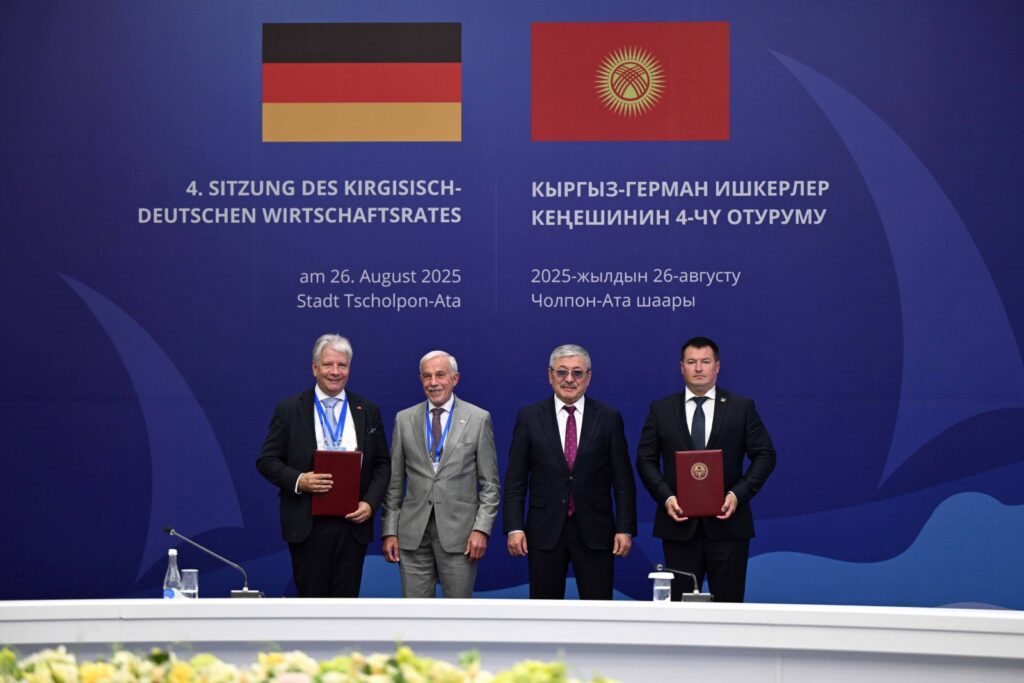
On August 26, the resort city of Cholpon-Ata on Lake Issyk-Kul hosted the Day of German Economy in Kyrgyzstan, alongside the 4th meeting of the Kyrgyz-German Business Council. Opening remarks were delivered by Adylbek Kasymaliyev, Chairman of the Cabinet of Ministers of Kyrgyzstan, and Professor Reinhold Krämmel, Honorary Consul of Kyrgyzstan in Bavaria and Thuringia and Deputy Co-Chairman of the Business Council. Calls for Green Investment and Innovation Kasymaliyev highlighted Kyrgyzstan’s interest in attracting German investment and advanced technologies to modernize its industries, create jobs, and strengthen export potential. He identified key areas for cooperation, including renewable energy, green technologies, transport and logistics infrastructure, and the financial sector. Environmental issues featured prominently in the discussions. Kasymaliyev further emphasized the threat of rapidly melting glaciers, which he said "requires the consolidation of efforts and joint initiatives." “We know Germany as one of the most active defenders of nature. Unfortunately, environmental problems are worsening each year. Glaciers in our mountains are melting and shrinking drastically. Addressing such critical issues requires joint efforts,” he said. Youth and Education as Bridges of Cooperation Kasymaliyev also underlined the importance of youth in Kyrgyzstan’s development and in strengthening bilateral ties. He noted a growing interest among young Kyrgyz citizens in the German language, culture, and vocational education, elements he described as forming the foundation for long-term partnership. While acknowledging current progress, Kasymaliyev stressed that Kyrgyz-German economic relations have significant untapped potential. New Agreements and Sectoral Priorities Following the meeting, a memorandum of cooperation was signed between Kyrgyz Temir Jolu, the national railway company, and Rhenus SE & Co. KG to jointly explore logistics and transit infrastructure opportunities. Kasymaliyev also held bilateral talks with Michael Harms, Executive Director of the Eastern Committee of the German Economy. He underscored Germany’s growing importance as a trade partner, noting that bilateral trade had nearly quadrupled between 2020 and 2024. The Kyrgyz side presented several promising areas for German investment, including the IT sector, data center and logistics hub development, renewable energy and green hydrogen production, and mining. “Kyrgyzstan is fully committed to supporting German companies interested in launching investment projects in our country,” Kasymaliyev stated. Tourism Growth Highlighted Tourism was also spotlighted as a rising sector of bilateral engagement. Germany is now among Kyrgyzstan’s top tourism partners, with more than 23,000 German visitors recorded in 2024, and over 10,000 arriving in the first half of 2025 alone.

Switzerland to Help Tajikistan Promote Tourism Globally

A meeting in Geneva has set the stage for closer cooperation between Tajikistan and leading Swiss tourism organizations to promote its tourism potential internationally. Expanding Tajikistan’s global presence Deputy Chairman of the Tajik Tourism Development Committee Ziyodullo Salimzoda and Tajik Ambassador to Switzerland Sharaf Sheralizoda held talks with Geneva Tourism Office Director General Adrien Genier, as well as executives from Swiss companies Trade Wings Voyages and Executive Travel. Discussions focused on increasing Tajikistan’s visibility in the global tourism market. Proposals included organizing presentations of Tajik tourist routes in Switzerland, launching advertising campaigns, and participating in specialized international tourism events. Tourism as an economic driver Both sides emphasized the importance of attracting foreign investment to modernize tourism infrastructure, develop the hotel sector, and create jobs. “Tajikistan is known for its unique nature and hospitality, as well as the legendary Pamir Highway, one of the highest and most picturesque roads in the world,” noted Primus Publishing, a Swiss media outlet specializing in travel content. Officials expressed confidence that cooperation with Swiss partners will help increase foreign traveler interest in Tajikistan and strengthen bilateral economic ties. Partners with global expertise Trade Wings Voyages is a well established Swiss travel company offering premium business and leisure services worldwide. Executive Travel, based in Geneva, specializes in customized itineraries and full-service travel arrangements. Both companies have signaled their readiness to include Tajikistan in their travel programs and promote it across the European market. Following the meeting, participants agreed to pursue long-term initiatives, including cultural exchanges and joint promotional campaigns. This partnership could mark a shift from isolated marketing efforts to a coordinated, sustained promotion of Tajikistan as a distinctive destination for international travelers.

Charvak Resort Plan Sparks Public Outcry in Uzbekistan

A proposed tourism development at Uzbekistan’s Charvak reservoir has drawn widespread public scrutiny following an announcement by Azerbaijani businessman Emin Agalarov. The project, dubbed “Sea Breeze Uzbekistan,” envisions a vast resort complex covering 500 to 700 hectares and featuring hotels, cottages, pools, sports facilities, restaurants, retail outlets, a bridge across the reservoir, and event venues. Public reaction has been swift, with critics raising concerns over transparency and environmental impact. The hashtag #SaveChorvoq has gained traction as citizens question the lack of open consultation. Minister Calls for Transparency and Public Input Speaking at a July 23 press conference near the Charvak reservoir, Uzbekistan’s Minister of Ecology, Aziz Abdukhakimov, addressed the mounting concerns. He clarified that the project has not yet been formally submitted to the government. “Frankly speaking, we’ve only heard about the project informally,” said Abdukhakimov, as quoted by Kun.uz. “That’s why we asked the investor to submit official documents. Once we receive them, our ministry, along with the Construction and Water Management Ministries, will conduct a thorough review.” Abdukhakimov urged the public not to rush to judgment. “Before saying no, let’s see what exactly is being proposed,” he stated. “Once the proposal is submitted, it will be opened for public discussion. No one can secretly approve this project overnight.” He emphasized that Agalarov was approached due to his track record of developing environmentally compliant projects in other countries. “Otherwise, he has many other offers,” the minister added, noting that Agalarov is also in talks with Kyrgyzstan, Kazakhstan, Turkey, and Montenegro. Safeguards and Planning To mitigate environmental risks, Abdukhakimov proposed developing a master plan to delineate zones for recreation and conservation. “We suggest designating specific areas for modern recreation facilities while imposing a moratorium on construction in protected zones,” he said. “This approach ensures the entire shoreline won’t be overtaken by buildings.” Addressing rumors that construction has already begun, Abdukhakimov clarified that only minor landscaping work has taken place to create a model beach area with umbrellas and leveled ground. “This is not major construction,” he stressed. On reports that a sales office had opened in Tashkent, Abdukhakimov explained it is linked to Agalarov’s existing Sea Breeze project in Baku, Azerbaijan. “They cannot sell anything in Uzbekistan yet because they don’t own land here and no project has been approved,” he said. Land Ownership and Oversight Jo'rabek Ahmedov, governor of the Bostanlyk district where Charvak is located, confirmed that most of the proposed site consists of public reserve land, along with some farmland and plots managed by the forestry service. “Around 100 hectares are under consideration for the first phase,” he said. “But nothing official has been submitted yet.” Deputy Construction Minister Davronjon Odilov reassured that there are no plans to build within local villages. “Future development will be guided by a comprehensive master plan that aligns with design and environmental standards,” he said. Officials have committed to full transparency and public participation once the project proposal is formally submitted for review.

Uzbekistan Faces Criticism Over Charvak Tourism Project

As previously reported by The Times of Central Asia, a major tourism development project on the shores of Uzbekistan’s Charvak Reservoir has sparked public criticism and environmental concern. The proposed resort complex, Sea Breeze Uzbekistan, has come under fire for proceeding without open public consultation, prompting a wave of backlash on social media. The hashtag #SaveChorvoq has emerged as a rallying cry for those demanding transparency and environmental accountability. Local Discontent and Environmental Concerns According to climatologist Erkin Abdulakhatov, preliminary construction activity has already begun along the reservoir’s shoreline. He warned that large-scale development near the water could negatively impact the local ecosystem and alter weather patterns. “If these promises are not fulfilled, the public has the right to organize a petition against mega construction based on the Aarhus Convention,” Abdulakhatov stated. His comments were later shared by Rasul Kusherbayev, an adviser to the Minister of Ecology, on his Telegram channel. However, Kusherbayev added that no official confirmation of construction has been released. Investor Response and Environmental Commitments Investor Emin Agalarov, the driving force behind the Sea Breeze brand, attempted to reassure the public during a press event in Baku. He emphasized that no construction would begin until full public consultations, environmental impact assessments, and technical planning are completed. “We will carry out construction only after these steps,” Agalarov said. During a joint press tour to Azerbaijan on July 8-9, Uzbek officials and journalists visited the Sea Breeze complex near Baku to observe the project's environmental safeguards. Hosted by Uzbekistan’s Ministry of Ecology and the State Center for Environmental Expertise, the visit aimed to assess compliance with international standards for water, soil, and engineering practices. “I want Sea Breeze to become the most environmentally friendly project in any country, whether Azerbaijan, Uzbekistan, Montenegro, or Kazakhstan,” Agalarov told the delegation, noting the project’s planned infrastructure, clean beaches, and green public spaces. Project Specifications and Safeguards Sea Breeze Baku was connected to a centralized sewage system in 2024, replacing more than 100 small treatment plants with a modern collection network that serves a 50-kilometer coastal area. A similar system is now proposed for Charvak. To protect the reservoir’s shoreline, project planners intend to shift the development zone 400 to 500 meters away from the water, significantly exceeding the legal minimum buffer of 50 meters. The area in between would feature parks, walking paths, public beaches, and recreational infrastructure. Agalarov also proposed a ring collector system for wastewater treatment along the entire Charvak coastline, a move he said would benefit both the resort and the wider ecosystem. Government Oversight and Expert Involvement Uzbekistan’s Minister of Ecology, Aziz Abdukhakimov, has expressed cautious support, stating: “Partners must follow Green-Based Solutions. We will fully support projects that meet ecological standards. Special attention must go to protecting water resources. All risks must be assessed by qualified experts.” To ensure accountability, the ministry has announced the formation of an International Environmental Council for Charvak, which will include independent specialists tasked with overseeing public dialogue, environmental assessments, and project...