• KGS/USD = 0.01144 0%
  • KZT/USD = 0.00211 0%
  • TJS/USD = 0.10526 0%
  • UZS/USD = 0.00008 0%
  • TMT/USD = 0.28530 0%
  • KGS/USD = 0.01144 0%
  • KZT/USD = 0.00211 0%
  • TJS/USD = 0.10526 0%
  • UZS/USD = 0.00008 0%
  • TMT/USD = 0.28530 0%
  • KGS/USD = 0.01144 0%
  • KZT/USD = 0.00211 0%
  • TJS/USD = 0.10526 0%
  • UZS/USD = 0.00008 0%
  • TMT/USD = 0.28530 0%
  • KGS/USD = 0.01144 0%
  • KZT/USD = 0.00211 0%
  • TJS/USD = 0.10526 0%
  • UZS/USD = 0.00008 0%
  • TMT/USD = 0.28530 0%
  • KGS/USD = 0.01144 0%
  • KZT/USD = 0.00211 0%
  • TJS/USD = 0.10526 0%
  • UZS/USD = 0.00008 0%
  • TMT/USD = 0.28530 0%
  • KGS/USD = 0.01144 0%
  • KZT/USD = 0.00211 0%
  • TJS/USD = 0.10526 0%
  • UZS/USD = 0.00008 0%
  • TMT/USD = 0.28530 0%
  • KGS/USD = 0.01144 0%
  • KZT/USD = 0.00211 0%
  • TJS/USD = 0.10526 0%
  • UZS/USD = 0.00008 0%
  • TMT/USD = 0.28530 0%
  • KGS/USD = 0.01144 0%
  • KZT/USD = 0.00211 0%
  • TJS/USD = 0.10526 0%
  • UZS/USD = 0.00008 0%
  • TMT/USD = 0.28530 0%

Viewing results 1 - 6 of 9

Iran Volatility Tests Central Asia’s Overland Corridors

The current escalation around Iran holds the potential for transforming the long-term geopolitical configuration of Eurasia, including Central Asia. In the short and medium term, aside from the security and safety of its citizens, Central Asia's main concern is economic, because it puts stress on overland rail and trucking routes that cross Iranian territory. Central Asian exporters do not ship through the Gulf, so for now the key issue is whether an Iran-crossing land route remains reliable enough, and financeable enough, to serve as a routine outlet for trade. The Iran transit option differs from trans-Caspian reliance on ports and rail interfaces around the Caspian Sea, transiting to onward rail across the South Caucasus and into Europe. The Iran option offers a continuous land arc from Central Asian railheads and road networks into Iran, then onward to Türkiye and connected European rail networks, with the additional possibility of reaching Iran’s southern ports for Indian Ocean-facing trade. Each route has its own chokepoints, paperwork burdens, and exposure to risk premiums. Rail is efficient for bulk and container flows when schedules and documentation are stable. Trucking provides flexibility, short-notice capacity, and last-mile options, but it is more sensitive to security conditions and border clearance delays. Technical capacity at the Iran–Turkmenistan crossings is key. Recent reports of discussions in Sarakhs describe efforts to expand the use of a specialized rail logistics process whereby entire wheel assemblies are replaced on railcars to transition between different track gauges. There is also a need to address customs constraints at Sarakhs and Incheh Borun. Against that operational background, Kazakhstan has signaled diplomatic attention to Gulf partners and Jordan. President Kassym-Jomart Tokayev has sent messages of support to leaders of the United Arab Emirates, Saudi Arabia, Qatar, Bahrain, and Kuwait, followed by a similar message to Jordan, and a phone call with Qatar’s emir. The language emphasized solidarity and diplomacy and, in commercial terms, reads as partner-management. It reassures major investors and energy-market counterparts that Kazakhstan is engaged, attentive, and positioning itself for stability rather than escalation. The trans-Iran rail foundation is over a decade old. On December 3, 2014, the presidents of Kazakhstan, Turkmenistan, and Iran inaugurated the 928-kilometer Uzen–Bereket–Gorgan railway, characterized by RFE/RL (which gave the length as 935 kilometers) as the shortest railway connecting the three states. The International Union of Railways similarly notes the inauguration of the Gorgan–Inche Boroun link on that date as part of the corridor connecting Iran to Turkmenistan and Kazakhstan. Recent reporting suggests renewed efforts to operationalize the Iran option as a westbound channel. Uzbekistan, in cooperation with Türkiye, launched freight rail services along the Uzbekistan–Turkmenistan–Iran–Türkiye route in 2022. The Organization of Turkic States described a December 2022 event in Tashkent as the first freight train organized from Türkiye to Uzbekistan, which anchors the same basic idea: make westbound rail via Iran more regular and more visible to logistics markets. The point is not that Iran becomes the sole answer, but that Central Asian exporters and transit states have been...
Kazakhstan Deepens Kuryk Port on Trans-Caspian Transport Corridor

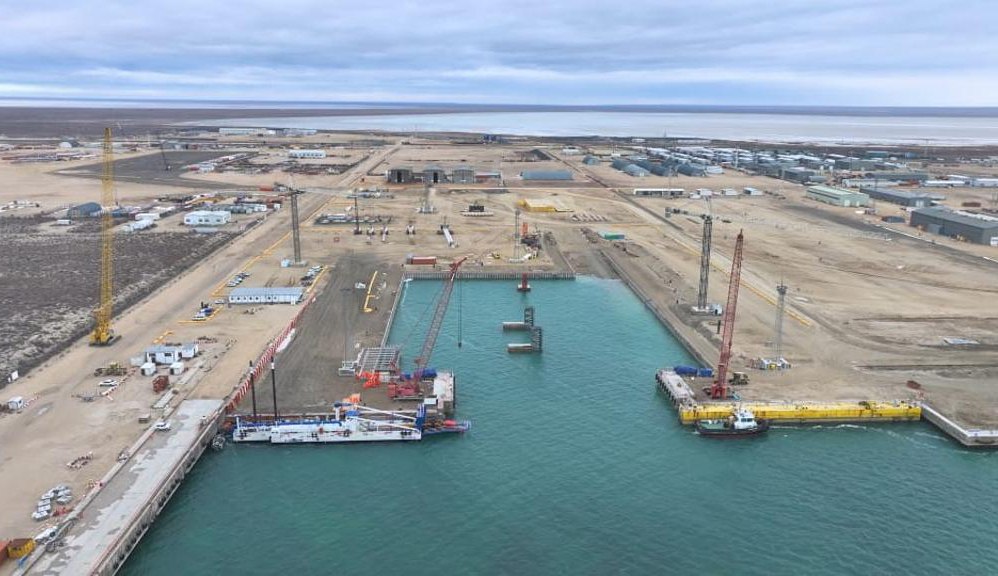
Kazakhstan has launched a strategic dredging project at the ERSAI industrial port, part of the Caspian Sea’s Kuryk Port, aimed at boosting its cargo-handling capacity and reinforcing its role as a key transit hub along the Trans-Caspian International Transport Route (TITR). Also known as the Middle Corridor, the TITR connects China to Europe via Central Asia and the South Caucasus. According to the Ministry of Transport, the project will deepen the port’s waters and approach channel to five meters, enabling year-round navigation. The initiative is fully financed by ERSAI, which is constructing its own Cutter Suction Dredger (CSD 650), named ERSAI 5, to carry out the dredging works between January and June 2026. Dredging is a core component of ERSAI’s broader expansion strategy, which also includes launching a new container terminal and expanding shipbuilding and repair operations. Located on the eastern coast of the Caspian Sea, south of the Aktau port, Kuryk’s ferry complex handles a variety of cargo, including grain, oil products, fertilizers, and chemicals. However, falling water levels in the Caspian have forced vessels to operate below full capacity to avoid grounding. As of early 2025, the Caspian Sea’s water level had declined by roughly two meters since 2006, posing growing challenges for Kazakhstan’s maritime logistics. In response, Kazakhstan has prioritized dredging efforts. In May 2025, the Ministry of Transport began deepening the Aktau port by 1.5 to 2 meters to expand its terminal capacity. Kuryk has already undergone a previous phase of deepening, completed in November 2024, which increased the port’s depth to 7-8 meters. The latest dredging project reflects Kazakhstan’s broader strategy to strengthen its maritime infrastructure and maintain the competitiveness of its ports amid shifting environmental and logistical conditions in the Caspian region.

EU Supports Connectivity Improvements in Kazakhstan, Kyrgyzstan, and Uzbekistan as Part of Trans-Caspian Transport Corridor

On November 27, Tashkent hosted the Trans-Caspian Transport Corridor (TCTC) and Connectivity Investors Forum, where representatives of the European Union, Central Asian and South Caucasus states, Türkiye, and international development banks reaffirmed the strategic importance of the TCTC as a fast and reliable route linking Europe and Asia. The TCTC is the EU’s designation for the Trans-Caspian International Transport Route (TITR), also known as the Middle Corridor. This multimodal route connects China and Southeast Asia to Europe via Central Asia, the Caspian Sea, Azerbaijan, Georgia, and Türkiye in no more than 15 days, offering an alternative to the northern route through Russia. Participants discussed efforts to modernize both hard infrastructure, roads, railways, ports, and logistics hubs and soft connectivity, including digitalization, regulatory alignment, and trade facilitation. According to the EU Delegation in Uzbekistan, the forum, attended by European Commissioner for International Partnerships Jozef Síkela and European Commissioner for Enlargement Marta Kos, produced several new agreements to enhance multimodal connectivity in Central Asia. The EU has committed EUR 10.4 million within an EBRD loan of EUR 35 million to modernize Aktau Port in Kazakhstan, a key logistics hub on the Caspian Sea. The project will expand berths, introduce energy-efficient cranes, and increase container-handling capacity, strengthening the Middle Corridor’s competitiveness. An envisaged EIB loan of EUR 150 million, backed by an EU guarantee of EUR 8.8 million, will support road rehabilitation in Kazakhstan. The financing for national operator KazAvtoZhol aims to improve sustainable transport infrastructure linked to the TCTC. The EU will contribute EUR 15.46 million within an EBRD loan of EUR 35 million for the modernization of the Karabalta-Chaldovar road in Kyrgyzstan. Upgrading the 31.7-kilometer section will enhance connectivity between Kyrgyzstan and Kazakhstan, reduce travel time and costs, and improve road safety. In Uzbekistan, an anticipated EIB loan of up to EUR 100 million, supported by an EU guarantee of EUR 6 million, will finance the Nukus Highway Development Project. The upgrade of 87 kilometers of the A380 highway, one of the country’s main transport arteries, is expected to strengthen regional trade and streamline transport flows with neighboring states. Speaking at the forum, Commissioner Marta Kos stressed the geopolitical and economic value of reliable east-west transport links: “All of us have learnt the hard way that excessive dependencies make us vulnerable," she said. "Investments in transport infrastructure, digital and energy connectivity create more options and less risk of blackmail. We need credible, long-term alternatives to the Northern Corridor. Cargo along the Middle Corridor has grown four-fold between 2022 and today. By 2030 it could again triple, if the right investments are made to increase capacity and close gaps.”

The Geopolitical Battle for Control Over Transportation Routes in Central Asia

Russia and Kazakhstan may be nominal allies, but their geoeconomic interests are not always aligned. As Astana seeks to develop the Middle Corridor – a transportation link connecting China and Europe through Kazakhstan, the Caspian Sea, Azerbaijan, and Georgia, bypassing Russia – Moscow reportedly aims to build a trade and logistics route that would connect Russia and Kyrgyzstan, thereby circumventing Kazakhstan.  While various regional actors and international institutions actively invest in the Middle Corridor, also known as the Trans-Caspian International Transportation Route (TITR), a potential route linking Russia and Kyrgyzstan, through Uzbekistan and Turkmenistan, remains merely an idea. From the geopolitical perspective, the TITR is seen as an alternative to reach European and international markets and bypass Russia. But what is the primary goal of the Russia-Kyrgyzstan route? Although both Kyrgyzstan and Kazakhstan are members of the Russian-led Eurasian Economic Union, queues of trucks at the Kyrgyz-Kazakh state border seem to have become a norm. Bishkek accuses Kazakhstan of “artificially creating obstacles at the border to weaken competition from Kyrgyzstan”, while the Kazakh authorities claim that Kyrgyz truckers are “unwilling to comply with Astana’s requirements and submit fraudulent documents for cargo.” Since Kyrgyzstan’s main connection with Russia – the major market for its agricultural products – goes through Kazakhstan, it is Astana that has the upper hand over Bishkek. From a purely economic perspective, a new route, including sea transport across the Caspian Sea, would enable faster delivery of vegetables, fruits, as well as other goods from Kyrgyzstan to Russia. However, it remains highly uncertain if Uzbekistan and Turkmenistan, as transit countries, are genuinely interested in this project. “Both nations are far more interested in East-West trade, actual supply chain relocations into the region, and new gas contracts with the West,” Samuel Doveri Vesterbye, Managing Director of the European Neighborhood Council, told The Times of Central Asia. In his view, a Kyrgyzstan-Russia corridor would offer a limited amount of trade, due to the sanctions the West imposed on Moscow over its actions in Ukraine. But in spite of that, Kyrgyzstan, like all countries, tries to be part of any connectivity corridor. “There is a lot of ‘corridor competition’ at the moment. Most of it is bluff. It is important to look at which projects are being built and how much investments is going into them. The Russia-Kyrgyzstan corridor, at present, is more hot air than reality. There is no funding from the United States, the European Union, China or Turkey. Also, major players like the European Bank for Reconstruction and Development (EBRD) and the European Investment Bank (EIB) do not seem interested in funding the construction of this route. Therefore, its lifespan and potential look rather limited,” Vesterbye stressed. European institutions seem interested in further development of the Trans-Caspian International Transportation Route. From the European Union’s perspective, Russia’s invasion of Ukraine has increased the need to find alternative, reliable, safe and efficient trade routes between Europe and Asia. That is why Brussels is reportedly willing to invest €10 billion ($10.5...

EU and Turkmenistan Launch Coordination Platform of Trans-Caspian Transport Corridor

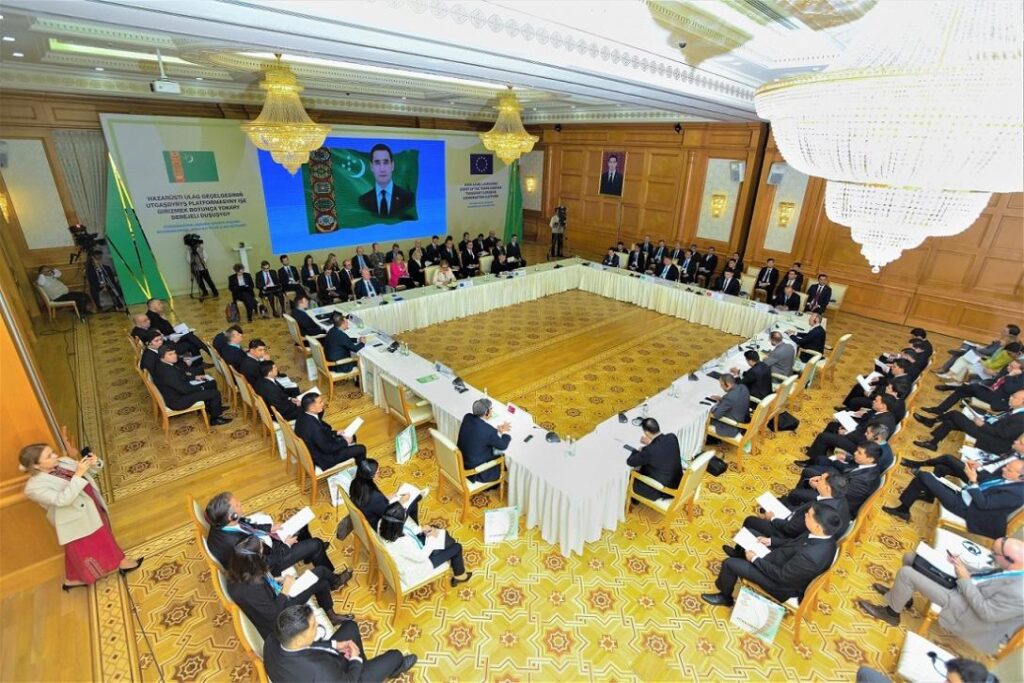
On October 3 in Ashgabat, the European Union and Turkmenistan launched the Trans-Caspian Transport Corridor Coordination Platform. The platform aims to strengthen connectivity by developing transport routes within Central Asia and the European Union. The event brought together the European Union, representatives of the countries along the Trans Caspian Transport Corridor in Central Asia, the South Caucasus, and Türkiye, and international financial institutions. The European Union delegation was led by European Commissioner for International Partnerships Jutta Urpilainen. As reported by the EU Delegation to Turkmenistan, the Trans-Caspian Transport Corridor is a flagship of the EU’s Global Gateway investment strategy, and the establishment of the Coordination Platform is one of the key deliverables of the Global Gateway Investors Forum for EU-Central Asia Transport Connectivity held in January 2024. European and international financial institutions at the Forum committed to mobilizing €10 billion for sustainable transport connectivity in Central Asia. The EU aims to work with partners towards a modern route that boosts trade and facilitates the flow of goods between Central Asia and Europe while driving economic development and regional integration. The platform's main role will be to promote the corridor and coordinate efforts to implement priority projects in hard and soft infrastructure in Central Asia. It will also coordinate with investments and activities in the South Caucasus and Turkey that are relevant to strengthening operational efficiency and seamless connections across the Trans-Caspian Transport Corridor. Urpilainen said: “Central Asia, as a region at the crossroads of Europe and Asia, plays a pivotal role in the EU Global Gateway investment strategy and connectivity vision. The Trans-Caspian Transport Corridor is a critical artery linking Europe and Asia, boosting trade, facilitating exchanges, and driving prosperity across our regions while ensuring improved connectivity, cooperation, and economic growth between all Corridor countries. Harnessing this potential will require massive infrastructure investments in the coming years; I am pleased to see governments from countries along the Corridor, key International Financing Institutions, EU Member States, G7 countries, and other partners coming together.” Urpilainen said that to the European Union, Turkmenistan is an important partner in Central Asia. She also emphasized the European Union's commitment to supporting Turkmenistan's transition to a sustainable, green economy while enhancing its business environment. The EU has further allocated €18 million to strengthen its partnership with Turkmenistan, highlighting its dedication to fostering sustainable development and economic growth.