

• KZT/USD = 0.00220
  • TJS/USD = 0.10820
  • UZS/USD = 0.00009
  • TMT/USD = 0.29760
  • KZT/USD = 0.00220
  • TJS/USD = 0.10820
  • UZS/USD = 0.00009
  • TMT/USD = 0.29760
  • KZT/USD = 0.00220
  • TJS/USD = 0.10820
  • UZS/USD = 0.00009
  • TMT/USD = 0.29760
  • KZT/USD = 0.00220
  • TJS/USD = 0.10820
  • UZS/USD = 0.00009
  • TMT/USD = 0.29760
  • KZT/USD = 0.00220
  • TJS/USD = 0.10820
  • UZS/USD = 0.00009
  • TMT/USD = 0.29760
  • KZT/USD = 0.00220
  • TJS/USD = 0.10820
  • UZS/USD = 0.00009
  • TMT/USD = 0.29760
  • KZT/USD = 0.00220
  • TJS/USD = 0.10820
  • UZS/USD = 0.00009
  • TMT/USD = 0.29760
  • KZT/USD = 0.00220
  • TJS/USD = 0.10820
  • UZS/USD = 0.00009
  • TMT/USD = 0.29760
08 September 2026

Viewing results 1 - 6 of 128

Speed vs. Stability: How Kazakhstan Is Leading Eurasia’s Transit Race

China’s successful test of a maglev platform weighing about one ton, accelerating to 700 kilometers per hour in just two seconds, once again underscored Beijing’s technological ambitions in the transport sector. With more than 50,000 kilometers of high-speed rail connecting cities such as Beijing, Shanghai, Guangzhou, Shenzhen, and Chengdu, China is paving the way for the next generation of mobility. Yet beyond China's borders, speed alone is no longer the decisive factor. In Eurasia and particularly in Central Asia, stability, predictability, and reliability have become the primary metrics for transit success. Within this context, Kazakhstan is positioning itself as a central hub in Eurasia’s evolving logistics landscape. China’s High-Speed Model vs. Eurasia’s Freight Realities Inside China, Fuxing high-speed trains and maglev routes have transformed domestic connectivity, forming the backbone of national economic integration. However, exporting this model faces inherent limitations. High-speed passenger lines require dedicated tracks, strict safety protocols, and massive investment factors incompatible with most of Eurasia’s existing freight-centric rail infrastructure. As a result, the China-Central Asia-Europe corridor is focused on accelerated freight movement. The goal is not maximum speed, but consistent delivery times, reliable scheduling, and minimal disruption, elements vital to modern supply chains. Kazakhstan’s Strategic Role in Eurasian Land Transit Kazakhstan serves as a critical artery for China's westward land transit. Key corridors to the Eurasian Economic Union, Europe, and Central Asia, including the Middle Corridor, traverse Kazakh territory. In the first ten months of 2025, Kazakhstan's State Revenue Committee reported that more than 11 million tons of goods were transited from China through Kazakhstan, marking double-digit growth year-on-year. This success stems not only from increased volume but from qualitative improvements in transit management. Digitalization has been pivotal. An automated system for filing and issuing transit declarations has slashed processing times from several hours to just 30 minutes per container train, facilitating the clearance of millions of tons of cargo. For businesses, this translates into lower costs and more reliable delivery schedules -- an essential factor amid ongoing global economic uncertainty. These institutional upgrades are reinforced by infrastructure investment. According to Kazakhstan’s Ministry of Transport, cargo transportation volumes have reached record levels, with steady growth in transit flows. Projects like the Dostyk-Moyinty line and the Almaty bypass are specifically designed to expand transit capacity. Why High-Speed Passenger Rail Isn’t on the Agenda Given China’s high-speed rail successes, some may question why similar routes are not planned between China and Kazakhstan. However, in the near term, such initiatives remain economically and logistically unfeasible. Existing rail lines in the region prioritize freight and mixed-use traffic, falling short of the standards required for high-speed passenger transport. Building separate lines would demand significant capital and a stable passenger base, conditions that currently do not exist. Freight transit, aligned with the Belt and Road Initiative, remains the primary focus. Unlocking the Caspian Bottleneck Despite the growth in rail transit, the Caspian Sea route remains a capacity bottleneck. Plans to build a new seaport in the Karakiyansky district of Mangistau region, through a...

Kazakhstan to Build New International Cargo Airport Near China Border

Kazakhstan plans to construct a new international cargo and passenger airport in the Zhetysu region, near the Chinese border, as part of efforts to develop a major multimodal aviation and logistics hub along key transit routes linking China, Central Asia, and Europe. The facility will be located within the Khorgos–Eastern Gate Special Economic Zone (SEZ), a strategic logistics cluster on the New Silk Road. According to Dias Esdauletov, Deputy Akim of the region, the project is one of the most significant and promising investment initiatives currently underway and aims to establish Kazakhstan as a central player in Eurasian trade. The project is being developed by the Kazakh-German joint venture Skyhansa LLP and is coordinated by the Ministry of Transport of the Republic of Kazakhstan. The airport is designed to complement the existing railway and road infrastructure in the SEZ, enabling faster movement of high-value and time-sensitive cargo, and bolstering regional passenger transport and tourism. Once completed, it will integrate rail, road, and air links in a single multimodal logistics system. Construction will be carried out in three stages. The first stage, set for completion by mid-2027, will include the development of core airfield infrastructure, a cargo terminal, a fuel complex, an aviation technical center, and a business center with hotel facilities. It will also integrate the airport with the SEZ’s existing rail and road networks. The second stage will expand the cargo and passenger infrastructure, build additional logistics and storage areas, increase refueling capacity, and attract airline and logistics partners. In the third stage, the airport is expected to evolve into a full-fledged international aviation hub with an expanded route network, full-service and MRO (maintenance, repair, and overhaul) operations, and deep integration with the SEZ’s industrial and commercial zones. Esdauletov highlighted the importance of the Air-Rail-Auto-Air transport model for improving logistics efficiency, particularly for sectors such as e-commerce, pharmaceuticals, and electronics. Seamless transitions between transport modes can dramatically reduce door-to-door delivery times and costs. Kazakhstan has already demonstrated the viability of such multimodal solutions. In 2014, KTZ Express piloted a successful international cargo transit from China to Europe via a rail-air corridor. HP products were shipped from Chongqing to Almaty by rail and then flown to Amsterdam, completing the 9,900 km journey in just seven days. The new airport is expected to ease congestion in the Almaty transport hub and significantly improve cargo throughput capacity in southeastern Kazakhstan. In the medium and long term, authorities anticipate strong growth in both cargo and passenger volumes, driven by increasing transit flows between China, Central Asia, Europe, and the United States, as well as ongoing shifts in global logistics routes. To mitigate risks, the regional government has launched comprehensive preparatory work. Skyhansa has already secured 800 hectares of land within the Khorgos-Eastern Gate SEZ. The project is expected to create approximately 700 jobs.

Opinion: Prospects for Central Asia’s Access to Persian Gulf Infrastructure

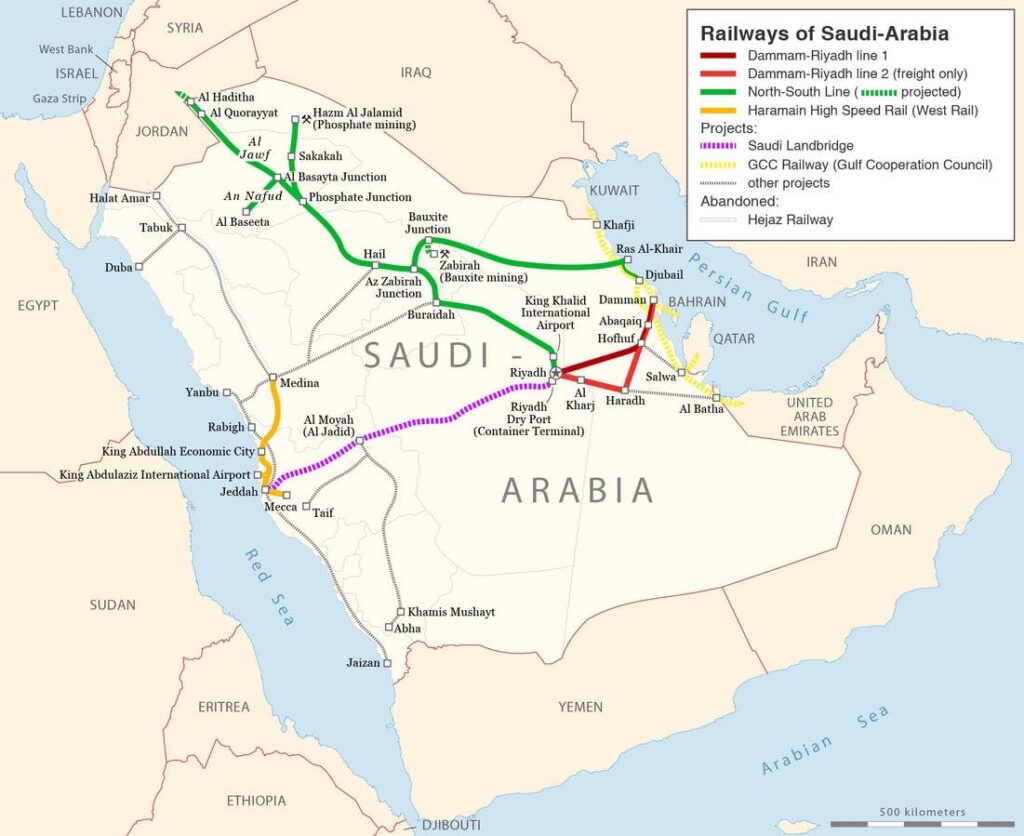
The agreement signed on December 8, 2025, between Saudi Arabia and Qatar to construct a high-speed railway linking Riyadh and Doha marks a pivotal development in transport connectivity across the Persian Gulf. Beyond its bilateral implications, the project could have broader consequences for transregional logistics, particularly for Central Asia and Kazakhstan. The 785-km railway will pass through key cities in Saudi Arabia’s Eastern Province, including Dammam and Al-Hufuf, and will connect King Salman and Hamad International Airports. Trains are expected to reach speeds exceeding 300 km/h, reducing travel time between the two capitals to approximately two hours. The six-year project is projected by officials to boost the combined GDP of both countries by around $30 billion and create up to 30,000 jobs. The Gulf Railway and New Regional Connectivity The Riyadh-Doha line is a central element of the Gulf Railway initiative, which is seeking to establish a unified railway network among Gulf Cooperation Council (GCC) member states, Saudi Arabia, Qatar, the UAE, Bahrain, Kuwait, and Oman, with a target date of around 2030. Originally envisioned primarily as a freight system, the Gulf Railway is increasingly incorporating high-speed passenger services alongside freight, reflecting the region’s push for greater internal integration and reduced dependence on air travel. The Riyadh-Doha segment forms a vital axis between the Gulf’s political and financial hubs and is expected to link with Saudi, Emirati, and Omani infrastructure, laying the groundwork for a more integrated regional transport system. Beyond the Peninsula While the Gulf Railway’s scope is geographically confined to the Arabian Peninsula, meaningful integration with Eurasia would require additional connectivity, particularly via land and multimodal routes through Iran, Turkey, and the Caspian region. Among these, the overland corridor through Iran is especially significant, though constrained by sanctions, financing risks, and political uncertainty. Kazakhstan-Turkmenistan-Iran Corridor Unlike many conceptual infrastructure proposals, the Kazakhstan-Turkmenistan-Iran railway, operational since 2014, is already a functioning freight corridor. It provides Central Asian nations with direct access to Persian Gulf ports and Middle Eastern markets. For Kazakhstan, the route offers strategic diversification away from traditional corridors. While no formal plans exist to link GCC rail infrastructure directly with Central Asia, the emergence of high-capacity Gulf rail corridors reshapes the long-term connectivity landscape. A future interface could allow Astana overland access to Gulf markets, while enabling reciprocal flows from the Gulf into Central Asia, China, and Europe. President Kassym-Jomart Tokayev has previously described Iran as a “gateway” to Southeast Asia and Africa. Kazakhstan has also outlined plans to establish its own logistics terminal in the Iranian port of Shahid Rajai in Bandar Abbas, further enhancing its position in Gulf-Eurasia trade flows. Iran’s Evolving Role Historically, Iran’s role as a transit state has been hampered by international sanctions and regional tensions. However, the 2023 normalization of relations between Saudi Arabia and Iran, brokered by China, has altered the regional calculus. Although still fragile, this diplomatic thaw improves prospects for long-term infrastructure projects involving Iran as a critical transit link between the Persian Gulf and Eurasia. Alternatives and Their...

Kyrgyzstan Signals Possible End to EU Aviation Ban

Kyrgyzstan says it is close to ending a near two-decade ban that has kept its airlines off European routes, after President Sadyr Japarov said the country has reached a “critical point” in efforts to leave the European Union’s air safety blacklist. The comments come as Kyrgyz officials push for international recognition of reforms in aviation oversight and airport infrastructure. Japarov said Kyrgyzstan has been developing civil aviation “on its own initiative,” investing “billions of soms,” buying aircraft for domestic and international routes, and building new airports. He described the effort as a state priority and added: “Kyrgyzstan has reached a critical point in its exit from the European Union’s ‘blacklist’… with God’s help, the skies of Europe will open to Kyrgyzstan.” The EU Air Safety List is the bloc’s mechanism for restricting airlines that, in the EU’s assessment, do not meet international safety standards. Airlines on the list are banned from operating “to, in and from the EU,” and the EU can also apply restrictions to all carriers certified in a country if national oversight is deemed inadequate, according to the European Commission’s official Q&A on the EU Air Safety List. Updates are prepared with support from the EU Air Safety Committee and the European Union Aviation Safety Agency (EASA), and are based on standards set through the International Civil Aviation Organization (ICAO), the Commission says. Kyrgyz airlines have been on the EU list since 2006. The EU’s most recent comprehensive update, published on December 8, 2025, still includes Kyrgyzstan among the countries whose airlines are banned because of “a lack of safety oversight by the aviation authorities,” according to the Commission’s December 2025 materials and the linked EU Air Safety List documentation. Kyrgyz airlines would be allowed to apply for operations linked to the European Union if the country is removed from the EU Air Safety List. Any carrier seeking to fly to, from, or within the EU needs to meet European safety requirements, including obtaining Third Country Operator authorization from the European Union Aviation Safety Agency, according to the European Commission’s air safety rules. Kyrgyzstan’s public messaging has framed the potential removal as an economic lever, with Japarov stating it would support tourism, attract investment, and improve the country’s international image. It could also lead to more direct scheduled flights between Kyrgyzstan and EU destinations, rather than relying on connections via third countries. The EU has not announced a decision to remove Kyrgyzstan, and any change would require a formal update to the list after technical review. Past EU updates show that changes can cut both ways. In June 2025, for example, the Commission added all carriers certified in Suriname and Tanzania after identifying serious shortcomings in national oversight, in an official announcement on its Mobility and Transport site. For now, Japarov’s statement signals confidence that Kyrgyzstan believes it has supplied the documentation and reforms the EU expects. Whether that will translate into removal will depend on the EU’s technical findings and the next formal update cycle of...

Why Regional Connectivity Is Reshaping Central Asia: Insights from ISRS Director Eldor Aripov (Part Two)

The Times of Central Asia presents the second part of an interview in Washington, D.C. with Eldor Aripov, Director of the Institute for Strategic and Regional Studies under the President of Uzbekistan. Dr. Aripov sat down with our Washington Correspondent, Javier M. Piedra, to discuss Uzbekistan’s geoeconomic and geopolitical strategic thinking. The conversation focused on Uzbekistan’s and the region’s efforts to cooperate diplomatically to maintain peace and stability with neighbors, irrespective of historical “hotspots,” cultural sensitivities, or the all-important matter of water resources. Aripov comments on Afghanistan, Chabahar Port (Iran), Ferghana Valley, and business development – key for U.S. investors thinking about Uzbekistan and the broader Central Asian region. TCA: What message do you have for businesses and private investors who do not have any experience in Central Asia? Many companies are sniffing around at this time – what do you want to tell them? Aripov: Uzbekistan is ready for committed investors - those who deliver lasting benefits, quality jobs, and shared prosperity. A decade of reforms has strengthened our fiscal discipline, boosted SMEs, and anchored stability. Coupled with our focus on good relations and a secure, integrated Central Asia, we offer a reliable platform for long-term, sustainable investment. While we have more work to do, we invite you to be part of our momentum. TCA: What are the risks that companies might face when considering long-term investment? Aripov: No country is immune to downside risks – not only in the developed but developing world. Having said that, downside risks, including trade shocks, commodity price volatility, tighter external financing, and contingent liabilities from state-owned enterprises, are mostly exogenous factors driven by global conditions. Risks are mitigated through political stability, diversification of the economy, prudent macroeconomic management, and reforms to state-owned enterprises and governance. For more in-depth commentary, I refer you to recent IMF, World Bank, and Asian Development Bank assessments about our economic conditions and trends. TCA: Let me move on to more regional issues. The first Ferghana Peace Forum was held in October 2025. How can it serve as a replicable model for other regions seeking sustainable peace? Aripov: First of all, I’d like to put this important forum on everyone’s radar. I’d like to underscore that peace is possible when hard work, respect for others, and a commitment to understanding guide our actions, despite historical memories and past differences. Someone should write a case study about our ability to bring consensus into an otherwise challenging region. In any event, the inaugural Ferghana Peace Forum brought together over 300 participants from more than 20 countries — representatives of Central Asian governments, international organizations, leading think tanks, research institutions, and local communities. A joint communiqué was adopted, confirming the intention to institutionalize the Forum as a permanent platform with rotating hosts. This broad participation highlighted an important reality: the Ferghana Valley is no longer viewed as a fragile zone; it is now viewed as a model of pragmatic peacebuilding. The Forum demonstrated how regional leadership — particularly the openness and...

The New Geoeconomics of Uzbekistan: Insights from ISRS Director Eldor Aripov

The Times of Central Asia presents a two-part interview in Washington, D.C. with Eldor Aripov, Director of the Institute for Strategic and Regional Studies under the President of Uzbekistan. Dr. Aripov sat down with our Washington Correspondent, Javier M. Piedra, to discuss Uzbekistan’s strategic thinking regarding its diplomatic posture, regional integration, and relations with Central Asian and global partners. The conversation includes commentary on “Great Game” geopolitics, U.S.–Uzbekistan relations, trade, the meaning of “Uzbekistan First,” the historically explosive Ferghana Valley, and water management. Recognizing the link between investment, a stable geopolitical ecosystem, and the need to de-risk potentially conflictive issues, Aripov further sheds light on Tashkent’s practical approach to internal governance and business development. [caption id="attachment_40284" align="aligncenter" width="2360"] Central Asia on the Front Lines; image: Defense.info[/caption] TCA: “America First” refers to U.S. policies prioritizing national interests, often associated with non-interventionism, nationalism, and protectionist trade. Given Uzbekistan’s pragmatic foreign policy, can we speak of an “Uzbekistan First” policy? It is certainly not isolationist — but how is it manifested on a day-to-day basis? Aripov: What you describe as “Uzbekistan First” is, in our understanding, fundamentally about prioritizing national interests – stability and predictability for the people of Uzbekistan. Yet Uzbekistan’s uniqueness lies in the fact that our national interests are closely intertwined with those of the entire region – this means shared upsides at the transactional and strategic levels and thinking long-term. We border every Central Asian country as well as Afghanistan, and therefore any issue — security, trade, transport, or water management — directly depends on the quality of our relationships with neighbors. From his first days in office, President Shavkat Mirziyoyev — with his strategic vision and deep understanding of regional dynamics — declared that regional unity and mutual benefit stand at the core of Uzbekistan’s foreign policy. The essence of his doctrine is to resolve agreeably any historically or materially problematic issues with neighbors, remove barriers to understanding, and create predictable, stable conditions for mutually beneficial cooperation and the free movement of goods, ideas, and people. That is the true meaning of “Uzbekistan First”: not isolation, but openness, predictability, and regional consolidation. TCA: How are you realizing “Uzbekistan First” in practice? Aripov: Uzbekistan is strengthening its economy domestically and global track - putting in place the building blocks for internal sustainable development and accelerating accession to the World Trade Organization. The latter means expanding the geography and composition of exports and increasing the country’s investment attractiveness. This approach is rooted in the logic of sustainable development within the broader international context: long-term national interests are best served by Uzbekistan integrating into global value chains and markets. The results speak for themselves: in 2024, Uzbekistan’s GDP grew by 6.5%, foreign direct investment increased by more than 50% to reach $11.9 billion, and the target for 2025 is to attract $42 billion. This performance is also a tribute to our style of diplomacy, grounded in respect and having a constructive attitude towards others. Thus, “Uzbekistan First” represents a modern model...