• KGS/USD = 0.01144 0%
  • KZT/USD = 0.00203 0%
  • TJS/USD = 0.10563 -0.09%
  • UZS/USD = 0.00008 0%
  • TMT/USD = 0.28490 0%
  • KGS/USD = 0.01144 0%
  • KZT/USD = 0.00203 0%
  • TJS/USD = 0.10563 -0.09%
  • UZS/USD = 0.00008 0%
  • TMT/USD = 0.28490 0%
  • KGS/USD = 0.01144 0%
  • KZT/USD = 0.00203 0%
  • TJS/USD = 0.10563 -0.09%
  • UZS/USD = 0.00008 0%
  • TMT/USD = 0.28490 0%
  • KGS/USD = 0.01144 0%
  • KZT/USD = 0.00203 0%
  • TJS/USD = 0.10563 -0.09%
  • UZS/USD = 0.00008 0%
  • TMT/USD = 0.28490 0%
  • KGS/USD = 0.01144 0%
  • KZT/USD = 0.00203 0%
  • TJS/USD = 0.10563 -0.09%
  • UZS/USD = 0.00008 0%
  • TMT/USD = 0.28490 0%
  • KGS/USD = 0.01144 0%
  • KZT/USD = 0.00203 0%
  • TJS/USD = 0.10563 -0.09%
  • UZS/USD = 0.00008 0%
  • TMT/USD = 0.28490 0%
  • KGS/USD = 0.01144 0%
  • KZT/USD = 0.00203 0%
  • TJS/USD = 0.10563 -0.09%
  • UZS/USD = 0.00008 0%
  • TMT/USD = 0.28490 0%
  • KGS/USD = 0.01144 0%
  • KZT/USD = 0.00203 0%
  • TJS/USD = 0.10563 -0.09%
  • UZS/USD = 0.00008 0%
  • TMT/USD = 0.28490 0%
20 February 2026

Viewing results 1 - 6 of 12

European Investment Bank to Allocate €100 Million for Tajikistan’s Transport Infrastructure Upgrade

The European Investment Bank (EIB) plans to allocate €100 million to finance transport infrastructure projects in Tajikistan, according to an announcement by the country’s Ministry of Transport. The funding will support upgrades to existing infrastructure and improve the accessibility of transport services across the country. The investment is aimed at accelerating economic development, reinforcing the national transport network, and enhancing Tajikistan’s integration into regional logistics corridors. The funding is outlined in a Memorandum of Understanding signed between Tajikistan and the EIB, which serves as a framework for long-term cooperation. The memorandum was initially presented at the Global Gateway Investor Forum on Sustainable Transport Links between Europe and Central Asia, held in Brussels in January 2024, and was formally signed on April 4, 2025. Implementation efforts advanced during a working meeting on January 19 between Tajikistan’s Minister of Transport and Communications, Azim Ibrahim, and an EIB delegation led by Edvardas Bumsteinas, the bank’s Director for Asia and the Pacific Region. The two sides discussed project parameters, financing mechanisms, fund monitoring, and a preliminary list of initiatives eligible for support. The EIB reaffirmed its interest in “close cooperation” with Tajikistan and stressed that it will prioritize projects with regional significance that foster economic growth and transport integration. Officials on both sides believe that implementing the memorandum’s provisions will lay a foundation for the comprehensive development of Tajikistan’s transport sector and bolster its role as a key transit hub in Central Asia. This initiative complements a parallel effort by the European Bank for Reconstruction and Development (EBRD), which recently approved €10 million for the modernization of electric public transport in the city of Bokhtar. The EIB is the European Union’s official investment bank, wholly owned by EU member states. It operates in alignment with EU policy priorities and often partners with other European institutions to promote sustainable development globally.
Trans-Afghan Corridor Becomes Central Asia’s New Trade Gateway Amid Competition

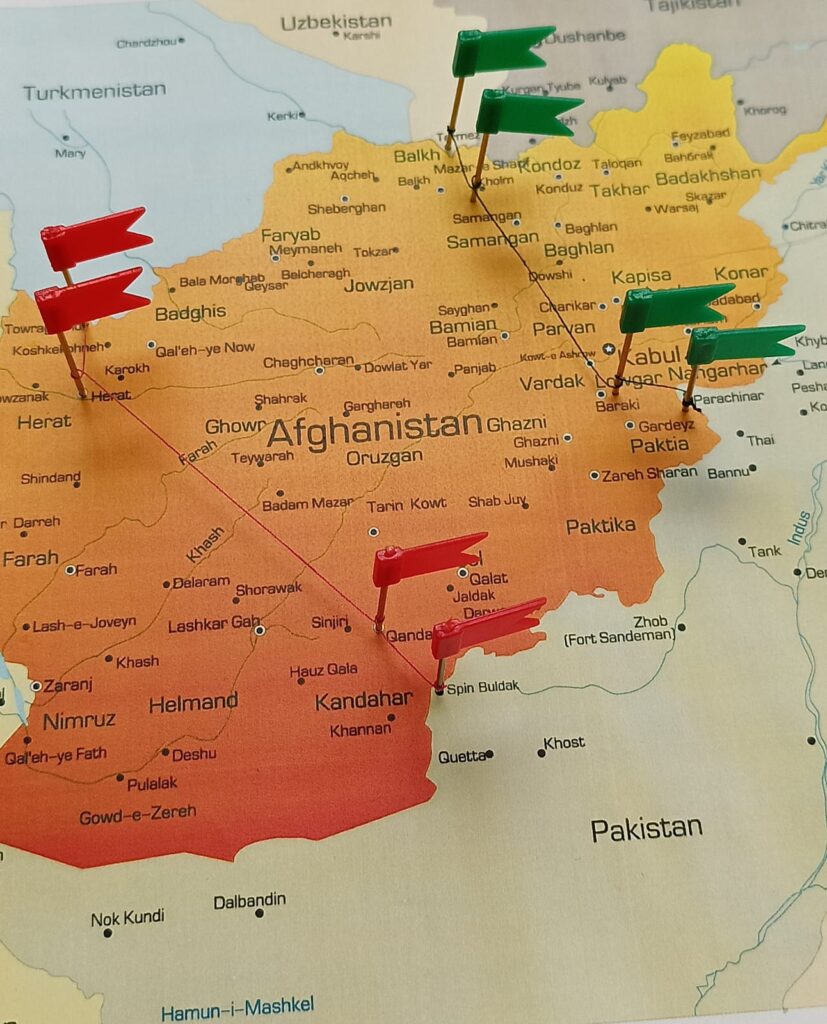
Kazakhstan plans to join in the Trans-Afghan Corridor project by constructing a 120-kilometer railway from Turgundi to Herat and establishing a transport and logistics center on Afghan territory. The new route is expected to expand the volume and improve the efficiency of Kazakhstan’s export and import shipments, while also providing access to the Indian Ocean, the Middle East, and the Persian Gulf. In August, Kazakhstan’s Deputy Prime Minister and Minister of National Economy, Serik Zhumangarin, announced that the country plans to invest $500 million in the construction of the Turgundi-Herat railway in Afghanistan. The 120-kilometer line will provide the shortest route to the Indian Ocean, linking Kazakhstan and Central Asia with Pakistan’s seaports of Karachi and Gwadar. Kazakhstan’s Deputy Minister of Transport, Zhanibek Taizhanov, told The Times of Central Asia that the project is expected to take about three years from the approval of the design and cost documentation. “More precise timelines will be determined after the completion of all design stages, approvals, and the signing of contracts with contractors and investors,” said the ministry representative. The railway will give Kazakhstan access to new transport routes and markets. Amid intensifying global competition for transit flows, it offers a cheaper alternative shipping option and represents an important new logistics solution for the republic. This promising route, however, also carries risks, as Afghanistan remains one of the world’s most unstable countries. Even so, trade potential between Kazakhstan and Afghanistan is considerable. In 2024, bilateral trade turnover reached $545.2 million, with $527.7 million accounted for by Kazakh exports. Kazakhstan remains one of Afghanistan’s largest trading partners and a leading supplier of grain and flour. Looking ahead to exports and imports moving toward Pakistan, India, and beyond, the potential is considerable. Yet market participants have repeatedly noted that logistics remains the main barrier to trade in this direction. “Projected freight volumes along the route are estimated at 35–40 million tons per year. A comprehensive study of the region’s economic potential, logistics flows, and expansion prospects is underway,” Taizhanov told TCA, adding that once operational, the line is expected to become a crucial link in the international transport system, boosting trade between Central Asia and South Asia. In Afghanistan, the Taliban resumed nearly all regional and interregional transport projects initiated under the previous government. Active negotiations are underway on the construction of the Termez–Naibabad–Maidan Shahr–Logar–Kharlachi line, commonly referred to as the “Kabul Corridor,” the Mazar-i-Sharif–Herat railway, and the completion of the Khaf–Herat line, among others. Regional countries have also joined this large-scale effort. The Trans-Afghan project involves the interests of Russia, China, Uzbekistan, Turkmenistan, and Iran, all of which are seeking to benefit from its implementation. Geopolitics and transport interests In pursuit of greater export, import, and transit opportunities, Kazakhstan, Russia, Uzbekistan, and Turkmenistan are actively participating in these initiatives, offering their own rail routes through Afghanistan to Pakistan’s borders. For Iran and Tajikistan, the transnational corridor through Afghanistan is also attractive, providing a potential route to China via Kyrgyzstan. Turkmenistan and Kazakhstan plan to...

EDB Estimates Central Asia-China Transport Connectivity Projects at $9 Billion

China has emerged as the principal investor in regional transport infrastructure, with analysts from the Eurasian Development Bank (EDB) estimating that cross-border projects linking Central Asia and China will require $9 billion in funding through 2035. According to the EDB, 12 projects valued at more than $9 billion are either underway or in the planning stages. These account for 17% of the $52.8 billion allocated to 90 transport corridor projects across Central Asia. The initiatives are expected to significantly boost trade and cargo flows with China, already the region’s largest trading partner. China-Kyrgyzstan-Uzbekistan Railway The most ambitious among them is the long-anticipated China-Kyrgyzstan-Uzbekistan (CKU) railway, a $4.7 billion project that will establish the first direct rail link between China and these two Central Asian states. Half of the funding will come from a Chinese concessional loan, while the remainder will be provided by a joint venture created to build and operate the railway. China will hold a 51% stake in the venture, while Kyrgyzstan’s contribution is valued at $575.75 million. On August 31 in Tianjin, Kyrgyz President Sadyr Japarov met with Chinese President Xi Jinping. Following the meeting, officials signed a letter of intent regarding China’s preferential loan to finance Kyrgyzstan’s share, according to the Kyrgyz presidency. The 523-kilometer railway officially broke ground on December 27, 2024, in Jalal-Abad, Kyrgyzstan. Once completed, the CKU will link Kashgar (China) with Torugart, Makmal, and Jalal-Abad (Kyrgyzstan), and Andijan (Uzbekistan). The line is projected to carry up to 15 million tons of cargo annually, significantly reshaping regional trade flows. Currently, Kazakhstan is the only Central Asian country with a direct railway connection to China. Kazakhstan’s Leading Role Kazakhstan leads Central Asia in cross-border infrastructure investment with China, accounting for $3.4 billion or 37% of the total. Key projects include: The modernization of the Dostyk-Moiynty railway section (836 km), scheduled for completion in 2025, which will increase freight capacity fivefold. Construction of the Ayagoz-Bakhty railway line and the launch of a third border crossing with China, aimed at further diversifying transit corridors. Regional Impact The scale and scope of these initiatives underscore the strategic importance of transport connectivity in China-Central Asia relations, particularly under the Belt and Road Initiative. By 2035, upgraded infrastructure is expected not only to enhance regional logistics and reduce transport bottlenecks but also to strengthen Central Asia’s position as a vital transit corridor between China and Europe, fostering deeper economic integration across the Eurasian continent.

Central Asia’s Transport Logistics Shift Eastward

At a recent roundtable in Bishkek on economic ties with China, former Kyrgyz Prime Minister and former presidential economic advisor Akylbek Japarov called on Central Asian states to improve coordination on regional transport infrastructure. He noted that Kyrgyz transport companies increasingly view transit through the Chinese city of Kashgar as the most efficient route. Japarov argued that China, given its global stature, should engage with Central Asia as a unified and coordinated region rather than as a collection of separate states. “We are facing both an opportunity and a challenge,” he said. “We must think not in terms of competition between countries, but as a single interconnected system. Only in this way will we achieve sustainable growth and maintain our independence in the new world order.” Eastern Shift: Freight Volumes Rise Through China According to the Kyrgyz Association of International Carriers, a growing volume of freight is now transported through China, and this trend is expected to accelerate following the completion of the China-Kyrgyzstan-Uzbekistan railway. Deputy Chairman of the Association, Igor Golubev, told The Times of Central Asia that private carriers are independently negotiating routes with transit countries across both eastern and western corridors. “We are actively cooperating with neighboring countries, developing new routes, and finalizing logistics. There are some challenges, like visa issues and fuel surcharges, but they are all solvable,” Golubev said. Previously, some carriers established routes through Turkmenbashi to transport goods across the Caspian and Black Seas to Europe. However, a shortage of ferries in Turkmenistan has created a serious bottleneck. In response, the Turkmen government is reportedly exploring the purchase of additional vessels. Western Routes: Costly and Complex Logistics along western routes remain difficult. Sanctions and transit restrictions through Russia, the shortest and most economical path to Europe, have forced freight operators to reroute via the so-called Middle Corridor. This involves ferrying goods across the Black Sea to Georgia, transporting them to Azerbaijan, then shipping them across the Caspian Sea to Aktau (Kazakhstan) or Turkmenbashi (Turkmenistan), and continuing overland to Uzbekistan and Kyrgyzstan. “This route is very expensive. Waiting for ferries adds to the costs,” Golubev explained. “We rarely use the Black Sea route. European cargo is primarily transported via Turkey, Iran, and the Caspian Sea. These logistics remain expensive and time-consuming.” Exploring Southern Routes: Pakistan and the Push Toward Karachi As Chinese industrial output continues to expand, the country’s existing logistics infrastructure is increasingly strained. Beijing is investing in new railways, expanding route networks, and seeking to streamline carrier operations. Amid high costs and administrative hurdles in western corridors, Kyrgyz carriers are turning to the east and south. Last year, Pakistani transport companies and wholesalers participated in the Kyrgyzstan Logistics Forum. Talks are now underway to secure access to Pakistan’s port of Karachi. “We had planned a joint motor rally with Pakistan, but tensions at the India-Pakistan border forced us to postpone,” Golubev said. A new route is being considered that would pass through China and Iran, bypassing Afghanistan. “Pakistanis are already using Afghan transit...

Trade Along Irtysh River Creates New Opportunities and Regional Challenges for Kazakhstan

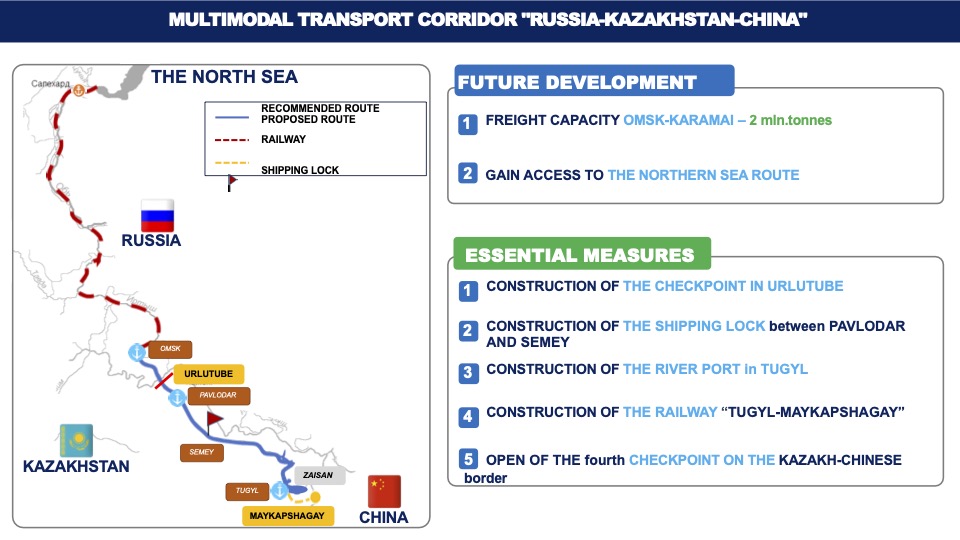
The Irtysh is the longest transboundary tributary river in the world. It flows through the territories of Kazakhstan, Russia, and China, which gives it important strategic significance as a connecting link in maintaining its ecological balance, as well as in its potential use for international transit logistics. Together with the Ob River, the Irtysh connects the transport corridor of the New Silk Road with the Northern Sea Route, thereby integrating Eurasian transport corridors into the global transport system. Reserves of River Logistics According to Kazakhstan's Ministry of Transport, the waterway along the river could be integrated into a large-scale multimodal logistics project. Currently, navigation on the Irtysh River within Kazakhstan runs for just over 1,600km — from Lake Zaysan to the border point of Klin with Russia. The navigation season lasts an average of 192 days, from April to November. During this period, river transport carried out a significant volume of shipments, ensuring connectivity between the regions of Eastern Kazakhstan, Pavlodar, and the border areas of Russia. The riverbank infrastructure includes the Pavlodar River Port, which has a handling capacity of up to 650,000 tons per year and a network of 10 permanent berths – Tugyl, Oktyabrsky, Ust-Kamenogorsk, "Irtyshtrans," "Gravelit," and others – that can handle up to 10,000 tons of cargo daily. The river fleet used for cargo transportation consists of about 95 vessels, including barges, tugs, and auxiliary units. Ship repair functions are performed by three specialized enterprises in Ust-Kamenogorsk, Semey, and Pavlodar. However, most of the technical base requires major renovation: equipment and structures are heavily worn, and the fleet of vessels is mostly outdated. The Irtysh basin remains a key cargo-generating region, accounting for more than 90% of the country's river freight. In 2024, the total volume of river transport amounted to 1.5 million tons, including 296,000 tons of export cargo to Russia. To systematically modernize river transport, in January 2025, a roadmap for the comprehensive development of shipping on the Irtysh River was approved. According to Deputy Transport Minister Maksat Kaliakparov, the main measures include the construction of a new river port in Tugyl, the modernization of existing berths, the purchase of modern transport vessels, the opening of the Urlitobe river crossing point on the border with Russia, and the creation of logistics and multimodal hubs. Plans also include the construction of hydraulic engineering structures, riverbed clearing, and dredging works, which will increase the waterway's throughput capacity and create conditions for year-round navigation. All this will undoubtedly require significant infrastructure investments, the amount of which, according to the Ministry of Transport, will be specified based on the results of the design and estimate documentation and negotiations with private and foreign investors. The implementation of these measures opens up opportunities for an even larger project – a multimodal transit corridor between Russia, Kazakhstan, and China, which will involve the movement of ships on the Omsk-Tugyl section with further delivery of cargo by road or rail to China. One of the key elements of the project being...

Modernization of Kazakh Railway Infrastructure is a Priority

According to the National Infrastructure Plan of the Republic of Kazakhstan until 2029, the overall level of wear and tear of the railroad network is about 50%. In addition, the qualitative characteristics of the track do not meet current business demands and are inferior to other countries in terms of its development. In order to improve the quality and guarantee reliable and safe transportation of passengers and cargo by rail, KTZ plans to repair about 11,000 km of railway sections by 2029. According to JSC NC Kazakhstan Temir Zholy, which operates the country's railway mainline network, 1,430 km of track was repaired as part of last year's summer track works, including 570 km of major railway track overhauls. As Sakеn Rakhmetov, Brach Director of KTZ’s Mainline Network Directorate, told The Times of Central Asia, train speed improvements were achieved on 413 km of track for passenger trains with Talgo cars, 605 km for passenger trains, and 406 km and 507 km for freight and container trains, respectively. In the upcoming season, which will begin in March, 1,480 km of track across the country are planned for repair, including 512 km of major overhauls. "Repair work will be carried out on key railway sections with heavy train traffic. The first projects are planned on the Beineu-Mangystau, Zhambyl-Tyulkubas, Shu-Almaty, and Makat-Aksarayskaya sections," Rakhmetov explained. KTZ has developed a corresponding Program for the Development of Railway Infrastructure Capacity. Several modernization and reconstruction projects are planned, including upgrades to signaling, centralization, and blocking systems. "A limiting factor in the railway infrastructure's throughput capacity is the processing ability of stations, as well as the useful length of receiving and departure tracks. With the introduction of modern locomotive types and the increasing share of container trains, both train weight and composition length have grown, while station infrastructure has remained unchanged. For instance, 59% of stations and passing loops currently cannot accommodate long trains. Therefore, by 2029, the development of approximately 200 stations and junction points is planned. This year alone, work is set to begin on 31 stations," Rakhmetov stated. Notably, to increase the processing capacity of railway stations, a Sorting Systems Development Program was approved in 2024. As part of this program, work will begin this year on modernizing the sorting system at Karaganda-Sortirovochnaya station. Overall, by 2029, Kazakhstan plans to construct 5,000 km of new railway lines and repair 11,000 km of tracks, with 2,800 km already having been renovated over the past two years. Regarding the modernization of station buildings and passenger platforms, efforts to provide high-quality services to the population saw the completion of routine repairs on 36 stations in 2024. Architectural lighting was installed at the Astana-1 and Kurort-Borovoe stations, while heating systems were repaired at 16 stations. In total, between 2024 and 2029, 54 stations across the country will undergo modernization and major renovations at an estimated cost of 100 billion tenge ($204 million).