• KGS/USD = 0.01144 0%
  • KZT/USD = 0.00204 0%
  • TJS/USD = 0.10441 0%
  • UZS/USD = 0.00008 0%
  • TMT/USD = 0.28490 0%
  • KGS/USD = 0.01144 0%
  • KZT/USD = 0.00204 0%
  • TJS/USD = 0.10441 0%
  • UZS/USD = 0.00008 0%
  • TMT/USD = 0.28490 0%
  • KGS/USD = 0.01144 0%
  • KZT/USD = 0.00204 0%
  • TJS/USD = 0.10441 0%
  • UZS/USD = 0.00008 0%
  • TMT/USD = 0.28490 0%
  • KGS/USD = 0.01144 0%
  • KZT/USD = 0.00204 0%
  • TJS/USD = 0.10441 0%
  • UZS/USD = 0.00008 0%
  • TMT/USD = 0.28490 0%
  • KGS/USD = 0.01144 0%
  • KZT/USD = 0.00204 0%
  • TJS/USD = 0.10441 0%
  • UZS/USD = 0.00008 0%
  • TMT/USD = 0.28490 0%
  • KGS/USD = 0.01144 0%
  • KZT/USD = 0.00204 0%
  • TJS/USD = 0.10441 0%
  • UZS/USD = 0.00008 0%
  • TMT/USD = 0.28490 0%
  • KGS/USD = 0.01144 0%
  • KZT/USD = 0.00204 0%
  • TJS/USD = 0.10441 0%
  • UZS/USD = 0.00008 0%
  • TMT/USD = 0.28490 0%
  • KGS/USD = 0.01144 0%
  • KZT/USD = 0.00204 0%
  • TJS/USD = 0.10441 0%
  • UZS/USD = 0.00008 0%
  • TMT/USD = 0.28490 0%

Viewing results 1 - 6 of 535

E-Scooter Ban and Moped Crackdown on Bishkek’s Agenda

The Jogorku Kenesh, Kyrgyzstan’s parliament, has called on the Ministry of Internal Affairs and the Bishkek City Council to urgently address the rising threat posed by electric scooters and mopeds on city sidewalks. Lawmakers claim that the growing presence of these vehicles has made pedestrians fearful and contributed to an increase in traffic accidents, some of them fatal. Speaker of the Jogorku Kenesh, Nurlanbek Turgunbek uulu, has formally appealed to the Minister of Internal Affairs and the Mayor of Bishkek to take swift and decisive action. “Most scooter and moped drivers are children. They do not have driver's licenses, and mopeds are not captured by traffic cameras. Many countries have strict regulations for such vehicles. We need to implement similar rules,” said Turgunbek uulu. Lawmakers argue that the unchecked proliferation of electric scooters, often abandoned on sidewalks, makes Bishkek resemble cities in Southeast Asia. According to the Patrol Service, the capital has seen a sharp rise in accidents involving scooters and mopeds, with 186 incidents recorded since the beginning of 2025, resulting in six deaths and 207 injuries. This marks a 118% increase compared to the previous year. In response, the Ministry of Internal Affairs has proposed a total ban on electric scooter rentals, asserting that rental users are the primary source of risk. Many of them ride at high speeds, ignore traffic rules, and operate scooters on sidewalks and narrow alleys. Authorities also point out that rental companies often neglect maintenance, leaving safety unchecked. The city’s infrastructure, they argue, is ill-equipped to manage the growing number of scooters. “Everyone rides however they want, there are no rules and no responsibility,” a police spokesperson commented. To improve safety on highways, the ministry also recommends mandatory registration for mopeds and the introduction of a new driver's license category, M1. Parliamentarians have drafted a bill currently under review by the State Security and National Security Committee. It introduces a new classification, individual mobility device (IMD), modeled after similar legislation in Russia. Under the proposal, all IMDs capable of exceeding 50 km/h, or with an engine displacement over 50cc or a power output above 4 kW, must be registered. Less powerful IMDs would require users to obtain a special license, available from the age of 14. The Bishkek city administration has expressed support for the Interior Ministry’s proposals but emphasized that implementing the new rules would necessitate revisiting existing agreements with scooter rental firms.

Central Asia’s Transport Logistics Shift Eastward

At a recent roundtable in Bishkek on economic ties with China, former Kyrgyz Prime Minister and former presidential economic advisor Akylbek Japarov called on Central Asian states to improve coordination on regional transport infrastructure. He noted that Kyrgyz transport companies increasingly view transit through the Chinese city of Kashgar as the most efficient route. Japarov argued that China, given its global stature, should engage with Central Asia as a unified and coordinated region rather than as a collection of separate states. “We are facing both an opportunity and a challenge,” he said. “We must think not in terms of competition between countries, but as a single interconnected system. Only in this way will we achieve sustainable growth and maintain our independence in the new world order.” Eastern Shift: Freight Volumes Rise Through China According to the Kyrgyz Association of International Carriers, a growing volume of freight is now transported through China, and this trend is expected to accelerate following the completion of the China-Kyrgyzstan-Uzbekistan railway. Deputy Chairman of the Association, Igor Golubev, told The Times of Central Asia that private carriers are independently negotiating routes with transit countries across both eastern and western corridors. “We are actively cooperating with neighboring countries, developing new routes, and finalizing logistics. There are some challenges, like visa issues and fuel surcharges, but they are all solvable,” Golubev said. Previously, some carriers established routes through Turkmenbashi to transport goods across the Caspian and Black Seas to Europe. However, a shortage of ferries in Turkmenistan has created a serious bottleneck. In response, the Turkmen government is reportedly exploring the purchase of additional vessels. Western Routes: Costly and Complex Logistics along western routes remain difficult. Sanctions and transit restrictions through Russia, the shortest and most economical path to Europe, have forced freight operators to reroute via the so-called Middle Corridor. This involves ferrying goods across the Black Sea to Georgia, transporting them to Azerbaijan, then shipping them across the Caspian Sea to Aktau (Kazakhstan) or Turkmenbashi (Turkmenistan), and continuing overland to Uzbekistan and Kyrgyzstan. “This route is very expensive. Waiting for ferries adds to the costs,” Golubev explained. “We rarely use the Black Sea route. European cargo is primarily transported via Turkey, Iran, and the Caspian Sea. These logistics remain expensive and time-consuming.” Exploring Southern Routes: Pakistan and the Push Toward Karachi As Chinese industrial output continues to expand, the country’s existing logistics infrastructure is increasingly strained. Beijing is investing in new railways, expanding route networks, and seeking to streamline carrier operations. Amid high costs and administrative hurdles in western corridors, Kyrgyz carriers are turning to the east and south. Last year, Pakistani transport companies and wholesalers participated in the Kyrgyzstan Logistics Forum. Talks are now underway to secure access to Pakistan’s port of Karachi. “We had planned a joint motor rally with Pakistan, but tensions at the India-Pakistan border forced us to postpone,” Golubev said. A new route is being considered that would pass through China and Iran, bypassing Afghanistan. “Pakistanis are already using Afghan transit...

Kyrgyz Security Agency Condemns Osh Mayor’s City Toll Plan

Kyrgyzstan’s State Committee for National Security (SCNS) has sharply criticized a controversial proposal by the mayor of Osh, the country's second-largest city, to introduce an entry fee for vehicles arriving from other regions. Mayor Jenishbek Toktorbayev raised the idea earlier this week during a municipal meeting focused on identifying new sources of revenue for the city budget. Arguing that Osh cannot rely indefinitely on central government support from Bishkek, Toktorbayev floated the possibility of charging motorists for access to the city. According to the mayor, Osh is home to over 500,000 residents, with the population exceeding 800,000 when accounting for daily inflows from neighboring areas. “About 56,000 vehicles enter Osh each day, leading to traffic jams, accidents, and air pollution,” he said. Toktorbayev proposed charging 50–100 KGS (approximately $0.60-$1.15) per car and 100-150 KGS per truck, estimating that such fees could generate around 2 million KGS daily. This could add up to an additional 3 billion KGS (roughly $34.5 million) in annual revenue for the city budget. However, the SCNS issued a strong rebuke, calling the idea unacceptable. In a statement cited by local media, the agency warned that the financial burden would disproportionately affect ordinary citizens, particularly low-income families. It added that higher delivery costs would likely be passed on to consumers, driving up prices for goods and services. The Committee urged all mayors and local officials to refrain from proposing such "crazy ideas" and instead focus on addressing the real challenges facing their constituents​. Following public backlash and the SCNS statement, the Osh municipal government's Facebook page, which previously contained details about the mayor’s proposal, has become inaccessible. The notion of charging vehicle entry fees is not new in Kyrgyzstan. Last year, a similar proposal was floated for Bishkek as a potential solution to the capital’s worsening traffic congestion. However, President Sadyr Japarov rejected the idea, instead ordering the expansion of road infrastructure and the construction of new parking facilities. The Times of Central Asia has previously reported on Mayor Toktorbayev’s active economic agenda. Notably, his urban development plans have sparked public opposition, including from the head of the Russian Orthodox Church in Kyrgyzstan, who urged city authorities not to demolish a historic cemetery to make way for a new road​.

Bishkek Activists Demand Comeback for City’s Scrapped Trolleybuses

As Bishkek prepares to introduce its first fleet of electric buses, local activists are mounting a legal campaign to save the city’s trolleybus system from complete dismantlement. Municipality’s Modernization Push The first two electric buses from China’s Anhui Ankai Automobile Co. have already arrived in Bishkek and will soon begin operating on city routes. In total, the city has procured 120 electric buses, with the remaining 118 expected to be delivered by May, according to Daiyrbek Orunbekov, head of information policy at the President’s Office. Orunbekov said the new vehicles will replace outdated public transport and help improve the capital’s environmental conditions. “City streets used to be clogged with shuttle buses, and the roads were in disarray. Now modern buses are replacing minibuses. Last year, the roads were reconstructed and old trolleybus lines dismantled. Some residents were initially unhappy, but electric buses, more spacious and comfortable, are now on the routes,” he explained. A Contested Phase-Out Despite these upgrades, the decision to remove trolleybus lines has sparked a backlash. Bishkek residents and activists have sued the mayor’s office, arguing that officials acted without proper authorization in dismantling the network. All trolleybus lines in Bishkek were removed in a short period. Of the remaining fleet, 100 trolleybuses, many still under loan repayment, were transferred to Osh, six to Naryn, and 42 remain parked on the outskirts of the capital. Meanwhile, Kyrgyz MP Ulan Bishimbayev has announced that the authorities plan to retrofit some of the old trolleybuses with batteries to convert them into electric buses. One pilot project is already underway. “We invited specialists who confirmed it was possible. One trolleybus is being remodeled in pilot mode and should be launched within 10 days,” Bishimbayev said. Legal Battle and Environmental Concerns The next court hearing on the trolleybus issue is scheduled for April 9 at the Bishkek City Court. Activists argue that trolleybuses, powered by a network of 19 existing substations, remain one of the most sustainable forms of transport. “Trolleybus wires are a consumable material that needs replacement every 20 years. The challenge of restoring them is manageable. What matters are the substations, and they are still intact,” activist Bermet Borubayeva told The Times of Central Asia. She also questioned the narrative that the old system was outdated. “A representative from the president’s staff claimed the trolleybuses were outdated and would be replaced with electric buses. But that’s misleading. The trolleybuses bought with a €23.5 million European Bank for Reconstruction and Development (EBRD) loan just six years ago are still modern, with a service life of 20 years,” she said. Borubayeva also pointed out that the batteries used in electric buses typically last only 5-10 years and pose environmental risks when recycled. According to earlier electrification plans approved by European lenders, Bishkek was expected to combine trolleybus and electric bus networks. However, city authorities have opted for a different course.

Kazakhstan and Kyrgyzstan Plan Faster Routes from Almaty to Issyk-Kul

Kazakhstan and Kyrgyzstan have taken another step toward implementing a long-discussed infrastructure project: the construction of an alternative highway linking Almaty, Kazakhstan’s largest city, to Lake Issyk-Kul, Kyrgyzstan’s top tourist destination. On March 28, Almaty hosted the sixth meeting of the Kyrgyz-Kazakh Working Group on Transport and Infrastructure Development, held under the framework of the Almaty-Bishkek Economic Corridor Project, with support from the Asian Development Bank. Participants agreed on the key parameters for a feasibility study and committed to accelerating the implementation of the new road. [caption id="attachment_30342" align="aligncenter" width="740"] @AKIPress/The existing road from Almaty to Issyk-Kul and three possible alternative routes[/caption] Lake Issyk-Kul remains a major draw for tourists from across the region and is especially popular with residents of Almaty seeking weekend or summer getaways. Although the two locations are only 80 kilometers apart in a straight line, they are separated by mountain ranges. The existing route detours through Bishkek, extending the distance to more than 460 kilometers and turning what could be a short trip into an 8-hour drive to Cholpon-Ata, the largest resort town on the lake’s northern shore. Kazakhstan and Kyrgyzstan first signed a memorandum of understanding on the construction of an alternative route in 2007, but progress has since stalled. The proposed new highway would bypass Bishkek, passing through the town of Uzynagash, west of Almaty, and the town of Kemin, located approximately 100 kilometers east of Bishkek, before continuing to Cholpon-Ata. This revised route would reduce the total distance to around 260 kilometers, significantly shortening travel time.

Bishkek Considers Monorail System to Ease Transport Woes

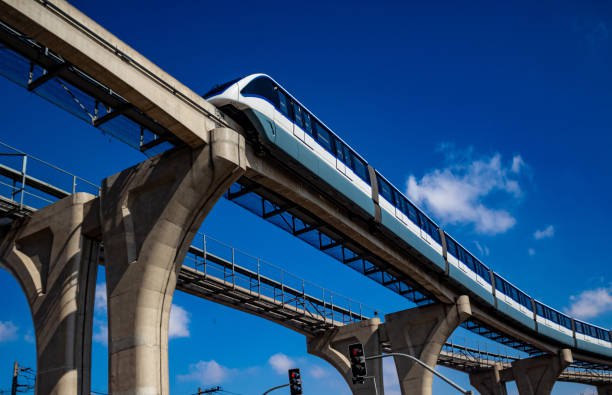
Bishkek is exploring the possibility of building a monorail system to address its long-standing transport challenges and alleviate traffic congestion in Kyrgyzstan’s rapidly growing capital. According to the Kyrgyz Ministry of Economy and Commerce, discussions were held on March 19 between Chinese company CRRC Changchun Railway Vehicles, the Bishkek municipality, and Kyrgyzstan’s national railway company Kyrgyz Temir Jolu. The talks focused on assessing the feasibility of constructing a monorail network in Bishkek. The parties agreed to conduct a detailed study of the project, evaluating its economic and technical viability. As part of this process, the Bishkek municipality will provide sketches of the proposed monorail system for analysis. City officials also emphasized that the project could be implemented as a public-private partnership, creating opportunities to attract foreign investment. If built, a monorail system could significantly improve Bishkek’s public transport infrastructure, offering a modern and efficient alternative for city residents. The project aims to reduce traffic congestion, shorten travel times, and improve urban mobility. The idea of constructing a monorail in Bishkek was first proposed in 2020. At the time, then-acting mayor Balbak Tulobaev dismissed skepticism surrounding the project and even suggested that in the future, monorail travel could extend as far as Karakol. In 2021, a memorandum of cooperation was signed with the Turkish company Sky Ray Ve Oto Yedek Parça Ekipmanlari Üretim Sanayi A.Ş. during President Sadyr Japarov’s official visit to Turkey. By 2022, the municipality had developed a preliminary plan for high-speed transport lines over the Ala-Archa and Alamedin rivers, which connect the southern and northern parts of the city. While the monorail remains in the planning stage, the renewed discussions signal a potential step toward modernizing Bishkek’s transport network and easing its growing traffic burden.