• KZT/USD = 0.00218
  • TJS/USD = 0.10800
  • UZS/USD = 0.00008
  • TMT/USD = 0.29850
  • KZT/USD = 0.00218
  • TJS/USD = 0.10800
  • UZS/USD = 0.00008
  • TMT/USD = 0.29850
  • KZT/USD = 0.00218
  • TJS/USD = 0.10800
  • UZS/USD = 0.00008
  • TMT/USD = 0.29850
  • KZT/USD = 0.00218
  • TJS/USD = 0.10800
  • UZS/USD = 0.00008
  • TMT/USD = 0.29850
  • KZT/USD = 0.00218
  • TJS/USD = 0.10800
  • UZS/USD = 0.00008
  • TMT/USD = 0.29850
  • KZT/USD = 0.00218
  • TJS/USD = 0.10800
  • UZS/USD = 0.00008
  • TMT/USD = 0.29850
  • KZT/USD = 0.00218
  • TJS/USD = 0.10800
  • UZS/USD = 0.00008
  • TMT/USD = 0.29850
  • KZT/USD = 0.00218
  • TJS/USD = 0.10800
  • UZS/USD = 0.00008
  • TMT/USD = 0.29850
26 November 2026

Viewing results 1 - 6 of 2

U.S. Backs New Routes for Turkmen Gas Exports and Caspian Trade

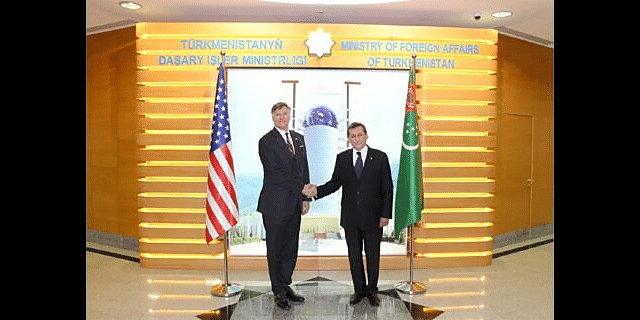
The United States is seeking to help Turkmenistan diversify its energy exports and expand trade across the Caspian Sea. U.S. Deputy Secretary of State Christopher Landau and Turkmen Foreign Minister Rashid Meredov discussed both priorities at talks in Ashgabat on November 23. Landau also met with President Serdar Berdimuhamedov that day. In addition to energy and transportation, they discussed trade and investment. Berdimuhamedov expressed interest in joint renewable energy projects. Turkmenistan depends heavily on China, its largest natural gas customer. In October, Maksat Babayev, chairman of the state-owned gas company Türkmengaz, said Turkmenistan had supplied China with more than 477 billion cubic meters of gas between the opening of the export pipeline in December 2009 and October 1, 2026. Ashgabat also hopes to reach South Asian markets. Babayev said Türkmengaz was building a section of the Turkmenistan-Afghanistan-Pakistan-India (TAPI) gas pipeline from the Turkmen border town of Serhetabat to the Afghan city of Herat. TAPI is designed to supply the three importing countries with up to 33 billion cubic meters of gas a year. The proposed Trans-Caspian Gas Pipeline would run beneath the Caspian Sea, connecting Turkmenistan’s gas network to Azerbaijan. From there, gas could reach European markets through existing pipelines in Georgia and Turkey. Construction of the subsea link has yet to begin. Ferries already carry trucks and trailers between the port of Turkmenbashi and the Azerbaijani port at Alat, near Baku. Cargo can then continue overland through the South Caucasus. Turkmenistan was one of nine countries covered by a September World Bank study of the Trans-Caspian Transport Corridor, also known as the Middle Corridor, which links Asia and Europe. To reduce delays, the bank recommended a single digital system for transport and trade documents. It called for rail operators to coordinate more closely with ports and shipping companies. Washington is also backing the Trump Route for International Peace and Prosperity (TRIPP), which would connect mainland Azerbaijan to its Nakhchivan exclave through southern Armenia. It would give Central Asian freight another route through the South Caucasus toward Turkey and Europe. In a November 7 joint statement, Armenia and Azerbaijan agreed with the United States to form two working groups for the project, one on transportation and the other on electricity transmission. Ahead of Landau’s visit, the State Department identified TRIPP and the Middle Corridor as areas for cooperation with Turkmenistan. On the day of the Ashgabat talks, Armenian Prime Minister Nikol Pashinyan announced that preparatory construction work had begun in southern Armenia.

Middle Corridor Debate Shifts From Geopolitics to Commercial Viability

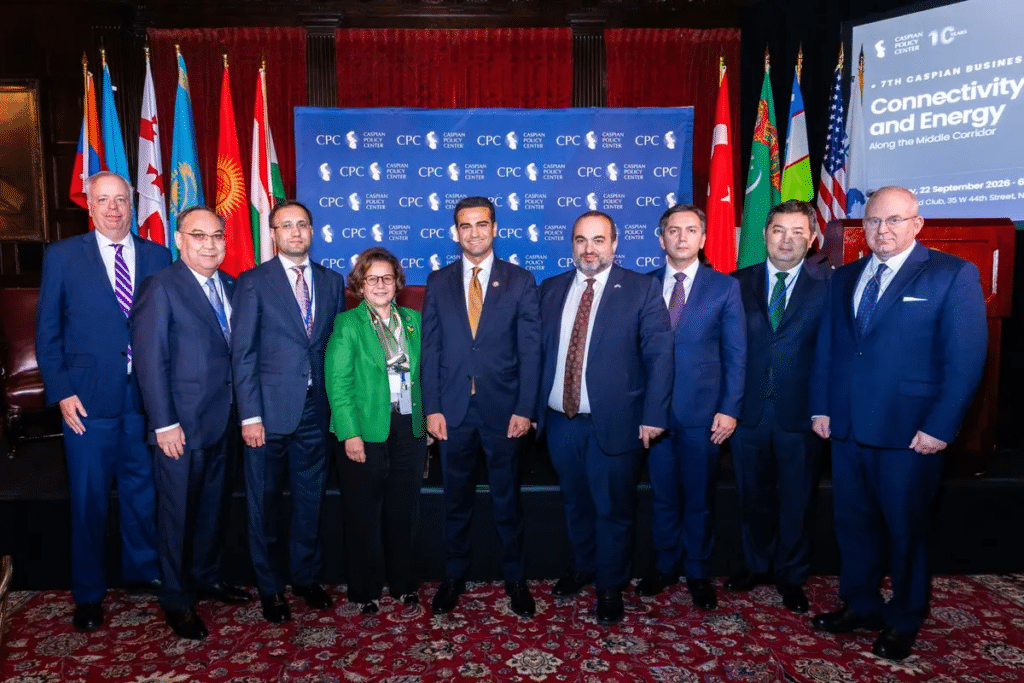
For several years, interest in the Middle Corridor has risen sharply amid the war in Ukraine, tensions around Iran, sanctions, instability on maritime routes, and governments’ efforts to diversify supply chains. The route runs through Central Asia, the Caspian Sea, and the South Caucasus. The way the issue is framed is now changing. The debate over whether this route is needed is moving into the background. A more important question is whether the Middle Corridor can develop from a politically attractive alternative into a sustainable transport and economic system that businesses will use not because of geopolitical circumstances, but because it is competitive. In this context, the 7th Caspian Business Forum, held in New York on September 22 and organized by the Caspian Policy Center (CPC), provided a useful snapshot of this shift. Representatives of the United States, Kazakhstan, Kyrgyzstan, Azerbaijan, Georgia, Turkey, and major businesses took part. The discussions focused on the Middle Corridor, the Trump Route for International Peace and Prosperity (TRIPP), energy, critical minerals, and attracting private capital. Freight volumes on the Trans-Caspian International Transport Route rose from 0.8 million tons to 4.5 million tons in the seven years to 2025, according to Kazakhstan’s Ministry of Transport. The route carried about 77,000 twenty-foot equivalent units of containerized cargo in 2025, and Kazakhstan aims to raise that total to 300,000 by 2029. These volumes are substantial, but they show the limits of the Middle Corridor’s current capacity. It has not yet become a replacement for all traditional overland routes between China and Europe. The World Bank has noted that the Middle Corridor is more than a transit bridge between China and the European Union (EU). Growth in trade among the countries along the route, as well as their trade with Europe, could be equally important. With the necessary investment and organizational reforms, it estimates, trade flows could triple and transport times could roughly halve by 2030. The route passes through several countries, crosses the Caspian Sea, requires transfers between different modes of transport, and depends on coordination among railway operators, ports, customs services, and tariff policies. A study of transport connectivity between Europe and Central Asia by the European Bank for Reconstruction and Development, at the request of the European Commission, identified 33 priority investment needs in physical infrastructure and seven soft-connectivity measures, ranging from the digitalization of transport documents to the harmonization of tariffs, customs, and border procedures. The CPC forum addressed these issues as well. CPC President Efgan Nifti put it this way: “For the Corridor to reach its full potential, it must increasingly function as one integrated system – with harmonized border procedures, coordinated ports and railways, and digitalized documentation.” Kazakhstan’s position reflects this approach. The country’s presidential representative for negotiations with the United States, Erzhan Kazykhan, called the Middle Corridor a “strategic investment in the future” connecting Kazakhstan with the South Caucasus, Turkey, and Europe. He said Astana views TRIPP as a logical extension of the system that could shorten the route to European markets...